Communications earn its seat at the table by being useful to the business: Bhavya Sharma
Urban Company’s Bhavya Sharma on how the communications function is evolving, building business influence, managing reputation in B2B space, and preparing communicators for what lies ahead
 by
by
Published: Sep 11, 2026 11:42 AM | 10 min read
 Follow Us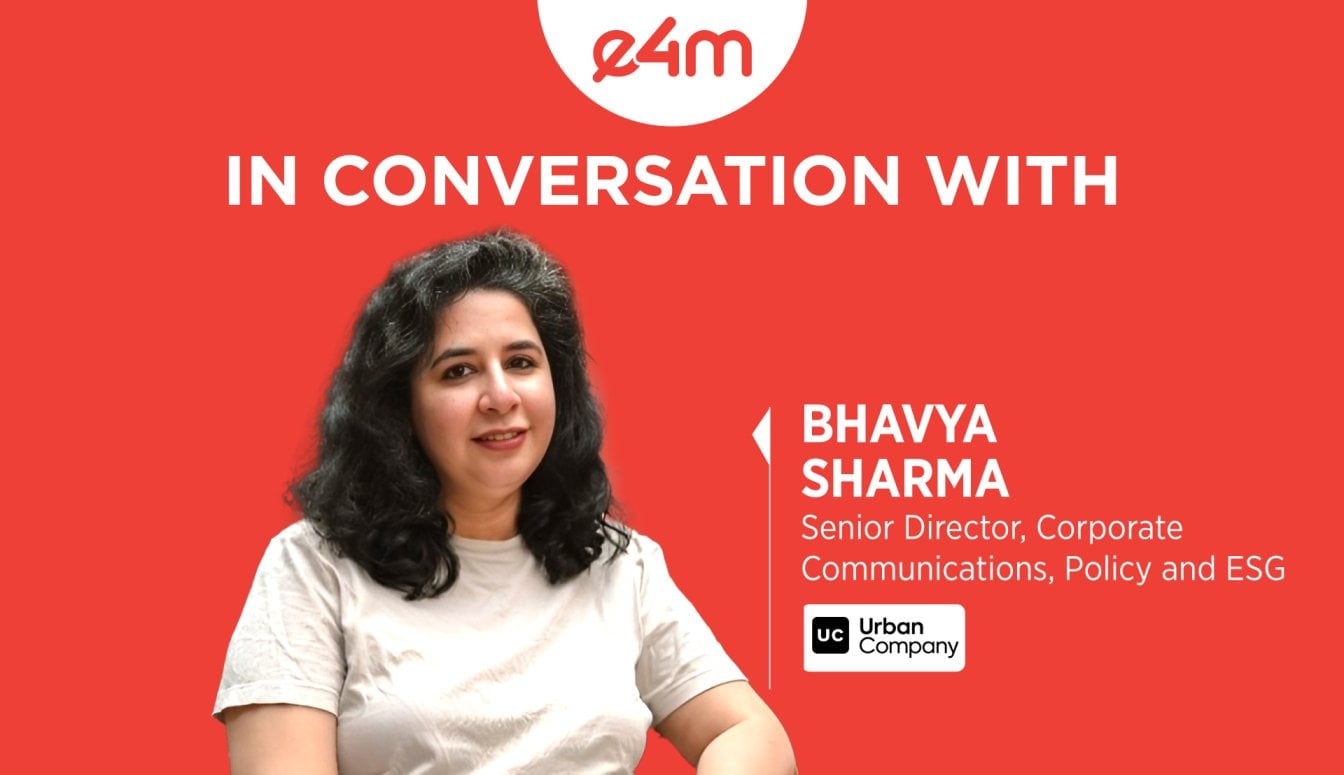

- The role of communications has evolved significantly, with professionals now expected to understand business dynamics, customer needs, and market trends, alongside traditional communication tasks.
- Bhavya Sharma, Senior Director at Urban Company, highlights the importance of trust and judgment in communications, emphasizing that effective communicators must influence leadership decisions and navigate crises adeptly.
- The rise of AI and emerging technologies is transforming corporate communications, enabling greater scale in content creation and analysis, while underscoring the irreplaceable value of human judgment in managing reputation and decision-making.
- Sharma advocates for a modern corporate communications function that integrates stakeholder trust across various areas like reputation, policy, and crisis management, rather than focusing solely on traditional communication channels.
“Communications is never really just about communications.”
Today, that may be one of the biggest shifts in the profession. Communications today has a much bigger seat at the business table and now, communicators are expected to understand the product, the customer, the market and the business, while also navigating various avenues of industry like reputation, policy, ESG, technology, and more.
This shift is best understood by leaders who have experienced it firsthand. Bhavya Sharma, Senior Director, Corporate Communications, Policy and ESG at Urban Company, is one such practitioner. With close to two decades in the profession and nine years at Urban Company, she has seen the role evolve alongside the businesses and stakeholders it serves. At a highly visible B2C business like Urban Company, that also means being prepared for the moments when the narrative can change overnight.
Her journey has not been a straight line. It has involved different roles, changing business priorities, new challenges, opportunities, and plenty of learning along the way.
So, as the communications function takes on a larger role within business,we had an engaging conversation with Bhavya Sharma to discuss how the communications profession has changed, what senior communicators need to bring to the boardroom, how to build a crisis and reputation playbook for a consumer brand, and where AI fits into the future of the function. She also reflects on building teams, mentoring the next generation and the lessons her own journey has taught her about leadership.
Excerpts:
What has made your journey in communications most meaningful so far? Why did you choose this profession, and if you weren’t in communications, what would you most want to be doing?
I’ve been incredibly lucky with the range my career has given me. Over the years, I’ve had the opportunity to straddle both B2B and B2C, and work across almost the entire spectrum of communications and corporate affairs — from media and reputation to internal & external communications, brand, policy, ESG and stakeholder engagement.
What has made the journey particularly meaningful is that communications is never really just about communications. As you grow in this profession, you realise that the best work happens when you are deeply connected to the business, working alongside marketing, product, engineering, legal and leadership to understand what the organisation is building, why it matters and how to tell that story credibly to the world.
I was always drawn to external-facing roles — understanding stories, shaping narratives and engaging with different stakeholders. But over the years, I’ve come to appreciate that the role of a communications leader goes well beyond storytelling. It is about understanding the business, building trust and helping organisations navigate moments that can shape their reputation for years.
I’ve never really given much thought to what I would be doing if I weren’t in communications. But I would still have ended up somewhere close to stories, people and the media. Those are the things that have kept the profession interesting for me, even after all these years.
You have recently completed nine years at Urban Company, moving through multiple communications roles. What has this journey taught you about how the communications function has evolved? What did communicators focus on when you started, and what does the business expect from them today?
Urban Company has given me the opportunity to experience almost every facet of corporate communications — from PR, social media and influencer marketing to impact communications, public policy, investor communications and crisis management. I’ve also had the opportunity to lead communications around some defining moments for the company, including our rebranding, IPO and several product and brand launches.
When I started, the mandate was much more centred around content development — the website, the app and the more traditional outputs of communications. Over the years, I’ve had the opportunity to build a more structured corporate communications function and steadily expand what sits within its ambit.
But I think the bigger evolution has been in how I understand the role itself. The learning curve in communications is never really a hockey stick. It’s less about accumulating more tools or adding more responsibilities, and more about developing judgement. Early in your career, you learn how to tell a good story. With experience, you learn which stories are worth telling, when to tell them, who needs to hear them, and sometimes, when not to tell them at all.
As communicators become more embedded in business, what skills do senior leaders need to influence leadership and boardroom decisions?
More than any individual skill, it comes down to trust. Leadership needs to trust that you understand the business, that you can exercise judgement, and that you will tell them what they need to hear rather than what they want to hear. And this last part about being willing to disagree is the most important. Our job isn’t always to make an idea sound better. Sometimes it is to say: this may make perfect business sense, but that is not how the world will receive the message.
That trust is built over time. It comes from knowing when something is genuinely a reputational risk and when it isn’t, understanding different stakeholder perspectives, and being able to connect a communications decision to a business outcome. Once that trust exists, communications stops being an advisory function on the sidelines and becomes part of the decision-making process. You earn your seat at the table by being useful to the business, not by simply demanding that communications gets a seat at the table.
For a highly visible D2C brand like Urban Company, what is your playbook for crisis and reputation management?
I don’t think there is a one-size-fits-all playbook for crisis and reputation management. But what is consistent is the principle with which you navigate them. For us, it has always been -- doing the right thing by our stakeholders. So, in any situation, our first priority is to understand what has happened, establish the facts quickly and accordingly make decisions.
Good crisis management also includes resisting the urge to react simply because there is noise. You have to separate the immediate conversation from the underlying issue, understand what actually needs to be solved, and then determine what the organisation needs to do. Communications plays an important role in that process. But honestly, it cannot solve a business problem with messaging. So, decide whether a statement will suffice, or a product or process change is needed or something else. In any case, your actions need to back your words as during a crisis it is the trust you have earned with your stakeholders that is put to the test.
How do you see AI and emerging technologies transforming corporate communications, and what human capabilities do you think will remain irreplaceable?
AI is going to make communications a very interesting space. We will be able to create, analyse and respond at a scale that simply wasn’t possible earlier. Ironically though, this will have an opposite effect too: good communications teams will become far more discerning about what they actually put out into the world.
The harder challenge will be managing reputation. With the rise of misinformation and the speed at which narratives escalate, reputation management and crisis response will become significantly more complex.
What AI cannot replace easily is judgement. Instinct, context and decision-making will remain critical — knowing what matters, what doesn’t, when to respond, and when not to.
What would you do differently if you were setting up a modern corporate communications function from scratch today?
If I were starting today, I would organise around stakeholders and reputation rather than channels. So, I wouldn’t build a traditional corporate communications function, I’d build a corporate affairs function.
The lines between reputation, policy, investor communication, ESG, crisis and brand are increasingly blurred. The common thread across all of them is stakeholder trust. So rather than building separate capabilities and then trying to connect them, I would start with that integrated view.
After nearly two decades in the profession, what are the challenges and opportunities you believe the communications industry is still underprepared for?
The biggest change I’ve seen is that communications is no longer a function that comes in at the end to communicate a business decision. Increasingly, we are in the room when those decisions are being shaped. That requires communicators to understand the business, anticipate reputational implications and ensure that what we say and do is aligned with the organisation’s larger goals.
What prompted you to start The Breakfast Table? What gap did you feel existed in the way communications leaders were exchanging ideas, and what have these conversations taught you about where the profession is headed?
The Breakfast Table started from a conversation between Aakriti (Founder Wizikey, a PR SaaS firm) and myself sometime back in 2025. We have known each other for a long time and have always bonded over how the industry was compiling, absorbing and analysing data. Why or how some organisations do it exceptionally well and what the rest of us could learn from them.
Aakriti, given how Wizikey works at the intersection of technology, data and communications, was also seeing some of these shifts firsthand. That made both of us curious about creating a space where the conversation could go beyond data and dashboards, and into the thinking, experiences and decisions behind them.
That eventually became a larger idea: creating a closed-door, safe space where communications leaders could have candid conversations about strategies, pain points, experiments and what comes next. One of my biggest takeaways from these conversations is that everyone is figuring something out. And that there is enormous value in simply creating a room where people are comfortable saying, “I don’t know — how are you solving this?”
Having been both a mentor and a leader building teams, how has your definition of leadership changed over the years? What do you see in the next generation that gives you confidence about the future of the profession, and where do you think young communicators need more exposure or preparation?
When you are younger, you tend to think leaders are the people in the room who know the answers and sound the most certain. With experience, you realise leadership is often much less comfortable than that. Sometimes it is saying “I don’t know” or even being the person who says “no” when everyone else in the room is saying yes. A lot of leadership is finding your voice and then having the conviction to hold your ground when it matters.
What I like about the next generation of communicators is that they are less boxed in by definitions of PR, content, marketing or social. They are comfortable moving between formats, platforms and disciplines. But while craft can get you into the room; business understanding and judgement will help you contribute once you're there. Because eventually, being great at communications isn't just about knowing how to tell the story.
As you look at the next phase of your career as a blank canvas, what would you like to create in your career and in your life that you haven’t had the chance to yet?
I’ll simply say that the best is yet to come!!!
Read more news about PR and Corporate Communication News, Internet Advertising, Marketing News, Digital Media News, People Movement News
For more updates, be socially connected with us onInstagram, LinkedIn, Twitter, Facebook YouTube & Google News