Ratings report card: A mixed bag for GECs as TV crosses path with digital
While the ratings show a shift in viewership trends, industry experts dived deep into the challenges faced by GECs, such as changing audience preferences and the growing dominance of digital platforms
 by
by
Published: Oct 1, 2024 9:14 AM | 9 min read
 Follow Us

The latest viewership data for GEC in India for Week 36 and 37 of 2024, shows a slight decline in ratings for some channels. Shifting audience preferences, rise of digital platforms and increasing production costs have begun to pose significant challenges for traditional TV channels, sparking concerns among industry experts over declining ad revenues and unsold airtime.
GEC viewership trends
exchange4media has captured ratings data for urban and rural sectors combined, spanning six weeks—24th, 25th, 26th, 27th, 36th, and 37th—highlighting notable trends in audience preferences and engagement across various platforms.
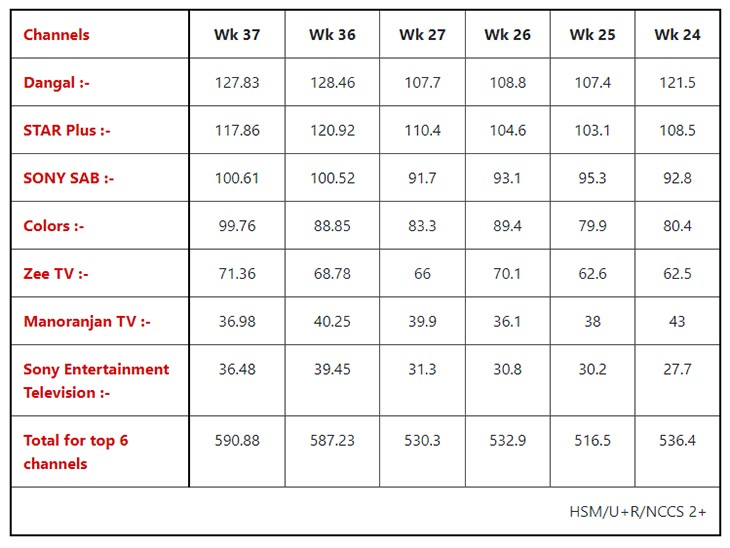
The collective ratings for urban and rural audiences combined (U+R) among the top six General Entertainment Channels (GECs)—Dangal, Star Plus, Sony SAB, Colors, Zee TV, Manoranjan TV, and Sony Entertainment Television (SET)—demonstrate fluctuations in viewership. The ratings dipped from 536.4 in week 24 to 516.5 in week 25. However, a rebound occurred in week 26, with ratings rising to 532.9, followed by a slight dip again in week 27, landing at 530.3.
In weeks 36 and 37, collective ratings climbed to 587.3 and reached 590.8, respectively.
While the overall ratings reflect growth, individual channel performances varied significantly. Some channels experienced dips, while others saw notable increases.
Dangal TV stood at 121.5 in week 24 which dropped to 107 in week 25, but picked up in week 36 at 128, before marginally dropping to 127.
Star Plus, too, saw a similar trend when it stood at 108.5 in week 24 before dropping to 103.1 in week 25. It reached 120.9 in week 36 before seeing a slight dip to 117.86 in week 37.
Both the channels have maintained numbers above 100 across the reporting period, but the fluctuations are noticeable.
Both Manoranjan TV and Sony Entertainment Television were seen grappling with lower viewership numbers between week 24 and week 37. Manoranjan TV peaked at 43 in week 24 but has not shown significant growth since then. Similarly, the rating for Sony Entertainment Television remained below 40 in all the six weeks but saw very slight increase in the six weeks data.
SONY SAB, however, maintained consistency in weeks 36 and 37 at 100.5 and 100.6 respectively. The ratings went slightly down each week from week 25 when it was at 95.3, in 26th week it went to 93.1 and in 27th week it touched 91.7.
Colors, which was peaking at 99.76 in week 37, also saw some fluctuations in week 26 and 27 when it dipped from 89.4 to 83.3.
Zee TV, while remaining below 80, has shown moderate stability, with a high of 71.36 in week 37, up from 68.7 the previous week. However, it also saw a minor drop in ratings from 70.1 in week 26 to 66 in week 27.
In the combined urban and rural sector (HSM U+R), Dangal TV holds a viewership score of 127.83, a slight dip from 128.46 in Week 36. In the urban only sector HSM (Urban), Dangal has seen a drop from 69.61 to 67.63 from week 36 to 37.
Star Plus has recorded a viewership of 117.86, also experiencing a decline from 120.92 in HSM (U+ R) sector while in urban only. It tops the rank but saw a drop from 197.59 in Week 36 to 190.23 in Week 37.
Sony Entertainment Television too saw a drop in viewership score from 36.48 from 39.45 in Week 37 in U + R. In only urban, it saw a drop from 68.1 to 62.6.
Colors has recorded a viewership of 99.76 from the previous 88.85 in U+ R. In the urban sector (HSM Urban), Colors ratings stand at 170.18 from 150.91. Sony SAB has recorded a viewership of 166.32. Zee TV also saw a jump in viewership score from 95 to 100 in urban only sector while in urban and rural combined, it grew from 68.7 to 71.3 points.
Some channels that have seen a decline include Manoranjan TV, Shemaroo TV, Chumbak TV, Sony Pal, Unique TV and Sun Neo.
While the ratings show a shift in viewership trends, industry experts dived deep into the challenges faced by GECs, such as changing audience preferences and the growing dominance of digital platforms.
Industry experts recently shared with e4m that the media landscape is evolving rapidly. "While TV penetration and reach remain strong, there is a noticeable shift in viewership patterns, particularly with the growing influence of OTT platforms catering to Hindi audiences," an industry head had said.
Some other experts also opined that the viewership shift has been largely driven by the high penetration of platforms like YouTube.
Challenges
According to a senior industry expert, who did not wish to be named, the challenges in GECs are significant with declining viewership and ad revenues. He highlighted that production costs are rising while budgets are being cut, leading to a potential crisis in traditional TV.
“GECs are facing significant challenges, with declining viewership and ad revenues. Shows that once ran for years are now struggling to survive beyond a few months. Production costs are rising, and channels are forced to cut budgets by up to 30%, leading to lower-quality content.
“Additionally, viewers are increasingly shifting to OTT platforms, where convenience and digital content dominate. The squeeze on both budgets and audience reach is causing a crisis in the traditional TV space, with many channels struggling to remain profitable,” the expert told e4m.
He also mentioned that the pressure on airtime sales is palpable, with some channels struggling to fill slots.
“Airtime is perishable and precious and some are struggling to sell it. A well-known GEC channel that is famous for its reality shows, had a maximum of 1260 seconds of airtime to sell for a certain show. In the first few weeks of September, they were only able to sell 550 seconds, with 740 going unsold. The only solution here is to drop the price.
“If you don’t drop the price, the airtime remains empty. However, once you lower the price, there’s no turning back—it's a slippery slope with no end,” he said.
Another leading brand’s marketer shared that television saw a decline because rather than focusing on rebuilding their dominant social core, it became a fluid of program sequencing from 6-10 pm.
According to him, “Till the time Indians didn’t come across content like Game of Thrones, Indian entertainment content worked well. Now you can't win on visual splendour, you can't win on scale of productions, you have to win on stories.”
Advertising on digital platforms, all said and done, is more cost effective because it allows businesses to track metrics, he believes. It makes it more appealing and also the optimisation function is quite attractive in digital.
How advertisers feel about GEC?
Offering her perspective on the ongoing shift in media consumption, Anita Nayyar, former COO of Media, Branding & Communication at Patanjali, highlighted the noticeable drop in TV ad rates over the past year. She pointed out that the growing popularity of CTV and digital streaming platforms is gradually compromising linear TV’s dominance.
“In the last one year, some drops in ad rates have been observed across TV channels and genres. CTV is gaining ground and so is digital streaming. Hence, linear TV is being compromised.”
Sharing a similar view, Rajiv Dubey, Vice President and Head of Media of Dabur, noted that a continued decrease in viewership could eventually lead to lower ad rates and presently, the rates have not fallen sharply.
He said that while ad rates have not yet fallen significantly, a continued decrease in viewership could eventually lead to lower rates. The decline in GEC ratings has not yet affected the top channels severely.
“The decrease in the rates has not happened yet. But if the viewership keeps plummeting, the ad rates will also go down. For example, if you look at top shows like Anupama, the show used to be highly viewed two years back versus today. The ratings have definitely fallen.
Impact on ad rates
The rates have not fallen in that proportion. That's also because demand on these programmes is probably higher, because of which the rates have not come down. Rates have not fallen that sharply,” Dubey said.
Dubey attributed the stagnation in growth to factors such as viewer fatigue from repetitive programming and the rise of alternative content formats like short videos and OTT platforms. He also emphasized on the need for fresh, innovative content to re-engage audiences and maintain viewership levels.
“Another reason why GEC viewership has taken a hit, which is also the most critical factor, is shrinking attention spans. You see, television in its poorest episode segment is 22 minutes,” shared the marketer.
GEC think in terms of 30-minute slots and their advertising is sold in 30-second slots which one can purchase at 10-second units. But that's not the dominant habit nowadays. Today, the dominant habit is shorts and OTT. Overall, while challenges exist, GECs continue to play a critical role in Dabur's marketing strategy. “For us, the first protocol is still GEC,” he said.
Demand persists
According to a media planner, the fluctuations in ratings do not suggest a general downturn in ad rates and that demand for advertising remains strong, especially with the upcoming festive season.
However, he did agree that advertisers are increasingly shifting budgets toward digital platforms.
“This shift means that traditional TV advertising investments are being reduced, with many brands opting to focus on regional channels where costs are lower.
“The media landscape is becoming more fragmented, making it harder for brands to connect with audiences. Viewers are spread across various platforms, and advertisers need to diversify their strategies to maintain visibility,” he said, on the condition of anonymity.
The marketer further added, “The overall shift towards digital seconded by the changing consumer habit led to the decline of entertainment channels.”
The future is heading only in one direction, quite clearly, which is more and more of platform-dependent, social media-dependent digital consumption. General entertainment and television will have to continue to peddle more furiously to remain in the same place, say marketers.
The following chart depicts data for top 6 GECs spanning six weeks in the Hindi speaking market for urban and rural sectors combined.
Read more news about Television Media, Digital Media, Advertising India, Marketing News, PR and Corporate Communication News
For more updates, be socially connected with us onInstagram, LinkedIn, Twitter, Facebook YouTube & Google News