Traditional media must balance in-depth news with digital-savvy content: Rajdeep Sardesai
Veteran journalist Rajdeep Sardesai delves into his latest book, reflecting on the challenges of TV news in the digital age, the impact of hyper-polarization, and more
 by
by
Published: Feb 11, 2025 9:11 AM | 6 min read
 Follow Us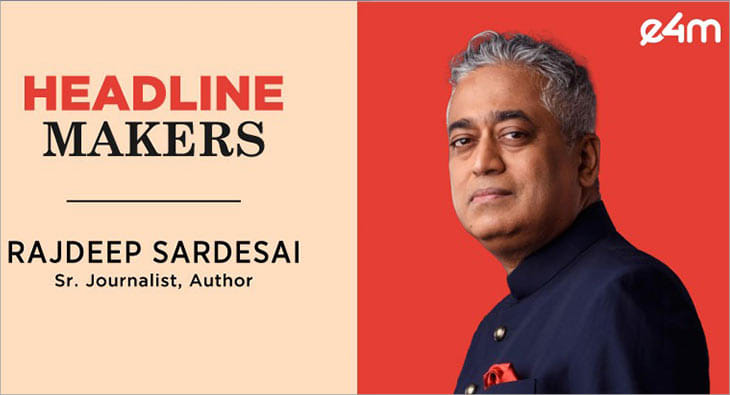

Veteran journalist Rajdeep Sardesai delves into his latest book, 2024: The Election That Surprised India, exploring how television journalism misread voter sentiment and the shifting dynamics of political coverage. In this exclusive interview with exchange4Media, he reflects on the challenges of TV news in the digital age, the impact of hyper-polarization and why the future of journalism depends on reclaiming credibility and ground reporting.
Edited Excerpts
In your book 2024: The Election That Surprised India, you highlight how the media shaped and misread the political narrative. What led journalists to misread the sentiment on the ground?
One of the biggest challenges in modern journalism is the over-reliance on data-driven predictions, exit polls, and digital narratives over real, on-ground reporting. The 2024 elections were a stark reminder that elections are won on the streets, not in television studios or social media debates. Many journalists, myself included, failed to pick up on the deep undercurrents of local sentiment, especially in rural India, where the real electoral shifts happen. The media has increasingly become urban-centric, often driven by elite discourse, which can sometimes be completely out of sync with ground realities.
Additionally, there has been a shift towards convenience journalism—where reporters and analysts rely on social media sentiment, think tank reports and political soundbites rather than engaging in the hard work of traveling and interacting with voters. This detachment has resulted in a scenario where newsroom discussions become echo chambers, disconnected from the actual concerns of the electorate. Political narratives in mainstream media were often shaped by pollsters and political consultants rather than by the voices of real people on the ground. This overdependence on digital chatter created a misleading sense of political momentum, which ultimately did not align with voter behaviour.
Having covered elections for decades, how do you think political journalism in India has evolved, and where do you see it heading?
Political journalism in India has undergone a seismic shift. When I started, journalism was about legwork—physically being in constituencies, talking to people, and understanding their aspirations. Today, newsrooms rely heavily on technology, analytics and social media trends. While these tools are valuable, they cannot replace the essence of true reportage.
There is also increasing political polarization in the media, where objectivity has taken a backseat. Many media houses align with political interests, leading to biased coverage that reinforces existing narratives rather than challenging them. This, in turn, has impacted the trust factor that audiences have in the media. However, I do believe that the future of journalism will see a pushback against sensationalism. There is an appetite for fact-based, deeply researched journalism and I see hope in young journalists who are taking up the challenge of authentic, unbiased storytelling.
Another major shift has been in how news is consumed. The rise of digital platforms has fragmented audiences, with social media influencers and independent news creators emerging as new-age journalists. While this has democratized the media, it has also created an environment in which misinformation spreads rapidly. Traditional media needs to adapt by balancing in-depth reporting with digital-savvy content strategies.
Your book highlights miscalculations by pollsters and political analysts. Do you think the media has become over-reliant on data-driven predictions rather than ground reporting?
Absolutely. The rise of psephology and political analytics is a double-edged sword. While data can provide macro trends, it can never fully capture the emotional pulse of an electorate. We saw this in 2024—many forecasts underestimated voter sentiment, particularly among the youth, rural communities and marginalized sections. Data models can predict voting behaviour to some extent, but they often fail to capture the nuances of personal grievances, regional dynamics and last-minute shifts in political perception.
The media needs to strike a balance between analytics and storytelling, ensuring that data complements rather than replaces ground reporting. Numbers can be misleading when they do not take into account the deeper political and social currents shaping voter behaviour. As journalists, we need to step out of our comfort zones and engage with people at all levels rather than relying solely on statistical models.
Where do you see the future of election coverage on television? Has digital media overtaken traditional newsrooms in shaping political discourse?
There is no doubt that digital media has disrupted traditional journalism. The way people consume news has fundamentally changed, with social media influencers, YouTubers and independent platforms taking center stage.
However, television still holds power, especially in smaller towns and rural India. The future of TV news depends on its ability to adapt—focusing on in-depth analysis, breaking away from the noise, and building credibility. Trust will be the biggest currency in the years to come.
Election coverage needs to evolve beyond superficial debates and panel discussions. TV news channels need to invest in investigative journalism, deep-dive reporting and community-driven narratives. The audience is looking for authenticity, and channels that provide meaningful content rather than sensationalism will thrive in the long run.
Many journalists complain about pressures from corporate and political interests when covering elections. From your experience, do you believe self-censorship is now a bigger issue than direct political interference in newsrooms?
That is a critical point. While political pressure on newsrooms has always existed, the more insidious threat today is self-censorship. Journalists, editors, and even media owners often second-guess themselves, avoiding stories that could be deemed 'controversial' or 'risky' for business. This chilling effect is more dangerous than direct government interference because it creates an environment where uncomfortable truths are simply not reported.
True journalism requires courage and we need more journalists who are willing to ask tough questions, regardless of the consequences. Unfortunately, many news organizations prioritize access over accountability, leading to a reluctance to challenge those in power. If we do not address this issue, the credibility of the media will continue to erode.
Your book touches on misinformation and social media propaganda. Do you think TV news is any better than WhatsApp forwards now? How do you see the 24/7 cycle of outrage-based content on TV?
That’s a provocative but valid question. The line between journalism and propaganda is increasingly blurred, especially in the TV news ecosystem. Many prime-time debates are no longer about information but about spectacle—designed to provoke rather than inform. This, in turn, fuels WhatsApp forwards and fake news.
The solution is to bring back editorial discipline, focus on facts rather than sensation and ensure that journalism is about public service, not just TRPs. Unless we shift from outrage-driven content to issue-based reporting, we risk losing credibility completely.
Looking back at how the 2024 elections were covered, what is the one thing you wish mainstream media had done differently?
I wish we had spent more time on the ground, listening to real people rather than relying on studios and data. Journalism is about trust, and that trust is built by being where the story is. If the 2024 elections taught us anything, it’s that the media must rediscover the power of real storytelling over manufactured narratives.
Read more news about Television Media, Digital Media, Advertising India, Marketing News, PR and Corporate Communication News
For more updates, be socially connected with us onInstagram, LinkedIn, Twitter, Facebook YouTube & Google News