Difficult to imagine where AI will stop: Sanjay Jaju on creative future
At the 12th CII Big Picture Summit, MIB Secretary Sanjay Jaju called on the industry to embrace new formats, new platforms and new modes of creative expression
 by
by
Published: Dec 1, 2025 1:07 PM | 4 min read
 Follow Us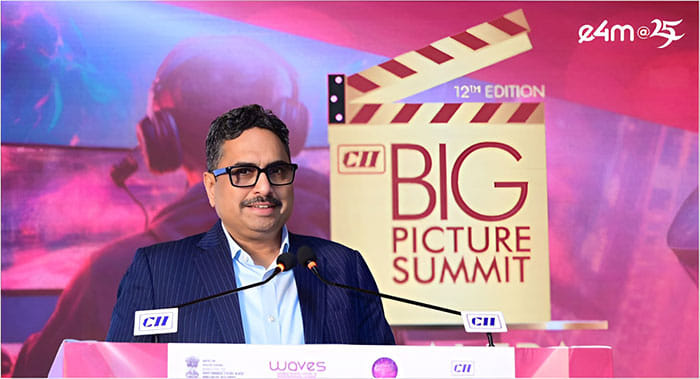

“It’s time for many of us to understand that in this modern age, creativity alone is not enough.” With this call, Sanjay Jaju, Secretary, Ministry of Information & Broadcasting (MIB), set the tone for his inaugural address at the 12th CII Big Picture Summit, emphasising a decisive shift is underway in India’s creative and media landscape.
The summit, organised by the Confederation of Indian Industry (CII), became the backdrop for a vision centred on creators, technology and India’s storytelling power.
Jaju opened with the biggest structural intervention in the ecosystem — the Indian Institute of Creative Technologies (IICT). Responding to long-standing concerns around infrastructure and skill gaps, he said, “And that’s when the union cabinet came up with the Indian Institute of Creative Technologies.”
He noted that the institute will be housed at the University of Mumbai.
“The Indian Institute of Creative Technologies will be fully shaped and coloured and take about two years’ time to get established at the University of Mumbai.”
Jaju emphasised the institute’s unusual ownership framework, positioning it as a true industry-driven body, “CII, 52% owners, we are 34%, State Government of Maharashtra is 14%. So that is a very unique model because this is completely run by the industry.”
He underlined the passion behind the project and the speed with which it has taken shape:
“And this has come out in just about three to four months’ time. It was being done as a passion project for the members of the industry.”
Acknowledging the personal commitment of stakeholders, he added, “Many of the industry members have actually taken time out of business schedules, compromising revenues, but giving time to IICP, and I think that’s where the strength of IICP will come in.”
Stressing that India’s creative strength must evolve with global shifts, Jaju reiterated the need for creators to reimagine their craft.
“Now it’s not just movies alone… but the way they are told, the way they are creating an environment where technology immerses with craft, is what ultimately sets this modern age.”
He called on the industry to embrace new formats, new platforms and new modes of creative expression.
Broadening the conversation, Jaju described India’s audiovisual summits as part of an ongoing national creative movement, not isolated annual events. Recalling the Prime Minister’s guidance, he said: “A wave should give rise to a new wave because it starts from where the old wave has ended.”
Each summit, he noted, builds on the last — setting the stage for India’s larger cultural ambition.
Jaju asserted that entertainment is not a peripheral pursuit but a fundamental human need, one that evolves alongside societies. He pointed to the nearly 10 million livelihoods connected to India’s creative economy, calling it a sector that must be nurtured and expanded.
Drawing from India’s oral (Shruti), written (Kriti) and visual (Drishya) traditions, he highlighted the vast reservoir of untold stories. Despite this richness, India holds only 2% of the global entertainment market — a gap he urged the industry to confront with greater ambition.
Jaju cautioned that artificial intelligence is reshaping creativity faster than most anticipate.
“There are songs being made about AI. There are videos being generated about AI. It’s very difficult to even imagine where it is going to end and stop.”
Without embracing technological shifts, he warned, the industry risks a “shared meltdown”.
Reinforcing policy clarity, he said, “I think it is the business of business to do business. It’s not the business of the government to do business.”
The government’s role, he added, lies in fixing market failures and enabling growth, not running the industry.
Looking forward, Jaju highlighted India’s potential in new storytelling formats: “We know we have huge potential to build social games, video games, and so many stories that are yet waiting to be told. And you know, take our stories to the rest of the world.”
He closed with optimism, calling this era “the dawn of India’s modern age” — powered by imagination, innovation and a creator-first mindset.
Read more news about Television Media, Digital Media, Advertising India, Marketing News, PR and Corporate Communication News
For more updates, be socially connected with us onInstagram, LinkedIn, Twitter, Facebook YouTube & Google News