We now need to build the 'IPL of Creativity': Gaurav Banerjee at CII Summit
Gaurav Banerjee, Chair of the CII National Council on Media & Entertainment and MD & CEO of Sony Pictures Networks India, highlighted India’s vast potential in nurturing creative talent
 by
by
Published: Dec 1, 2025 11:26 AM | 3 min read
 Follow Us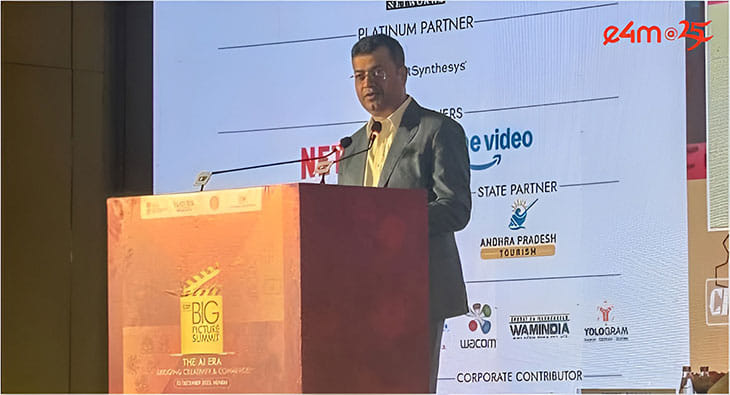

The 12th CII Big Picture Summit, themed “The AI Era – Bridging Creativity and Commerce”, kicked off today at JW Marriott Juhu, Mumbai, running from 1–2 December 2025. The opening keynote was delivered by Gaurav Banerjee, Chair of the CII National Council on Media & Entertainment and MD & CEO of Sony Pictures Networks India. He highlighted India’s potential in nurturing creative talent, stating, “We now need to build the IPL of Creativity.”
Banerjee welcomed industry leaders and stakeholders to what he called “a moment of profound transformation” for India’s Media & Entertainment sector. “Every once in a generation, an industry gets a narrow window when talent, technology, culture, ambition and confidence align. For India’s creative economy, that moment is now,” Banerjee said.
Reflecting on global innovation ecosystems, Banerjee said that Silicon Valley’s success was no accident. “It was constructed,” he noted, growing out of Stanford and Berkeley, “a culture that celebrated risk and experimentation, public–private partnerships that scaled early innovation, and clusters where networks mattered more than hierarchies.”
Drawing a parallel to India, Banerjee pointed to the IPL as a comparative model, stating, “India’s closest comparative model is the IPL, a system that discovered, trained, and showcased talent at every level, from grassroots to global. We now need to build the IPL of Creativity.”
Banerjee highlighted the need to scale India’s creative ecosystem to match global standards. He shared, “When we look at global creative economies, one pattern is clear: the countries that lead have invested deeply in specialised creative-arts education. The United States has dozens of globally recognised film, design and media schools; China, with more than 3,000 higher-education institutions, has rapidly expanded its animation, gaming and digital-arts programmes over the last decade.”
“India, too, has made progress. Today, we have more film, design and media programmes than we did ten years ago. But as our ambitions grow, our capacity must grow even faster,” he further added.
Banerjee outlined four key priorities:
- The next generation of specialised creative institutions - Centres of Excellence dedicated to writing, animation, gaming, VFX, design, post production, and creative entrepreneurship across all languages, and not just Hindi or English
- Stronger industry–academia partnership - Where training is practical, contemporary, immersive, and directly connected to real industry needs
- Regional creative clusters - Where talent, technology, creators, and businesses can work in close proximity, a model proven worldwide
- Public–private partnerships with urgency - Government enabling and industry energising, working together to rapidly expand capacity
Banerjee urged the industry to measure success not just by ‘domestic scale’ but by ‘global influence’. “If we raise our ambition, if we build institutions with seriousness, if we nurture creators across languages, and if we think boldly, not just about the India we are, but the India we can be, then India will not just grow. India will lead,” he said.
Read more news about Television Media, Digital Media, Advertising India, Marketing News, PR and Corporate Communication News
For more updates, be socially connected with us onInstagram, LinkedIn, Twitter, Facebook YouTube & Google News