AIM members meet Ashwini Vaishnaw, seek support for magazine industry
Earlier, in a memorandum submitted on April 17, AIM flagged key challenges ranging from ambiguous classifications under new legislation to disruptions in traditional distribution channels
 by
by
Published: Apr 23, 2025 9:51 AM | 4 min read
 Follow Us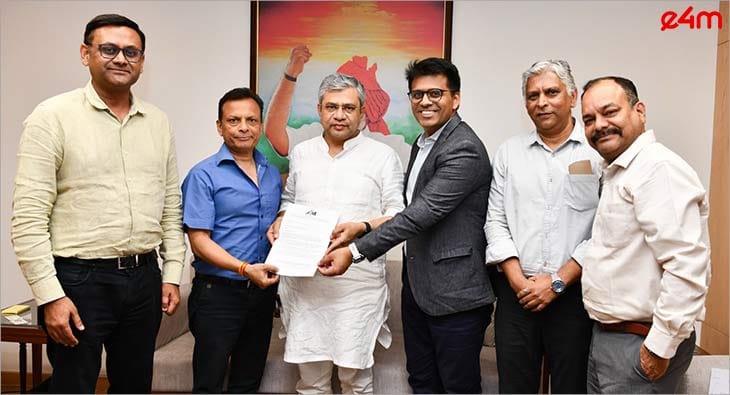

A delegation of the Association of Indian Magazines (AIM), a collective representing over 40 publishers nationwide, recently met Ashwini Vaishnaw, Minister of Information and Broadcasting. During the meeting, the members urged the government to safeguard the interests of the magazine industry, citing a slew of regulatory and logistical issues threatening its viability. The meeting follows a memorandum submitted by the AIM on April 17, flagging key challenges ranging from ambiguous classifications under new legislation to disruptions in traditional distribution channels.
One of the central concerns raised by AIM pertains to the Press and Registration of Periodicals (PRP) Act, enacted in 2023. The law introduces distinct categories for “newspapers” and “periodicals”, diverging from the earlier Press and Registration of Books Act of 1867, which clubbed magazines within the broader definition of newspapers. This shift, according to AIM, has led to serious confusion across ministries regarding eligibility for long-standing benefits extended to print media.
Talking about the meeting with Vaishnaw, Anant Nath, President of AIM & Executive Publisher of Delhi Press and Editor of The Caravan, said, "The new Press Registration Act had two new definitions called 'Newspapers' and 'Periodicals', whereas the earlier PRB Act had only a definition called 'Newspapers', and magazines were counted within 'Newspapers'. With magazines now falling under the 'Periodicals' category, there are a lot of policy confusions regarding the various benefits that were being given to magazines by various other ministries."
He elaborated on how this semantic change has impacted the industry. “Various government departments like the Ministry of Railways, postal department, customs department give special benefits to the print industry. But now, with the change in the categorisation, they say that magazines do not fall under the 'Newspapers' category and therefore they can no longer offer those benefits to magazines.”
Nath stressed that AIM had sought clarity and continuation of existing entitlements. “We wanted a clarification that the benefits that were being given to magazines earlier continues to be given and either they make a change in the Act or issue a notification to other ministries.”
Vaishnaw, according to Nath, was receptive to the concerns. “He realized that this was an unintentional fallout and they will either make an amendment to the Act or issue the necessary instructions to various ministries.”
Distribution hurdles were another major point of discussion. Nath pointed out the dwindling availability of magazines at railway stations due to the decline of traditional retail players. “The availability of Magazines in Railway Stations has decreased, the earlier system has sort of collapsed.”
To address this, AIM proposed identifying new agents and suggested new sales avenues through Indian Railways’ digital platforms. “We gave some suggestions on how magazines can be sold through either IRCTC or in premium trains like Shatabdi, Vande Bharat, Rajdhani,” Nath said.
He added that the minister was “open” to these ideas and encouraged further detailing.
AIM also proposed creating a magazine store widget on the IRCTC website, leveraging its vast user base to boost subscriptions. “AIM is working with ONDC to create a magazine store across all the ONDC network apps and IRCTC that can have a Magazine Subscription Store. IRCTC obviously gets a commission, then that can open a lot of Subscription possibilities.”
Further, AIM pitched for a similar initiative on the government’s new digital platform, WAVES. “We proposed that if we can have a magazine store there as well, and he was very, very receptive since they want to promote WAVES as a destination for entertainment, news and information.”
The association also urged the ministry to promote magazine subscriptions in government-run schools, colleges, and libraries. “The Tamil Nadu government has done it, Telangana government has done it and Karnataka is doing it... that’s become a big revenue possibility,” said Nath. He added, “We will write a letter to Minister of Education... urging them to allocate budget for Magazines.”
Logistics and distribution cost emerged as a final point of concern, with Nath warning of increased freight charges for magazine shipments. “The new Railway Policy had sort of had the chance that they might not give concessional rate of shipment to Magazines... that also he clarified that no, they will ensure that no such step is taken.”
Through this series of proposals and discussions, AIM aims to ensure policy clarity, sustained institutional support, and new-age distribution avenues for the industry.
Read more news about Print Media, TV Media, Advertising India, Digital Media, Marketing
For more updates, be socially connected with us onInstagram, LinkedIn, Twitter, Facebook, YouTube & Google News