Stay true, stay sharp: New-new Media ushers in a born-again Press Freedom
Guest Column: Madhavan Narayanan, senior editor and commentator, shares thoughts on ‘New New Media’ on this National Press Day
 by
by
Published: Nov 17, 2025 1:54 PM | 7 min read
 Follow Us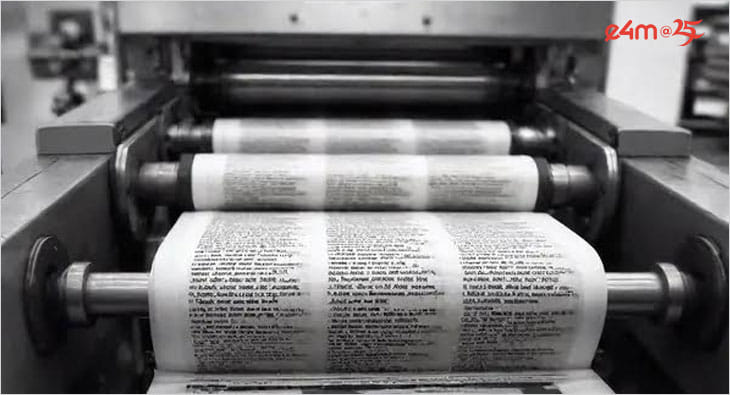

‘Don’t make AI your boss,’ read the headline of an interview with Sonu Nigam that appeared in a newspaper on Sunday, which happened to be the National Press Day in India. I think the singer’s crisp words of wisdom apply not only to music but as much to journalism, news, and media in general. AI is only one of the perceived threats across the world, even as others view it as an opportunity.
It all depends on how you look at it and approach it.
We are indeed living in times where there are challenges all around, thrown up by a new kind of politics that in some ways, looks like a throwback to authoritarian times we thought were over. Disruptive technologies add to the complexity of the issue. It makes sense for us to take stock of it all – looking beyond both dark cynics and rosy optimists, so that we get a reality check on what the Press as we know it stands for in the truest sense, and uphold the core of it all.
First up, the term “National Press Day” itself requires a clinical examination. In the connected world of the Internet and instant global communications, the word “national” means less as we are all international almost by default. “Press” no longer connotes the printing press that churned out well-laid-out newspapers and journals vetted and curated by editors though discerning audiences still speak of terms like the “Fourth Estate,” “Watchdog,” and “the fourth pillar of democracy.”
All these expressions are noble, no doubt. But then, we live in a new reality in which all old assumptions need to be revisited. An astute cynic might even remark why the government salutes the National Press Day when the head of government has not held a press conference since coming to power. Yet we know the press is thriving in its own way, though it defies some of the old conventions and principles that won the institution the respect traditionally associated with it.
Institution, did one say? Unlike the legislature, executive or the judiciary, the so-called “Fourth Estate” does not enjoy any special privilege in India unless you count accreditation passes to journalists and advertisements given to media entities.
Unlike the United States, where the First Amendment of its Constitution protects the media from abridgement of freedom of speech, the Indian media functions under the broader constitutional provision called “Right to Freedom” that includes freedom of speech and expression. This freedom is subject to “reasonable restrictions” – and of late we have IT laws that enable government appointees or the police to restrict and even punish media freedom.
But there are some saving graces. The National Press Day is celebrated on November 16 as it marks the establishment of the Press Council of India in 1966 under the Indian Press Council Act, 1965. The law was repealed in 1975 in the Emergency era, and a new bill brought it back in 1979. However, the PCI has no powers to punish. It essentially investigates ethical violations and uses gentle raps on the media’s knuckles through censures and admonishments. That is perhaps understandable as anything overdone by a government-constituted body can only be seen as an interference in media freedom, but some loud TV news anchors remind us of how this freedom can be abused or misused. Then there are issues like defamation and libel that are separately dealt with punitive powers by an independent judiciary.
“As a powerful tool for progress, it is essential that the press remains free from bias and upholds its duty to inform and educate the masses. For years, the media has been at the forefront, safeguarding the interests of millions and fostering transparency,” the government said in a media release on the National Press Day, as it noted that India’s media landscape currently has as many as 154,000 registered publications, zooming up from 60,143 two decades ago.
Ask yourself now: Are these numbers and the statement even relevant now? We have hundreds of millions of social media users on X, Instagram, and Facebook, and thousands of news-focused YouTubers now, not to speak of self-appointed professors of the mythical WhatsApp University, giving us strange concoctions of facts, opinions, hate messages, perspectives, and even fake news. Each one of them is now an editor, reporter, or publisher in her or his own right. An anarchic chaos is upon us.
The respected bunch of editors as we knew them is a threatened species, even as IT-related laws and recent provisions of “Right to Privacy” lead to what free-spirited journalists call “legal terrorism” to restrict independent professionals through coercive techniques. Understandably, India is ranked at 151 out of 180 countries in the 2025 World Press Freedom Index, according to Reporters Without Borders (RSF).
There is, however, a lot of evidence floating on your smartphone to suggest that all sorts of political, social and other information and views are freely dispensed on the media that are difficult to police and nearly impossible to restrict.
You cannot silence a billion keyboards powered by new technologies.
Let us start using the term “media” rather than “the Press” and include in that everything from messages on WhatsApp, Signal or Telegram, bunch them up with Instagram feeds and random posts on X, and pool them with status messages on Facebook. Independent websites and apps run by young, ethically conscious journalists and old-school entrepreneurs are in turn, influencing the people called influencers. When the Internet happened, it was called “new media” – and what we now experience may be called the “New New Media.”
There is chaos, yes. There is fake news, yes. Deepfake videos are emerging fast, yes. Populist, tough, personality-cult leaders have emerged across the planet, not just in India. Yes. I write this during a week in which President Donald Trump of the US, that supposed temple of modern democracy, is threatening to sue the venerable BBC for airing a falsely edited video that showed him in poor light. BBC’s apology and the sacking of two top executives has not been enough for the American strongman. Threats to the media are a clear and present danger.
Yet, everybody from tweeting individuals to stand-up comedians and millions of meme-creators are now joining the ranks of fearless journalists.
The media is thus no longer an institution but a movement – though not without its flaws and warts.
It is important to realise that a free, independent and credible media is necessary not just for democracy but also to ensure fair play in business. Competition in both business and democratic politics is enabled and empowered by a credible media.
Smartphones, cheaply and freely available cameras, and the power of AI tools to process publicly available data and archival material are empowering the New New Media. AI is a double-edged sword. Here is where independent micro-institutions behaving like the old “watchdogs” play a new-age role in managing and sifting through a chaotic flow of text, photographs, videos, sounds, and tables to tell the real, hard truth with innovative narrative techniques.
In the world of appearances, they say style never goes out of fashion. In the world of media, credibility never goes out of fashion. There lie the opportunities beyond the threats we are well aware of. Making AI your assistant, and not boss, has to be part of the new normal.
Read more news about Digital Media, Television Media, Out of Home Advertising, Print Media, Latest Advertising India
For more updates, be socially connected with us onInstagram, LinkedIn, Twitter, Facebook, YouTube & Google News