Media organisations must embrace change and technology to survive: Anurradha Prasad
In an interview with e4m, Anurradha Prasad, CMD, BAG Network, & Editor-in-Chief, News24, discusses newsroom transformation, AI, the distinction between journalists and content creators, and more
 by
Published: Oct 26, 2026 11:46 AM | 11 min read
 Follow Us
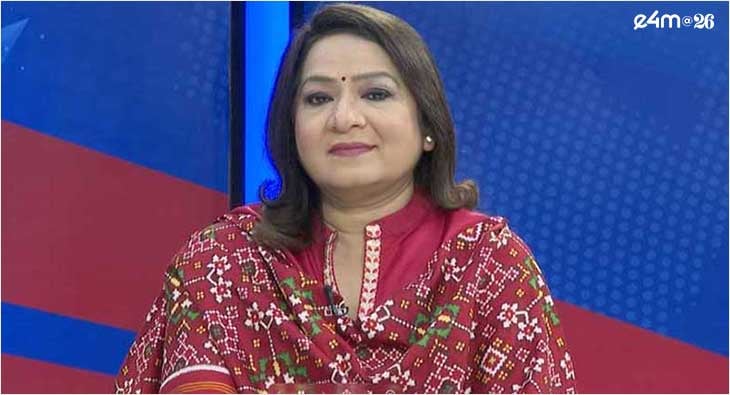

- Indian media is undergoing significant transformation due to digital platforms and AI, with credibility and audience trust being major concerns for organizations like News24, as highlighted by Anurradha Prasad, CMD of BAG Network.
- News24 is evolving by integrating technology into its operations, aiming for a unified newsroom that caters to various platforms while maintaining a commitment to impartial journalism and accurate reporting.
- The rise of content creators and influencers poses challenges for traditional journalism, emphasizing the need for credibility and responsibility in news reporting, as well as the importance of distinguishing between journalists and content creators.
- The media industry faces pressures from financial constraints and changing audience preferences, necessitating thoughtful decisions regarding content and technology to ensure survival and growth while maintaining journalistic integrity.
Indian media is navigating a period of rapid change in how news is sourced and delivered. Digital platforms and artificial intelligence have created new opportunities for distribution, while credibility, ratings pressure, business challenges and audience trust remain critical concerns.
In an interview with exchange4media, Anurradha Prasad, CMD, BAG Network, and Editor-in-Chief, News24, discusses newsroom transformation, AI, audience measurement, editorial independence, the distinction between journalists and content creators, and the challenges facing women in journalism.
Edited excerpts:
News sources and platforms are changing rapidly, while media organisations face challenges around credibility, commercial pressures and audience trust. What is the biggest concern today, and how should organisations respond?
The biggest challenge facing the media is credibility. Media organisations must be trustworthy, and audiences must also perceive them as trustworthy.
I have always believed that journalism’s role is to provide people with accurate information. Audiences should feel confident that the news coming from us is correct. News24 has always believed in impartial journalism. Throughout my career, I have assessed journalism against this standard, and media organisations should follow the same principle.
You have consistently emphasised the need for the media to evolve. How is News24 changing to stay connected with its audience?
Social media, digital media and broadcasting have expanded the opportunities to take content to audiences. I have always believed that content must be accurate and available across platforms. I see this as a 360-degree approach to content creation, audience reach and distribution.
News24 can no longer remain only a broadcast channel. We must be present wherever our audiences are. I believe the media organisations that survive and grow will be those that also become technology organisations.
With this in mind, we are working towards a unified newsroom at News24. Our aim is to bring content creation for different platforms under one newsroom and then distribute that content through various channels.
AI is increasingly being used in newsrooms for tasks such as scriptwriting and translation. Do you see it as an opportunity or a challenge?
I see AI as a tool that can help us move forward. If our objective is to produce better content, we should consider how AI can help us improve it. What matters is the additional value we can offer audiences, content consumers and advertisers.
We should not feel overwhelmed by AI; we should learn to use it effectively. Human beings must remain in control of technology. Today, we have AI; tomorrow, we may have technologies such as superintelligence. That does not mean we should become robots. We must know how to use technology.
AI also brings challenges such as deepfakes and misinformation. Should media organisations establish clear policies governing its use?
A media organisation must follow one fundamental principle: it must not publish or broadcast false news. Reports must not contain incorrect information, and audiences must not be misled through deepfakes or similar techniques.
News must be accurate and credible. This principle cannot be compromised when using technology.
You launched NowWhy with younger audiences in mind. Many young viewers quickly lose interest in lengthy programmes and television debates. What is your strategy for engaging them?
We developed NowWhy specifically for Generation Alpha and Generation Z. Young people want information, entertainment, knowledge, fashion and food-related content. They want a wide range of content, but in their own language and style.
They do not want someone to lecture them. We need to change how we communicate with younger audiences. Earlier, people spoke of a generational shift happening over ten years. Now, change is taking place much faster. Media organisations and newsroom professionals must keep updating their thinking.
I previously produced saas-bahu programmes, but at a certain point, I felt it was time to move on. When you realise that you no longer enjoy something as much as you once did, you should be ready to try something new.
Journalism also requires passion. It is important to enjoy your work and remain interested in it.
Q. Many journalists are launching their own platforms and becoming content creators or influencers. Can an individual’s identity become bigger than that of a news channel?
Absolutely. But success comes to those who remain grounded in their fundamental principles.
Whether a journalist becomes a content creator or an influencer, success depends on how seriously that person approaches the work. Many people emerge as content creators or journalists, but we must also consider how many actually succeed.
News can go viral within seconds on social media. How do you distinguish a journalist from a content creator, and what qualities should a journalist possess?
Simply sharing news is not journalism. The question is whether people trust the information you provide. Many people go viral, but does that make them good journalists?
I believe a journalist can become a content creator, but creating content alone does not make someone a journalist.
Credibility and responsibility are essential to journalism. You must understand whether you are producing content merely to go viral or creating something useful and important for people.
How does News24 balance speed and accuracy in the race to break news first?
If we broadcast an incorrect report, we must apologise. You cannot put out a story, let it go viral and then walk away from responsibility. You must be accountable for your reporting.
If a mistake occurs, you should be prepared to acknowledge it and apologise. I believe news must be both accurate and timely. If you want to be first, your team must be equipped to meet that standard. Expectations of journalists are continually rising.
TRPs, digital views, watch time and engagement have become important metrics for media organisations. Does the pressure to deliver these numbers influence editorial decisions?
There was a period when excessive importance was attached to TRPs and distribution. As a result, news channels sometimes carried content that was more entertainment than news.
I am not against entertainment. But should ratings pressure diminish the importance of news? A major story affecting the entire country may attract lower ratings than an entertainment programme. This affects news channels’ advertising and revenue models.
I am not against TRPs either. Every business needs a way to measure performance. However, audience measurement for news channels should properly account for both the importance of the content and its reach. The value of news should not be determined solely by numbers.
Your programme, Bharat Ek Soch, covers politics, society and technology. With audiences having so many choices, how do you keep it relevant?
I try to address subjects that need discussion and can offer viewers additional insight.
For example, we need more discussion about the role and needs of older people in our country. Retiring at 60 does not mean that someone loses the ability to think or understand. We should consider how to keep such people engaged with society.
Many important political and social issues are also overlooked in the race to go viral. They deserve attention.
I do not create content simply to make it viral. My aim is to produce something useful. Even if it does not go viral every time, it matters if viewers learn something new.
There have recently been reports of senior and middle-level departures at News24 and other media organisations. Should these be viewed as signs of newsroom transformation or financial pressure?
Change is a reality of life, and I have always accepted it. When we hire someone, we expect that person to give 100 per cent. For as long as they are with the organisation, they should give their best.
It is also true that media organisations face financial pressure. I have always believed that you should work within your capabilities and resources. Spending far beyond your means can create difficulties.
Technology cannot be ignored either. If people do not adapt, technology will leave them behind and they will become irrelevant. Media organisations must understand market, business and technological pressures and make considered decisions.
Is this a cause for concern across the media industry? What are the main factors driving it?
Certainly, it is a concern. Financial pressure is one factor, and the impact of technology is another.
Today, everyone has a mobile phone. Large numbers of people are creating content on social media and using reels to communicate with audiences.
This affects newsrooms too. Media organisations face pressures arising from technology, business conditions and changing audience preferences.
We should confront these changes rather than ignore them. Tough decisions may be necessary, but they must be taken thoughtfully.
Your husband, Rajeev Shukla, is involved in politics and cricket administration, and your brother is also a politician. How do you ensure News24’s editorial independence given these political connections?
When I started BAG Network, and when we got married, Rajeev was a journalist, not a politician. Both of us worked in the media.
My family also has a political background. However, neither Rajeev nor any leader from his party has ever told me how to do my work.
For me, there is no question of political connections affecting my editorial independence. Rajeev’s politics and my professional work are separate. We are a family, but that does not mean our professional roles are the same.
If an organisation’s policy is to remain impartial and report accurately, it must stand by that policy. Allegations will continue to be made. If we allow them to put us under pressure, there is little point in running an organisation. We must not compromise our principles.
BAG Network held its AGM on September 17. What are the organisation’s priorities, and were any specific goals identified?
Our focus is on bringing media and technology together. We will continue in that direction without compromising our fundamental principles.
Our core belief is that news must be accurate, information must reach people, and audiences must be able to trust what we report.
Technology is becoming increasingly important to BAG Network. We want to use it to take our media operations forward.
You began your career as a reporter and now lead a major media network and a news channel. What has been the most positive change during this journey, and where do you see the industry heading over the next five to ten years?
I believe the biggest change has been the expansion of Hindi and regional-language media.
Earlier, English-language and print media appeared to dominate the industry. Television then expanded its reach, and social media has taken that reach even further.
This has empowered people. Women’s participation has also increased considerably. Today, large numbers of women work in newsrooms and express their views openly.
The media has helped bring about several positive changes in society. Technology and new platforms will continue to reshape the industry. Organisations will need to expand their reach while maintaining credibility.
What challenges do women face in reaching leadership positions in the media? Is the situation better today?
Women journalists faced greater challenges 20 or 30 years ago. When we entered television journalism, people were surprised to see women in those roles. Often, women were not given enough room to do their work.
Reporting brought its own difficulties. During coverage of Parliament and other important locations, it could be difficult to make your way forward. But if you are committed to your work, you can overcome these challenges and find your path.
Many women of our generation did that, opening doors for those who followed. The situation is considerably better today. Seeing women move into leadership roles is a positive development.
Recent allegations of misconduct towards women journalists at Jantar Mantar have raised concerns about journalists’ safety. What measures should be taken, including safety guidelines?
Journalists must be protected because they are doing their jobs. Whether they work in print, broadcasting or social media, their safety matters.
We must also consider the safety of police personnel. I believe dialogue and a structured system would help address such situations. Clearly identifying journalists at coverage locations could improve coordination. When crowds grow and situations become difficult to control, everyone faces problems.
Media organisations also have a responsibility to protect their journalists. For example, when our bureau staff in Kashmir were working in sensitive conditions, we provided them with bulletproof jackets.
If a journalist or camera operator is entering a high-risk area, the organisation must make the necessary arrangements for their safety.
The media is often described as divided into different camps. How do you view this?
The media should not be divided into camps. Even where such divisions exist, I believe they are temporary.
It is difficult for anyone to sustain such a position indefinitely. Eventually, people can see how seriously and responsibly each person approaches their work.
If you could recommend three essential changes for the Indian media industry, what would they be?
First, you must persevere. Every profession has pressures, and the media is no exception. You must continue working while facing these challenges.
Second, always be ready to change. If you do not adapt, someone else will move ahead of you.
Third, embrace technology. Do not allow it to dominate you. Use it effectively as an assistant. If we understand technology and incorporate it into our work, it can become a strength.
Read more news about Digital Media, Television Media, Out of Home Advertising, Print Media, Latest Advertising India
For more updates, be socially connected with us onInstagram, LinkedIn, Twitter, Facebook, YouTube & Google News