BRICS 2026: How competing media narratives framed the summit
A deep dive into how the BRICS summit was covered by world media
 by
by
Published: Sep 15, 2026 9:22 AM | 4 min read
 Follow Us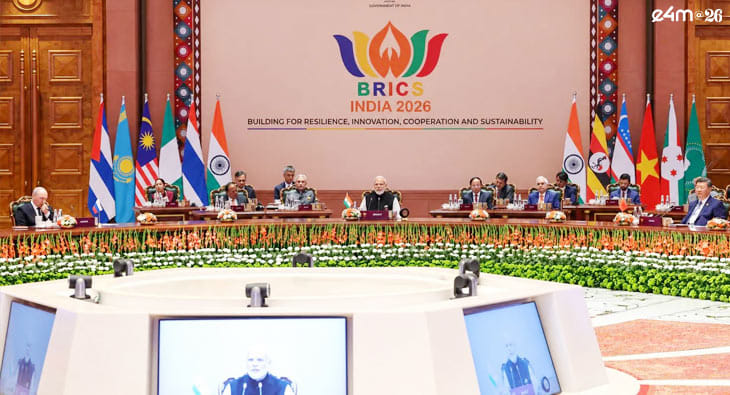

The BRICS Summit in New Delhi produced more than diplomatic declarations and political optics. It also produced two noticeably different media narratives.
For observers of the media, the interesting question is not whether one narrative was “right” and the other “wrong”. It is what different news ecosystems chose to emphasise and what those editorial choices tell us about how BRICS is perceived around the world.
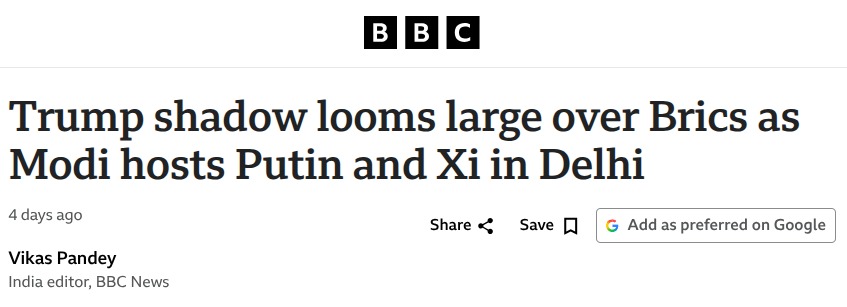
Much of the Western coverage before the summit was framed around a recurring set of words: division, rivalry, war, strain and unity under pressure.
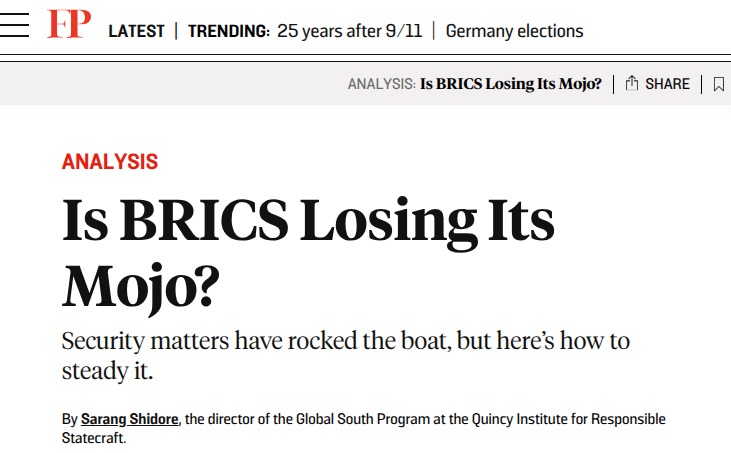
On September 2, Foreign Policy asked: “Is BRICS Losing Its Mojo?” The article itself was nuanced and acknowledged BRICS' achievements, but the headline framed the forthcoming summit around questions about the grouping's cohesion and effectiveness.
Reuters followed on September 10 with “India hosts BRICS summit as Iran war tests bloc unity.” A day later, Associated Press led with “BRICS leaders gather in New Delhi as wars and rivalries strain the expanded bloc.” Deutsche Welle chose “India looks to steer BRICS away from anti-Western turn.”
Individually, these were legitimate editorial frames. BRICS does contain competing interests, and the conflicts involving member countries were significant news developments. But viewed collectively, a media pattern emerges.
The dominant pre-summit Western news frame was not primarily “What will BRICS deliver?” It was frequently “Can BRICS hold together?”
That distinction matters because headlines are not simply summaries. They establish the interpretative frame through which audiences enter a story.
Veteran journalist and Padma Shri awardee Alok Mehta believes the scepticism was visible.
“I feel that in BRICS, Western media coverage was biased and expected that it would not be successful,” he says.
What Mehta found more remarkable was the tone adopted by Chinese media towards India.
“On the contrary, for the first time Chinese media was more favourable to India and positive. Earlier, this never happened.” That shift deserves attention from a media perspective.
Chinese state media coverage around the summit repeatedly used the language of partnership, shared growth, consensus and cooperation. People's Daily reported the Modi-Xi meeting under the formulation that China and India “should be partners”, while Xinhua highlighted the possibility of the two countries achieving “shared growth”. China Daily spoke of BRICS entering another “golden decade.”
The contrast with Western headline vocabulary is striking. That is precisely what makes the comparison valuable: both sets of media were selecting frames. They were simply selecting different ones.
There is another media dimension that should not be overlooked.
Reuters and AP are global wire services. A framing adopted by a wire does not remain confined to one publication; it can travel across hundreds of newspapers, websites and broadcasters. AP's “wars and rivalries strain the expanded bloc” formulation, for example, was syndicated internationally. That gives wire-service framing disproportionate influence over how an event enters the global news cycle.
At the same time, Western coverage was not uniform.
Once the summit concluded, the Financial Times headline offered a markedly different assessment: “‘Trumpism’ spawns rare unity at Brics summit.” In other words, the media narrative evolved as the summit produced a joint declaration and demonstrated a degree of consensus that some pre-summit coverage had questioned.
Media and marketing expert Chintamani Rao argues that Western scepticism should itself be examined as a media phenomenon.
“The Western media have been playing down the BRICS summit, which is no surprise,” he says.
But perhaps the most consequential change is occurring beyond the traditional Western-versus-Chinese media binary.
Rajdeep Sardesai, Consulting Editor, India Today, points to the growing physical and editorial presence of media organisations from developing economies.
“It is good to see so many media outlets from the Global South represented at the BRICS summit. I hope to see a wider coalition of these voices in the future.”
For decades, the international news agenda has been disproportionately shaped by a relatively small number of Western news organisations and wire services. BRICS and other Global South platforms are increasingly creating alternative centres of reporting, commentary and agenda-setting.
BRICS 2026 was not only covered differently by different parts of the world. It demonstrated that the global media narrative itself is becoming more multipolar.
Read more news about Digital Media, Television Media, Out of Home Advertising, Print Media, Latest Advertising India
For more updates, be socially connected with us onInstagram, LinkedIn, Twitter, Facebook, YouTube & Google News