Young India’s consumerism playbook unpacked at Pitch BrandTalk 2025
Leaders from technology, media and marketing outlined how Gen Z has been reshaping identity, consumption and communication
 by
by
Published: Nov 24, 2025 12:43 PM | 4 min read
 Follow Us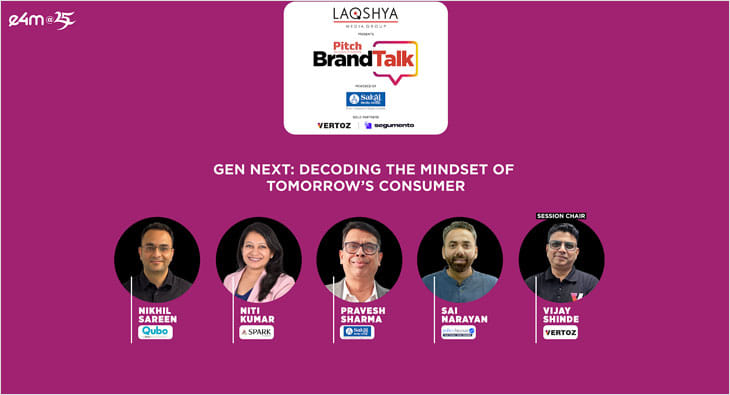

At Pitch BrandTalk 2025 held under the theme Building Connections in a BANI World, a panel of senior leaders explored how India’s youngest consumers are changing the rules of engagement for brands and platforms.
The session titled Gen Next Decoding the Mindset of Tomorrow’s Consumer brought together Nikhil Sareen, Co-Founder of Qubo, Niti Kumar, Chief Executive Officer India of Spark Foundry, Sai Narayan, Chief Marketing Officer of Policybazaar.com, and Pravesh Sharma, General Manager North and East of Sakal Media. The conversation was chaired by Vijay Shinde of Vertoz, who began by underscoring the need to understand how the next generation thinks and reacts.
Sareen opened the discussion with an insight into identity driven product choices among young buyers. He said that consumers today value design that fits naturally into their lives and cannot be forced. At Qubo the effort is to keep products minimalistic and rooted in user routines. He explained that different people use the same device for different purposes which is why the product must blend into their environment and should not stand out as intrusive technology. This approach, he said, helps products align with lifestyle and identity without appearing forced.
Kumar spoke about the agency perspective and the challenge of communicating with Gen Z in a manner that feels authentic. She said that Spark Foundry and Publicis Groupe have been investing heavily in understanding Gen Z through digital mapping and proprietary tools that analyse actual buying behaviour. She noted that it is not only about reach because the message itself carries most of the impact. She added that the focus is on how creative messaging and media backed by data work together. She pointed out that the agency applies these learnings across clients such as Meta, Spotify and PepsiCo.
Sharma addressed the rapid changes in content consumption and the challenge for a ninety two year old publication like Sakal. He said Gen Z does not consume news in the traditional sense and instead navigates through it and looks for verification. To adapt, Sakal is redesigning formats with stronger visuals, sharper headlines and storytelling that helps younger readers process information quickly. He said the publication has diversified into education material through NIE, expanded to television with Saam TV and invested significantly in digital platforms such as e-Sakal to rebuild relevance and trust.
Narayan reflected on the perception that Gen Z has a short attention span. He said the real issue is that content must prove relevance within eight seconds. He described the challenge of selling insurance to a generation that does not get a tangible product. The company focuses on simplifying information and engaging users with clear communication especially around claims which he described as the only real touchpoint in insurance. He said that health insurance is already among the top products for young buyers and that being a digital company helps serve this audience more naturally. He added that Policybazaar sees its role as developing the entire insurance category rather than only the brand and that this approach encourages younger audiences to invest in it and pass on that understanding to others.
On the subject of Make in India and innovation, Sareen said Indian consumer tech brands traditionally depended on imported hardware and software which limited control over the user experience. He explained that Qubo chose to build the entire technology stack in India including the app, firmware and cloud. This allows the company to solve for Indian use cases such as air purifiers that respond to local pollution levels. He said this level of customisation is only possible when the technology is owned locally and added that with increasing government support more hardware will also be made in India.
Kumar also addressed the rise of creators and the shift from advertising to peer influence. She said every brand is now trying to integrate influencers into its channel mix because audiences spend more time on digital platforms than traditional media. She stressed that authenticity is key and that success comes from understanding what consumers want to hear rather than signing large numbers of influencers. She cited an example of a bike launch that was funnelled through a gaming influencer and said that the campaign achieved booking targets within two days because it tapped into the right community.
Sharma spoke of the importance of credibility and said young audiences demand verified sources. He explained that Sakal builds trust by maintaining authenticity across print, television and digital and by adapting to the changing expectations of the audience while retaining its heritage.
Narayan closed with a reflection on the future generation. He said Gen Alpha is not yet an insurance buyer but can be a spokesperson for financial responsibility. He added that if brands succeed in engaging Gen Z with clarity and relevance the next generation will naturally follow.
Read more news about Marketing News, Advertising News, PR and Corporate Communication News, Digital News, People Movement News
For more updates, be socially connected with us onInstagram, LinkedIn, Twitter, Facebook, YouTube & Google News