In the age of collapsing attention, Ruchira Jaitly calls for culturally agile branding
Pitch BrandTalk witnessed a spotlight address by Ruchira Jaitly, Chief Marketing Officer at Diageo India, who spoke on need for agility in marketing has intensified because of the attention economy
 by
by
Published: Nov 21, 2025 1:08 PM | 5 min read
 Follow Us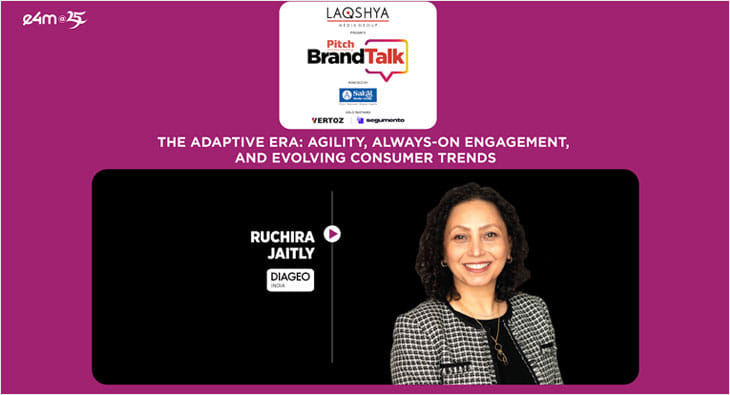

The rules of brand building have changed in an era where consumer attention is fragmenting faster than marketers can keep pace, said Ruchira Jaitly, Chief Marketing Officer at Diageo India, during her spotlight address at the Pitch BrandTalk on Friday.
Speaking at a time when brands face unprecedented pressure to stay relevant, she laid out why cultural agility has become non-negotiable for marketers who want to remain visible and meaningful.
On the theme ‘The Adaptive Era: Agility, Always On Engagement and Evolving Consumer Trends’, she explained why brands must learn to move at the speed of culture and context, especially in categories where experience, environment and consumer participation matter more than traditional communication.
Jaitly said the need for agility in marketing has intensified because of the attention economy. She pointed to research showing that half of all communication has zero impact. “People are scrolling at the speed of light,” she said, while consumers encounter more than ten thousand messages a day across social platforms and messaging apps. Despite the affection many may hold for brands such as Johnnie Walker, “they are not giving us the attention we think we should get.” The existential threat is clear. As she put it, “77% of brands could vanish from the world and consumers would not miss them.”
This disappearing act, according to Jaitly, is happening because brands have become static wallpapers. Old ideas of purpose, positioning or a perfectly articulated branding framework matter far less when consumers no longer pause to notice them. She contrasted this with the media environment she entered as a young brand manager when winning a single advertising spot after a break on Chhaya Geet or Chitrahaar felt like triumph. Today, the battle is completely different.
In this context, agility is not an operational trick but a strategic weapon. “It cannot be that the consumer has moved ahead and as a brand you are still talking about something that happened six months ago,” she said. The pace at which interests shift outstrips the time it takes to create traditional advertising. One message for everyone is no longer relevant. Signals from culture and social media often reveal more than a focus group conducted three months earlier.
Jaitly explained that marketers have moved from the attention economy to the engagement economy. Engagement, she said, is not just presence but participation. It means moving from attention to interaction, and from one time transactions to relationships.
“Consumers today do not want broadcast messages. They want a dialogue,” she said.
She illustrated this shift with a story about a friend who returned from a trip with sunburnt skin and, instead of seeking new products or visiting a dermatologist, photographed her existing products and asked an AI assistant to create a skincare regime.
This example, Jaitly said, shows how easily AI can disrupt traditional brand messaging. The challenge for marketers is to stay meaningful and emotionally connected.
She clarified that agility is not trend chasing. “Agility actually is way beyond hijacking a trend,” she said. A viral song or moment may give a short spike but often wastes resources. True agility must be proactive, precise, strategic and emotionally sticky.
To show how Diageo interprets agility, Jaitly described its Indian adaptation of Mexico’s Day of the Dead. India has no tradition of celebrating the dead, so the brand reinterpreted the moment using marigolds, Indian cultural cues and authentic elements such as pan de muerto and Mexican inspired cocktails. She said the brand hosted an immersive experience at Mukesh Mills with influential guests and then took micro experiences across the country.
“What is agile is making this cultural relevant,” she explained, emphasising that it went beyond copy pasting and instead created a meaningful reinterpretation.
She also spoke about the “whiskey experiments” for Johnnie Walker Black Label. Many consumers believe they already know the brand because they have grown up around it, yet they remain unaware of its true flavour profile. Diageo partnered with top bars in India to allow bartenders to create custom menus and new expressions using Black Label. This encouraged conversation and discovery, which Jaitly described as a form of agility that helps evolve a heritage brand in fresh ways.
She highlighted another example through McDowell’s No. 1, the only Indian brand to appear in the top twenty most valuable global alcohol brands. Diageo facilitated a friendship jam with leading musicians. The agile part, she said, was that the brand did not know what content, song or anecdotes would emerge. They created a creative environment and let the content form naturally, then amplified it across platforms and live concerts.
With Royal Challenge Packaged Water, the company moved its activation universe away from stadiums to digital spaces where audiences are verifiably of legal drinking age. This shift, along with the brand’s association with cricketer Smriti Mandhana, created engagement far deeper than traditional television campaigns. Jaitly said that while reach is easy to buy, conversation is what matters.
She closed by reminding marketers that “agility is not a tactic.” It is a mindset needed to navigate a nonlinear and often incomprehensible world. “Consumer attention has become rare and valuable, and the brands that build genuine engagement will be the ones that survive,” she said. She urged marketers to adopt this mindset wholeheartedly so their brands can grow meaningfully in a world where nothing stands still.
Read more news about Marketing News, Advertising News, PR and Corporate Communication News, Digital News, People Movement News
For more updates, be socially connected with us onInstagram, LinkedIn, Twitter, Facebook, YouTube & Google News