When it comes to market research, intuition often trumps data: Ajay Gupta, Ching’s Secret
At e4m RetailEX 2025, Ajay Gupta, Founder of Ching's Secret & Senior Advisor to the CEO, Tata Consumer Products Ltd., advised entrepreneurs to focus on business fundamentals over valuations
 by
by
Published: Mar 13, 2025 4:58 PM | 7 min read
 Follow Us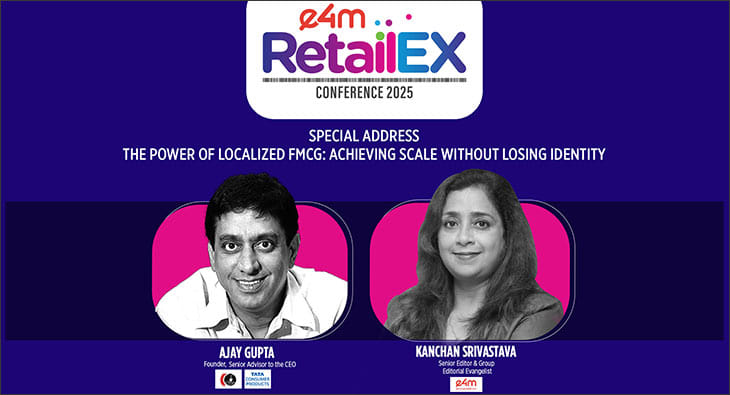

At the e4m RetailEX Conference & Awards 2025, Ajay Gupta, Founder of Ching's Secret & Senior Advisor to the CEO, Tata Consumer Products Ltd., delved into the intricacies of scaling localized FMCG brands while maintaining their core identity. In a fireside chat with Kanchan Srivastava, Senior Editor and Group Editorial Evangelist at exchange4media, Gupta shared insights on Ching’s Secret’s journey and its integration into Tata Consumer Products.
Gupta reflected on the brand’s transition, emphasizing why Tata was the right fit. “We started as a niche business, and that niche became mass. Our portfolio was built on flavors and formats that didn’t exist in the country, and we saw massive growth potential,” he said.
On the decision to choose Tata over other suitors, he remarked, “Why Tata? Simple—why not Tata? Growing up in India, Tata was synonymous with trust. It was either joining the government or Tata. I wanted to leave the brand in the hands of an Indian company, and Tata was the perfect choice. It was a very emotional decision.”
Discussing the integration process post-acquisition, Gupta noted that thorough planning ensured a seamless transition. “The deal was finalized in February-March last year, but the process had begun five months earlier. Culturally, the integration was smooth. We completed 100% of the integration in just three months because it was planned well in advance.”
Looking ahead, Gupta shared ambitious growth targets for Ching’s Secret and Smith & Jones. “Schezwan Chutney is already a ₹250 crore brand in a ₹600 crore tomato ketchup market. This year, it will touch ₹300 crore, and next year, ₹350 crore. I see it becoming a ₹1,000 crore brand in the next two years. With Tata’s distribution, Ching’s alone should reach ₹3,500 crore in five years,” he stated.
On Smith & Jones, he added, “Ginger garlic paste was niche in 1996 but has become mass. The ₹5 pack is one of our best sellers. With upcoming innovations, Smith & Jones should hit ₹1,500 crore. Overall, we are targeting ₹4,000-4,500 crore in five years.”
Gupta also shared the thought process behind Ching’s Secret’s product innovations, tracing its origins back to his advertising background. “I spent 16 years in advertising before crossing over. While working with brands like Kohinoor Basmati Rice and Mother’s Recipe, I studied how ethnic foods grew internationally. Indian food isn’t a single cuisine—it changes every 300 kilometers. If we had to introduce something pan-India, it had to be foreign yet deeply rooted in Indian food culture.”
He highlighted how Indo-Chinese cuisine evolved through Chinese immigrants adapting their methods to Indian ingredients. “By the early ’90s, street food stalls selling chowmein were competing with vada pav and chole bhature. This meant Indians would start cooking it at home,” he explained.
On the role of market research, Gupta maintained that intuition often trumps data. “Research confirms assumptions; it doesn’t drive innovation. We use it to validate ideas, but sometimes, common sense is better than research.”
Srivastava brought up Gupta’s deep understanding of regional food preferences, mentioning his time spent in UP, Bihar, and Madhya Pradesh studying local masalas. She specifically asked about pasta masala and how he discovered that market.
Gupta called it an “interesting story” and explained that Indians don’t just adopt international foods—they make them their own. “The samosa shell came from Central Asia—we put the potato in it. Naan also comes from there. Except for idli, dosa, and South Indian Dravidian food, most of our cuisine has been inspired by different parts of the world. But we only eat it once it feels like ours.”
He recalled the rise of pasta in India, saying he even imported pasta and launched a brand called Mama Maria. But after six months, he realized it wasn’t selling. Around the same time, major brands like Nestlé and ITC were pushing instant pasta. “I gave up, thinking that no one in India will eat this and it can’t be scaled.”
That changed when he visited Kanpur’s wholesale market. He noticed someone confidently placing food pipes in kirana stores—something difficult for newcomers. Curious, he asked, “Who has so many contacts here?” The man turned out to be his super stockist. When Gupta asked how, the man pointed to a gunny bag full of macaroni. “‘I sell this in the wholesale market’” Gupta pressed further: “How much do you sell in Kanpur?” The response stunned him: “8-10 truck.”
It was 2014, and one truck carried eight tons of pasta. Gupta’s next question: “Are you the only one?” The reply: “No, I’m the biggest. Three-four others sell 3-4 trucks each.” Suddenly, he saw what he had missed—macaroni pasta was everywhere.
From Kanpur, he traveled to Lucknow, Varanasi, Patna, and Ranchi, spotting pasta in every kirana store. “I was doing this by car, stopping in small towns—and it was everywhere.” Back in Mumbai, he checked Andheri’s municipal market and saw different types of pasta sold loose in gunny bags—at ₹45 per kilo. “We sitting in this audience have a different definition of pasta. But India eats pasta very differently.”
A quick survey of 25 women revealed a key insight: they made pasta with tadka. “There’s no money in selling pasta. The money is in ‘tadka’ i.e. the spice.” That led to the ₹5 pasta masala. Today, it’s a ₹120 crore business growing at 40% annually. “Hopefully, by next year, it’ll be ₹170 crores. It’s already double what Maggi and ITC sell in pasta numbers.”
He pointed out that major brands succeeded only after Indianizing their products. “Pizza Hut became Pizza Hut after tandoori pizza. McDonald’s took off with Aloo Tikki.” Through this observation, he concluded, “Food works only when it feels like ours.”
On being asked if he had any advice for the new generation of entrepreneurs, he said, “Don’t chase valuation before starting the business.” He pointed out that many young founders approach him with valuation as their first priority. “If you do great business—and the word ‘business’ is about making money—valuation will follow.”
He stressed the importance of solving for the consumer rather than focusing on burn rates. “First, think about what you’re solving for. Are you helping create aspiration in the Indian middle class? Are you helping them evolve?”
For food startups, he warned against blindly copying Western models. “It’s not going to work. There are enough and more ideas in aspiring India.” With rising per capita income, he saw huge potential for new food categories. “We are going to eat a lot more different things.”
He advised, “Don’t look back at what’s been done. Look up and see where the new ideas are.” Once founders find their idea, he urged them to commit fully. “Be passionate and run with it. Don’t worry about valuations. Valuations will come if the consumer accepts it and is ready to pay a premium.”
He concluded the session by saying, “Don’t take shortcuts. They don’t work. Passion will deliver numbers and profit—and from there will come valuation, not the other way around.”
Read more news about Marketing News, Advertising News, PR and Corporate Communication News, Digital News, People Movement News
For more updates, be socially connected with us onInstagram, LinkedIn, Twitter, Facebook, YouTube & Google News