'Brands should set aside personal biases, use strategy in influencer selection'
A panel of experts at e4m RetailEX 2025 shared insights on influencer marketing for retail brands
 by
by
Published: Mar 12, 2025 3:19 PM | 6 min read
 Follow Us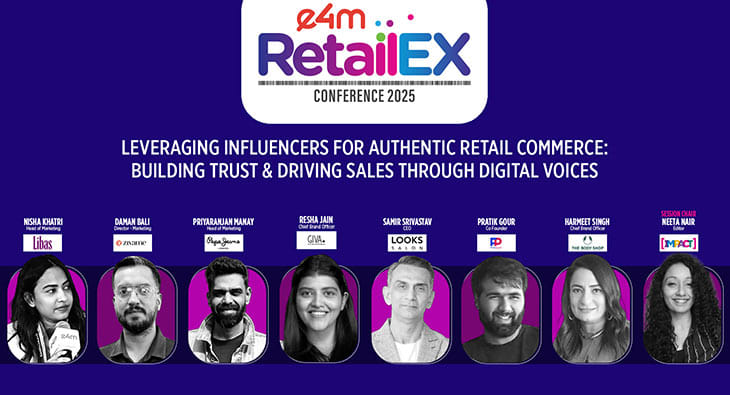

A panel of marketing executives at e4m RetailEX 2025 delved into the evolving landscape of influencer marketing in retail. The discussion focused on how authentic content creation, strategic influencer selection, and platform diversification are reshaping brand promotion strategies.
The panellists included Priyaranjan Manay, Head of Marketing, Pepe Jeans London; Daman Bali, Director - Marketing, Zivame; Nisha Khatri, Head of Marketing, Libas; Resha Jain, Chief Brand Officer, Giva; Samir Srivastav, CEO, Looks Salon; Pratik Gour, Co-Founder, Footprynt; and Harmeet Singh, Chief Brand Officer, The Body Shop. The session was chaired by Neeta Nair, Editor of IMPACT Magazine, exchange4media.
The discussion began with Manay sharing insights on influencer marketing for an established apparel brand like Pepe Jeans. "For us, a brand that is almost 50 years old, it's very important that we are relevant to the audience because we need to acquire newer consumers. We also need to build loyalty with some of them who are already there," he noted.
He emphasised that influencer marketing has grown significantly, now accounting for nearly 30 per cent of their marketing efforts, but stressed the importance of preserving brand DNA. "For us, we are looking at influencers as a strategic way of pushing content and product information rather than just doing storytelling," Manay said.
Bali highlighted the unique challenges intimate wear brands face in selecting appropriate influencers. "For an intimate wear brand, it's the hardest job to get influencers," he explained. He outlined three key criteria for Zivame's influencer selection: ensuring the influencer has predominantly female followers, evaluating engagement metrics beyond just follower counts, and maintaining brand relatability.
"We make it a point that whatever we do, the audience who sees the content should also be women. So I have to choose women influencers with above 60% women followership," Bali said. He added that engagement is crucial, looking beyond likes and comments to include metrics like content saves.
Khatri addressed the complexity of choosing between macro and micro-influencers. "I like how simple the question sounds, but only if it was as simple to choose influencers," she remarked, noting that she's seen campaigns with both types succeed and fail.
She explained Libas' content-first approach: "To come out of this vicious loop of influencers, what we have done is focus on content. And we make content the king slash queen, and then we revolve our influences around it." Khatri also highlighted the growing importance of employee-generated content, revealing that 40-50 per cent of Libas' Instagram content is created by their own team members.
The discussion moved to addressing authenticity concerns in influencer marketing. Singh emphasised The Body Shop's commitment to values-aligned partnerships. "With the Body Shop, I would say it's something which is extremely important. We want to choose authentic and very real influencers who would actually go by the values of our brand," she stated.
She supported her point by sharing a successful case study. "We've had a few campaigns in the past where we've had the influencers, and they did not necessarily have huge followership, but yes, they were very authentic and highly engaged audiences. That's where our results came in."
Srivastav discussed how Looks Salon is shifting from traditional influencers to authentic customer advocates. "Strategically, this year, we've decided that we will reduce the number of so-called influencers. We will use individuals who walk into our salons and customers for the same," he explained.
He added that focusing on real customers with smaller followings who genuinely influence their immediate communities has proven more effective. "Because that, according to me, is going to be far more genuine. And people can relate to it," Srivastav said while noting a growing trend of male influencers in the beauty space.
When questioned about the cost-effectiveness of influencer marketing, Gour provided practical insights. "Influencer marketing is expensive. However, it can be cost-effective if the brands follow a certain process," he explained. He cautioned against overreliance on mega influencers, suggesting that brands should instead seek content creators whose values align with their ethos.
"I would generally suggest to all the brands to try to avoid mega influencers," Gour advised, noting that many micro-influencers create excellent content and maintain highly engaged audiences. He emphasised that personal biases in influencer selection should be avoided, sharing an example of a failed campaign because a decision-maker chose influencers based on personal preference rather than strategic fit.
The panel then discussed platform preferences for influencer marketing. Khatri confirmed Instagram's dominance but highlighted Snapchat's surprising effectiveness. "One exciting platform that has come to our attention, and I've been astonished by how well it is still performing, is Snapchat.” She revealed that it is the third-best-performing platform after Meta and Google.
Manay explained that while Instagram drives conversions for Pepe Jeans, YouTube excels at building awareness. "From an awareness angle, we've seen YouTube do very well for us as well," he noted, describing how they collaborate with automobile reviewers and travel bloggers to reach their predominantly male audience.
Jain differentiated between platforms based on marketing objectives: "Instagram works super well for awareness," while "YouTube is an amazing platform if you want to push consideration and conversion." She added that YouTube's educational potential is particularly valuable for niche products like lab-grown diamonds.
Srivastav concurred on YouTube's importance for service demonstrations: "YouTube, in our case, is important because we have to show the demonstration of the service. So, there's only X that I can peddle with the product. I have to show the whole treatment of the hair."
Singh highlighted a multi-platform approach for the Body Shop, emphasising each platform's unique strengths. "YouTube gives us results in terms of brand awareness. And rightly said that it's not only the awareness but also the consideration, which is extremely important now," she said. She noted that platforms like Quora have driven website traffic by addressing consumer questions about their products.
Addressing concerns about fake followers, Bali explained how Zivame has adopted a data-driven approach while selecting influencers. "Today, many agencies and platforms have these native tools to define what audience exactly is. We get the exact engagement score of each and every influencer."
On measuring influencer marketing success, Manay shared tangible results: "Since we've signed with somebody like Kriti, she's the face of the brand, not only in India, but globally, we launched a campaign in September, and since then, we've seen almost 50% of people who come to us being first-time shoppers." He emphasised that impressions, comments, and link clicks are primary metrics, with conversion typically being secondary.
The panel concluded with a discussion on content quality versus virality. When asked about "cringe content," Jain provided a nuanced perspective. "You must know your brand. If I am a premium jewellery brand, there is no way that I'm going to collaborate with cringe content. Because my brand has a different value system." She emphasised that brands should focus on creating value rather than chasing numbers: "Numbers are nothing if they're taking you in the wrong direction."
Read more news about Marketing News, Advertising News, PR and Corporate Communication News, Digital News, People Movement News
For more updates, be socially connected with us onInstagram, LinkedIn, Twitter, Facebook, YouTube & Google News