e4m RetailEX 2025: Leaders decode the future of omnichannel shopping
From QR-enabled duty-free shopping to AI-driven customer insights and AR-powered virtual try-ons, the session highlighted how brands leverage innovation to enhance consumer journeys
 by
by
Published: Mar 12, 2025 12:52 PM | 8 min read
 Follow Us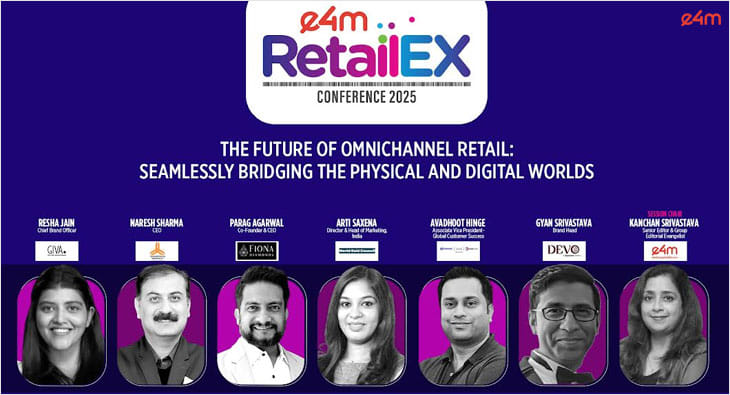

At the e4m RetailEX Conference & Awards 2025, a panel of retail leaders explored how consumers seamlessly switch between online and offline channels, emphasising the critical need for unified shopping experiences.
The panel titled ‘The Future of Omnichannel Retail: Seamlessly Bridging the Physical and Digital Worlds’ included insights from Naresh Sharma, CEO, IRHPL Group of Companies; Parag Agarwal, Co-Founder & CEO, FIONA Diamonds; Arti Saxena, Director & Head of Marketing, India, World Gold Council; Avadhoot Hinge, Associate Vice President - Global Customer Success, Route Mobile Limited; and Gyan Srivastava, Brand Head, Siyaram Silk Mills Ltd. Kanchan Srivastava, Senior Editor and Group Editorial Evangelist, exchange4media chaired the session.
The discussion began with Sharma sharing insights on omnichannel strategies in airport retail. Highlighting the unique challenges of limited store space, he explained how technology bridges the gap between physical constraints and customer expectations. "Because of the size issue, what becomes important is the range. Your assortment, which you can keep in a smaller store compared to an assortment in a bigger mall, should be the best-selling kind," he said.
Sharma illustrated this with a real-world example from his brand, Artport. "We wanted to sell higher-weight statues. The general perception is that in the airport, smaller-size products are sold, or you can't sell a product that weighs 110 kilos. But we did that," he revealed. Their approach involved displaying the item with a QR code that provides product details, allowing customers to place orders for home delivery to destinations worldwide.
Another example Sharma shared was about duty-free shopping. "Let's say you're flying in from Dubai, you are at Dubai airport, you want to buy your single malt, and you want to compare prices. You don't know when you'll land in Mumbai, and the app gives you the entire range of the brands and products available in Mumbai Airport," he explained, emphasizing how this creates price transparency while enhancing business.
Next, Agarwal discussed how the diamond industry approaches omnichannel retail, noting, "Diamond is all about perception. And the myth about diamond is getting broken." He emphasized that "retail is all about detail" and that omnichannel isn't merely about opening new sales channels but maintaining harmony across them.
He highlighted the challenges of customer acquisition: "When we talk about luxury, people are really not buying luxury; they're buying the experience. When you get the eyeballs, and if you're not present at the right location, trust me, many newcomers, when we were new, we would think, we've written a great copy, this is a great ad and people will look into our ad and they'll jump into our stores. Trust me, that doesn't happen."
Agarwal pointed out that users need to see an ad approximately seven times before conversion. He also explained how their lab-grown diamonds are democratizing the market, but customer doubts persist. "Those doubts cannot be satisfied unless and until they step into the store, look at the collection and change their mind. Because with women what happens is even if they are not agreeing with the concept, the moment they try something, it changes."
Saxena provided perspective from the World Gold Council, emphasizing that omnichannel has been evolving for years. "The first thing that comes to our mind is something which is absolutely unified, a consistent customer experience. And it has been there for the longest time," she noted.
She highlighted several key trends: "The first being personalization and customization. I think that's at the heart of the omnichannel and that's what facilitated it in the biggest possible way." Citing Nike as an example, she explained how they've created "a great community of fitness enthusiasts" and use insights from various platforms to offer highly personalized solutions.
Saxena stressed the importance of seeing channels through customers' eyes: "From the Gen Z, which is going to be almost contributing to 36% of the business in the near future, for them, it's just one window. They are not looking at you in different ways."
She also highlighted advancements in technology, particularly in the jewellery industry. "Tiffany has used a technology called ray tracing technology, which they have borrowed from the video game industry," she explained, describing how it captures light reflections on moving jewellery items to create realistic virtual try-on experiences.
Saxena identified conversational commerce as another significant trend, noting, "As per the estimate, 80% to 85% of the conversation has shifted to chatbot because it is a transaction, it is a function, and the chatbot is able to cater to all those conversations."
On social commerce, she observed, "In the last two decades, we've seen two big disruptors. One is e-commerce, and the second is social media. And with social commerce, both the disruptors come together." She explained that this integration creates highly engaging experiences as consumers interact with influencers, friends, and user-generated content.
The conversation then moved to Srivastava. He discussed how Siyaram Silk Mills bridges physical and digital experiences, particularly with their occasional wear segment. "Siyaram has a legacy of fabric and the trust that they have built up. The company operates for more than five decades," he said, noting the responsibility this creates when engaging with customers.
He emphasized how today's consumers begin their journey online: "The customer is wiser than what we think. They're exploring things before coming to the store or for any experience. They start on the mobile." This creates the challenge of providing seamless experiences across channels.
Regarding wedding attire, Srivastava explained, "You start from Sherwani, then there is an indo-western, then suits, and tuxedos. You end up shopping for more than ten garments." Their approach includes providing online style guides while maintaining crucial in-store experiences because "nobody wears Sherwani daily. So it's challenging for a person to really presume, even if we are working on something like VR."
Hinge, representing Route Mobile, explained how they enable brands to communicate with customers through multiple channels. "We are the world's leading cloud communication platform, and we enable brands to converse with their customers on the mobile front," he said, describing their role in unifying offline and online data.
He shared a success story about helping a retail brand connect with offline customers: "We created a small campaign. It was simple yet effective. We kind of created a buzz for these online consumers saying that there's some sort of surprise discount going on in your nearest outlet." When customers visited stores, they scanned a QR code through WhatsApp, provided minimal information, and received a discount code, effectively mapping offline customers to their online database.
On future consumer behaviour, Sharma envisioned highly interactive and personalized experiences, particularly in the food and beverage sector. He described how digital menus could evolve beyond simple PDF replicas: "What if it was interactive? Let's say you want to order mushroom masala. Some of you may like the spice to be more, some less. What if you could actually customize it?" This would eliminate dependence on servers to communicate preferences accurately to chefs.
He also predicted disruption in food retail: "I see that as a business model which is going to get disrupted. People will have two kinds of products which they will buy. The regulars in terms of your toothpaste and your soaps will be through e-commerce. However, they would also go out and look at products they want to experiment with."
The session then moved forward with Agarwal discussing how the diamond industry approaches Gen Z consumers, noting, "The affinity towards jewellery comes much later in life after you have arrived on a certain level and 35 plus, I would say or the marriageable age. With Gen Z's, it's about instant gratification." He observed that Gen Z prioritizes luxury brands or experiences over traditional jewellery investments.
He explained their focus on engagement rings, where sustainability and customization are key differentiators: "Engagement rings are too personal. Some brides come and tell us that they want the engagement ring band to be only 2mm, and 1.97mm will not do." These preferences often come from online research and global trends.
Agarwal predicted a fundamental shift in jewellery perception: "Even though the hardcore programming with us millennials is about jewellery having some store value, with Gen Z's in the next 20 years, it is going to evaporate." Their response includes offering more affordable, fashion-oriented pieces like brooches, styling elements, and watch charms.
Saxena then addressed how AR, VR, and AI are transforming retail, noting that these technologies are already reshaping the landscape. She emphasized AI's role in analytics: "The ability to understand the amount of data which is available today through all the digital channels, social channels, and the ability to use the data and predict trends, inventory management, cost efficiency, that has completely changed the way the retail experience is today."
She noted that while e-commerce penetration in the gold jewellery industry remains low at 2-3%, this will change as Gen Z shoppers, who are "digital first," engage with brands online before visiting stores.
Hinge described the evolution of customer communication."From plain Federal SMS or email or voice blast with a hint of personalization to AI-based chatbots where you can just type in your query and the chatbot will give you the right answer." He shared a case study of helping a Middle Eastern retailer reduce returns by implementing AR/VR try-on technology, creating "wow experiences" that improved customer retention.
On customer loyalty, Srivastava observed, "Retail is more like retain. Everyone works to retain the customers nowadays." He described the challenges of meeting specific customer demands, particularly in occasional wear where "the consumer is one person, and customer is someone different. Usually, the father pays and the son buys it." Their solution emphasizes customization and listening closely to customer needs across generations.
Read more news about Marketing News, Advertising News, PR and Corporate Communication News, Digital News, People Movement News
For more updates, be socially connected with us onInstagram, LinkedIn, Twitter, Facebook, YouTube & Google News