‘The future of agencies lies in blending art with science’
At the e4m iDAC 2024 panel, industry leaders highlighted the need for traditional agencies to adapt in a digital-first world by merging data, technology, and creativity
 by
by
Published: Sep 30, 2024 11:50 AM | 7 min read
 Follow Us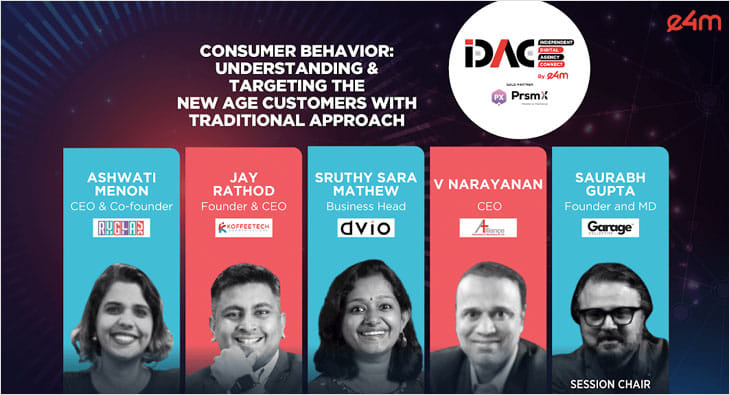

During a dynamic panel session at the e4m iDAC 2024, leaders from the advertising and media industry gathered to discuss how traditional strategies can be reimagined to meet the evolving expectations of today’s customers.
The panel, moderated by Saurabh Gupta, Founder and Managing Director of Garage Collective, featured Ashwati Menon, CEO and Co-founder of Ruglas Media Pvt Ltd; Jay Rathod, Founder & CEO of Koffeetech Communications; Sruthy Sara Mathew, Business Head at DViO Digital; and V Narayanan, CEO of Alliance Advertising.
Setting the tone for the session, Gupta reflected on the transformative nature of the advertising industry over the past two decades. "I have personally witnessed advertising transforming into marketing, getting mixed up as digital branding and then performance. So many things have happened, a lot of potpourri in the last 20 years or two decades, I would say," he remarked.
Despite these changes, Gupta noted that while tools have evolved, the core methods remain largely the same. He then posed the first question to Rathod, asking how the evolution of consumer behaviour has shaped the overall landscape.
Rathod responded by emphasising the drastic shifts in consumer behaviour post-pandemic. "We all will agree that post-pandemic, consumer behaviour has changed drastically in terms of more digital content consumption compared to traditional pieces," he said.
However today’s consumers now expect convenience as a given. "Consumers know they should have convenience before making any decisions because that is by default an understood parameter."
"I feel tradition is still alive, but it’s just wearing different clothes—like TV and print being taken care of by OTTs and other programmatic advertisements," he explained.
Narayanan agreed with Rathod, emphasising that consumer-centric strategies are key to success. "The whole strategy has to be consumer-centric and media-agnostic. I would say there’s no traditional media, no digital media—it’s all about how you are going to engage the consumer better," he said.
According to Narayanan, the cornerstone of any strategy today rests on three pillars: data, insights, and technology. "These are essential to create better engagement and communication that is more relevant to your target audience. That’s where the paradigm shift is happening."
Mathew built on this, stressing the importance of personalised communication. "If our feeds are super personalised, then why not have personalised communication from the brand side? Otherwise, as a brand, you’re not really relevant," she said.
She shared an example from her experience working with Symphony, a cooler brand with over 10,000 distributors. "They had run a television campaign and wanted to amplify the reach. The challenge was, how do we personalise the campaign for each distributor?" Mathew explained that her team used a proprietary tool to create personalised video ads for each distributor, featuring specific details such as the distributor's name and contact information.
Menon chimed in, highlighting how data has revolutionised the way brands work with audience cohorts. "One of the greatest things about the advent of data with digital is that we’ve been able to work with cohorts for a long time now," she said. Menon explained that personalisation has evolved from broad categories like millennials or Gen Z to much more specific segments. "Now you're talking to a small set of Gen Z who have a shared interest in niche topics—they’re all watching the same reel or engaging with the same corner of the internet."
She cited her experience working with Tata AIG on car insurance campaigns, illustrating how different generations approach the same product. "For younger audiences, it’s about explaining the technical details of the car, while for older audiences, it's more about the convenience of buying insurance. Every conversation is different," Menon explained. She concluded by noting that while personalisation at scale has been around for some time, its pace has accelerated. "Now, people are able to do it better and faster."
Intrigued by the discussion on personalisation, Gupta posed a follow-up question to Rathod. "You operate very closely with real estate. So, do we approach the market of real estate also with personalisation at scale, or is it something different?"
Rathod affirmed that personalisation is crucial in real estate due to its hyperlocal nature. "Yes, because real estate as a market is very hyperlocal, right? It’s not a national or regional campaign. It's a very hyperlocal campaign," he explained.
He elaborated on the complexity of real estate marketing, noting that personalisation happens not just by age group but by location. "Your personalisation is at every pin code. It's not just about every age group, but at every pin code the personalisation changes for real estate," he said.
He added that while personalisation is important, scale is equally critical. "It’s not only about just putting a name—that’s not personalisation. It’s the right message at the right time in the right format, at scale, that will make sense to advertisers and the brand," he concluded.
The session then shifted to Gupta acknowledging the complexities of campaign execution and posing a thought-provoking question: "For digital, planning and buying are easy, but execution and managing it over 30, 45, or 60 days is difficult. You can wake up to find Google has burned through your budget. So how do we manage and optimise campaigns in today’s hybrid structure, with young talent and so many tools available?"
Mathew shared her perspective, stating that, irrespective of medium, the core of a campaign remains the strength of the idea. "The effort is still the same, and I am a firm believer that whether it's traditional or digital, it's the power of your idea that drives success," she said. She noted that data has made this process more efficient, allowing insights to be drawn from online behaviour rather than relying solely on focus groups and interviews.
She went on to explain how post-COVID, consumer behaviour has shifted even more towards digital platforms. "There’s a comfort now in using online platforms for shopping and media consumption. So, when it comes to campaign planning, it’s about finding the big idea and determining the most effective touchpoints based on your target audience," she said.
On optimisation, Mathew pointed out the advantages digital platforms offer in tweaking campaigns in real-time. "In digital, you know the numbers, and you can adjust based on audience response. If one cohort isn’t reacting as expected, you can target different demographics, locations, or interests," she added.
The session then saw Menon emphasising the role of human insight alongside technology. "One advantage we have now is the abundance of tools. But even with predictive AI, there's a limit to how much automation can understand the nuances of a hyper-local market like real estate," she explained. "For example, selling in Lower Parel requires an understanding of that area, which no tool can fully grasp. The traditional insight from people who know the product and the market is still invaluable. While tools are evolving, they still can’t replace the expertise of an agency—not even 50%."
Her point reinforced the importance of combining traditional expertise with modern technology to achieve effective campaign management and optimization.
Narayanan responded to the final question about the future of traditional agencies in a digital-first world by emphasising the importance of evolving and leveraging both data and creativity. "You need to use data better, collaborate with technology partners, and create engagement strategies that will drive KPIs based on business outcomes."
He elaborated that traditional agencies are not becoming obsolete, but rather, they are transforming. "There's nothing inherently traditional anymore. For instance, personalisation isn't a new concept. A legacy brand like Amul has been doing it for years through topical ads that respond to current events and cultural moments. Their ads are highly personalised and relevant to the audience. For example, I recently saw an Amul ad for the Bihu festival, where the iconic Amul girl was replaced by a Bihu girl. That’s personalised communication at scale."
He concluded by saying that the future lies in mixing creativity with data and insights. "The key is to use data to learn, forecast, and then create stories that resonate. It’s a blend of art and science—creativity with data. That’s the future of agencies."
Read more news about Marketing News, Advertising News, PR and Corporate Communication News, Digital News, People Movement News
For more updates, be socially connected with us onInstagram, LinkedIn, Twitter, Facebook, YouTube & Google News