Return of legacy brands: Gaming start-up exits prompting a reset in cricket sponsorship?
After a frenzied run courting real-money gaming platforms, Team India and the IPL are now swinging back to legacy brands
 by
by
Published: Dec 9, 2025 9:08 AM | 5 min read
 Follow Us

After nearly half a decade of aggressive spending by fantasy-gaming platforms, crypto exchanges and venture-funded D2C disruptors, India’s cricket sponsorship economy is undergoing a complete reset with different sets of advertisers reclaiming the most coveted real estate in Indian media.
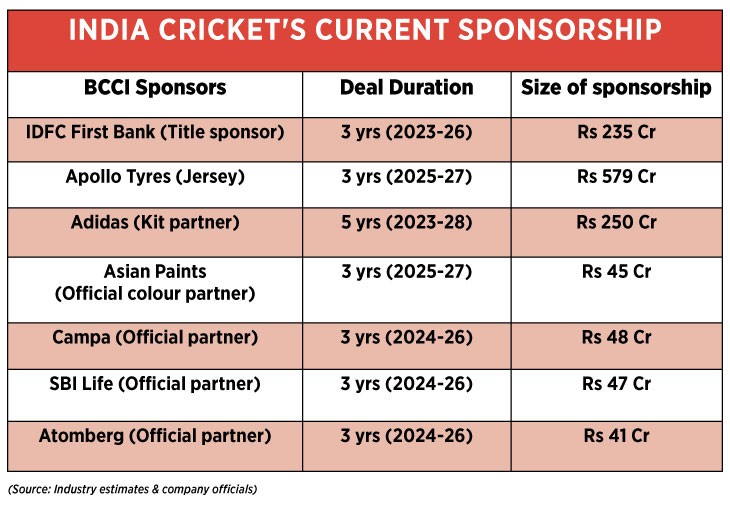
In September, Apollo Tyres became the Lead Sponsor of Team India in a sweeping three-year partnership worth ₹579 crore, replacing Dream11. The deal marks Apollo’s first-ever association with Indian cricket. Weeks later, Asian Paints also debuted in cricket sponsorship and signed a ₹45-crore-per-year deal as BCCI’s Official Colour Partner.
BCCI’s current sponsor roster includes IDFC First Bank (Title sponsor–who replaced the embattled edtech major BYJU’S two years ago, Adidas (kit), Atomberg, SBI Life and Campa (all official partners).
Across franchise cricket, the reset is just as visible. The retreat of fantasy sports platforms has been the biggest catalyst of this shift. Gujarat Titans have replaced Dream11 with Birla Estates as their front-of-jersey partner for IPL 2026, signalling the entry of a legacy real-estate brand into one of the league’s top-tier slots.
“Similar shifts have been underway across both the IPL and WPL in recent months. For the front-of-jersey slot, RCB has signed Nothing (mobile), while CSK and LSG have brought in Etihad Airways and JK Cements respectively. Market intelligence suggests Kings XI Punjab has onboarded another Indian hom-grown brand CP Plus. Kajaria tiles has been associated with RCB - WPL team and continues to extend their association,” said sports marketing expert Arun Rao.
Dream11 (₹358 crore) and My11Circle (₹625 crore) together pumped nearly ₹1,000 crore into BCCI through Team India title rights and IPL partnerships, making them the biggest revenue drivers of the boom phase. Both also backed multiple IPL teams. Their deals ended abruptly after Parliament passed the Promotion and Regulation of Online Gaming Bill, 2025, which bans all fantasy and real-money gaming platforms. Crypto platforms, declared illegal in 2023, had already exited cricket altogether.
A deeper structural shift
The sports sponsorship market is stabilising after years of inflated spending by VC-funded startups, reflecting a fundamental recalibration of the sports advertising economy, industry experts noted.
“It isn’t a temporary correction — it signals a fundamental shift in how advertisers evaluate risk, regulation and ROI in sports marketing,” says Udyan Ghai, Group Head, Marketing, Apollo Tyres.
Ghai notes that categories such as fantasy gaming, crypto, fintech and D2C drove unprecedented sponsorship inflation over the past decade. “With stricter regulations, tighter advertising norms and a sharper investor push for profitability, many of these sectors have pulled back. That vacuum is now being filled by brands with strong balance sheets and long-term marketing horizons.”
Legacy brands understand the sport, the audience and the regulatory environment — and they’re returning because they see reliable, long-term ROI, not volatility.
Karan Yadav, Chief Commercial Officer, JSW Sports, says, “Cricket itself has become more measurable — a key attraction for risk-sensitive legacy advertisers. Real-time analytics, near-instant attribution and granular viewership profiling have transformed cricket from a pure-branding play into a hybrid of mass reach and performance-led marketing. For most marketers today, the conversation has moved from ‘How many impressions can I buy?’ to ‘Which platforms genuinely build trust and credibility over time?’ Cricket remains unmatched on that front.”
Legacy brands have realised that their core consumers are deeply engaged with sports. In a cluttered market, high-investment properties like the IPL and WPL can significantly cut through, Rao noted.
Heavy lifting partners
Brands now prefer multi-year partnerships with deeper integration, rather than short-lived, high-burn deals. Valuations, insiders say, are becoming more grounded — driven by impact, engagement and brand fit, not by who wants to outspend the market.
“Even at the peak of the fantasy gaming wave, those deals contributed only a small single-digit share of revenue for most teams. The heavy lifting has always been done by paints, tyres, footwear, real estate, telecom and BFSI — and these categories are coming back in strength,” Yadav explains.
Deal structures are also shifting beyond just logo placement. More brands now want co-created content, grassroots programmes, community platforms and year-round association — a healthier model for both franchises and advertisers, he noted.
Startup ecosystem booming again
Meanwhile, India’s IPO market has surged to a record Rs 1.77 lakh crore this year driven by several tech-led platforms like Meesho, Physicswallah and Lenscart.
The VC funding scene for the Indian startup ecosystem has also improved this year. According to data compiled by TheKredible, Indian startups raised approximately $6.72 billion in funding during the first half of 2025. This amount included 148 growth and late-stage deals totaling $5.15 billion, along with 404 early-stage deals worth $1.57 billion. Additionally, there were 74 undisclosed deals during this period.
“With so much money rushing in for startups, you never know when the wind could suddenly blow the other way,” a senior industry expert quipped.
Read more news about Marketing News, Advertising News, PR and Corporate Communication News, Digital News, People Movement News
For more updates, be socially connected with us onInstagram, LinkedIn, Twitter, Facebook, YouTube & Google News
