Marketing is changing faster than our operating models: BFSI leaders at Techmagnate-e4m RT
Senior marketing leaders from India’s BFSI sector discuss AI, rising acquisition costs and evolving search behaviour at a Mumbai roundtable hosted by Techmagnate and e4m
 by
by
Published: Mar 6, 2026 11:11 AM | 6 min read
 Follow Us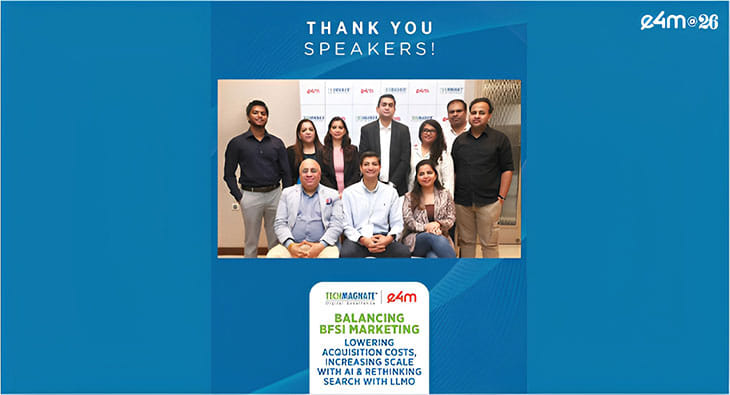

As digital transformation accelerates across industries, marketing leaders are grappling with a central challenge: change is happening faster than their operating models can keep up. This formed the core theme of a closed-door roundtable titled “Marketing Is Changing Faster than Our Operating Models”, hosted in Mumbai by Techmagnate in association with e4m.
Chaired by Sarvesh Bagla, CEO of Techmagnate, the session brought together senior marketing and business leaders from across the banking, broking, insurance, mutual funds and fintech ecosystem to examine how acquisition strategies, AI adoption and search behaviour are reshaping the marketing function in financial services.
Among the participants were Shekhar Gaud, Deputy Vice President - Leading SEO & Performance Marketing at Anand Rathi Share and Stock Brokers Ltd; Khushboo Sanghvi, Assistant Vice President – Brand Marketing, Digital & Content at Axis Mutual Fund; Harshita Hemnani, DVP - Marketing at Bharti AXA Life Insurance; Mohd Juved Khan, AGM - Product, Growth & Digital Transformation at IDBI Bank; Sunita M, DVP - Digital & Performance Marketing at IndiaFirst Life Insurance; Rahul Singh, AVP - Marketing & Partnerships at Mahindra Insurance Brokers Limited; Varad Laghate, DVP – Digital Marketing at Kotak International; and Sneha Batreja, Marketing Director & Head - Growth & Performance Marketing at PayU.
The discussion opened with a fundamental question: how much of business revenue in financial services is truly digital today? While most participants acknowledged that digital now drives a significant portion of leads and customer engagement, the revenue mix remains nuanced. In broking, retail trading is largely digital, but high-value and advisory-led segments still depend heavily on physical channels. Mutual funds and life insurance companies reported growing digital contributions, yet traditional distribution networks continue to dominate ticket sizes and investor trust.
Several leaders pointed out that digital influence extends far beyond final transaction metrics. Customers increasingly begin their journeys online, conducting research on mobile devices before engaging through offline channels. Even when the conversion occurs in a branch or through an advisor, digital touchpoints often shape the decision-making process.
Rising acquisition costs emerged as another critical concern. Participants noted that cost per lead in BFSI categories has surged over the past few years, especially in competitive verticals like insurance and broking. However, many leaders agreed that CPL is no longer the most meaningful metric. Instead, marketers are tracking cost per activation, cost per funded account, or cost per first transaction, focusing on profitability and lifetime value rather than superficial lead numbers.
Balancing paid and organic channels has therefore become a strategic necessity. While paid media remains indispensable for scale and speed, organic search is increasingly viewed as a long-term investment that supports sustainable growth. Leaders acknowledged that ignoring paid channels is not viable in highly competitive categories, but over-reliance without strengthening organic presence can distort unit economics.
The conversation then shifted to conversion rate optimisation and funnel efficiency. Participants shared that traffic alone is insufficient if internal systems are not designed to convert intent effectively. Several organisations are investing in assisted journeys, automation triggers and app-first experiences to reduce drop-offs. In regulated sectors like insurance and securities, compliance and documentation requirements add complexity, making seamless digital journeys harder to execute but even more critical to prioritise.
Artificial intelligence was a central thread throughout the roundtable. Sarvesh Bagla highlighted how AI-driven workflows are transforming SEO, content production and campaign optimisation at scale. Rather than using generative AI for one-off outputs, organisations are building structured workflows that connect keyword research, content audits, compliance checks and publishing processes. According to Bagla, such agentic AI models can significantly reduce turnaround times while maintaining brand and regulatory consistency.
However, the room also expressed caution. Participants emphasised that AI-generated content must be aligned with brand guidelines and regulatory frameworks, especially in BFSI. Blindly scaling content without strategic oversight can dilute brand voice and risk compliance breaches. Most agreed that AI should augment teams rather than replace human expertise, particularly in high-stakes financial communication.
The evolving nature of search was another focal point. With the rise of AI overviews and large language models, zero-click searches are increasing, leading to declining click-through rates on traditional search results. Leaders observed that while overall search volumes remain strong, the way users interact with information is changing. Consumers are increasingly seeking direct answers rather than navigating multiple websites.
This shift raises important questions around measurement. Traditional attribution models may fail to capture the influence of AI-powered search recommendations on downstream conversions. Participants discussed the need to rethink KPIs, moving beyond clicks to metrics such as share of voice, brand visibility and mentions within AI-driven ecosystems.
Interestingly, data shared during the session suggested that AI search does not necessarily replace Google search but may expand overall search behaviour. Users often consult AI tools for research and subsequently validate information through traditional search engines before making final decisions. This indicates coexistence rather than substitution, reinforcing the need for brands to optimise across both environments.
Participants agreed that foundational SEO remains critical even in the AI era. Strong technical architecture, updated content, structured data and authoritative brand mentions continue to influence visibility in both traditional search and AI-generated responses. Additionally, third-party credibility (through media mentions, forums and authoritative publications) is gaining importance as AI systems frequently reference such sources.
As the session progressed, a broader consensus emerged: marketing teams must evolve structurally, not just tactically. Operating models built around siloed teams and quarterly campaigns struggle to keep pace with real-time optimisation demands, AI-driven workflows and shifting consumer expectations. Cross-functional integration between marketing, product, compliance and technology teams is becoming indispensable.
Closing the discussion, Bagla emphasised that the future of marketing in BFSI will belong to organisations that combine agility with accountability. Rapid experimentation must coexist with regulatory discipline. AI adoption must be paired with governance. And performance marketing must integrate seamlessly with brand-building efforts.
The discussion underscored a shared industry reality: marketing transformation is no longer incremental. As digital channels deepen their influence, AI reshapes discovery, and acquisition costs climb, financial services brands are being compelled to redesign not just campaigns but entire operating frameworks.
If the evening’s discussion made one thing clear, it is that marketing is indeed changing faster than most operating models were built to handle. However, those who adapt first will define the next phase of competitive advantage.
Read more news about Marketing News, Advertising News, PR and Corporate Communication News, Digital News, People Movement News
For more updates, be socially connected with us onInstagram, LinkedIn, Twitter, Facebook, YouTube & Google News