How Indian brands are winning with storytelling, speed and trust
A panel at the e4m D2C Revolution Summit explored how fashion and beauty brands in India are building loyalty in a cluttered market
 by
by
Published: Sep 8, 2025 2:27 PM | 7 min read
 Follow Us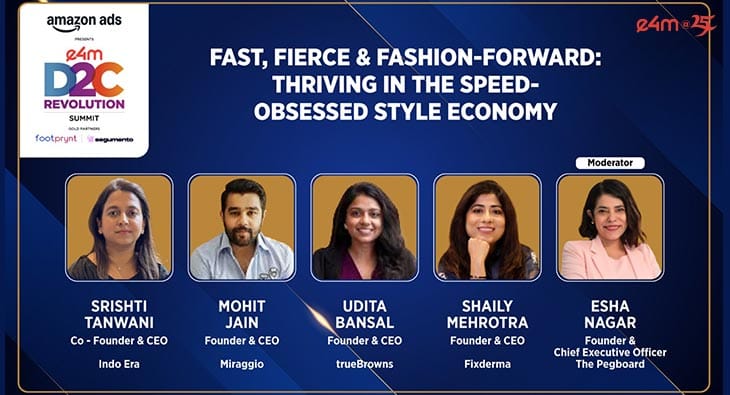

At the e4m D2C Revolution Summit, the session “Fast, Fierce & Fashion-Forward: Thriving in the Speed-Obsessed Style Economy” brought together brand leaders to explore how creativity and speed intersect in the fashion and beauty business.
Moderated by Esha Nagar, Founder & CEO of The Pegboard, the panel featured insights from Shaily Mehrotra, Founder & CEO, Fixderma; Udita Bansal, Founder & CEO, trueBrowns; Mohit Jain, Founder & CEO, Miraggio; and Srishti Tanwani, Co-founder & CEO, Indo Era.
Setting the tone, Nagar opened with the question of how brands are navigating the tension between design and speed.
Mehrotra reflected on Fixderma’s journey from clinics to consumers. “We are a skincare brand, a 15-year-old company that started in 2010. While most brands today are moving from e-commerce to offline, we had the reverse journey: from offline to online,” she said. Fixderma onboarded marketplaces only in 2020, having previously sold through dermatologists’ prescriptions.
Speaking of speed, she admitted that in earlier years, the brand had attempted to chase trends with new product variants. “But when you look at numbers, what really sells is what you’ve always been selling. The pink, blue, yellow products with different fragrances only work for a short time,” she noted. Mehrotra emphasised that chasing every new trend was unsustainable. “It’s better to stick to your core values and build scale. You can create a ₹100-crore brand by focusing on one strong product,” she said, adding that once scale is achieved, branding, supply chain, and even raw material sourcing fall into place.
She cautioned against spreading too thin in pursuit of novelty. “You may decide to keep 10 or 15 per cent of your range for new designs, but you should not run behind every trend,” she remarked.
Bansal echoed this perspective. “Your true core product is always your best seller. We have something that we launched five years back, which continues to top the charts every time we bring it back,” she said. In the fashion industry, she explained, design is categorised into core and non-core, with the former requiring a very agile supply chain. “That ensures our best sellers reach new customers faster and deliver high conversions,” she said.
At the same time, she acknowledged the need to keep the brand fresh. “Fashion can get monotonous if the consumer sees the same thing repeatedly. I wear trueBrowns myself, and if I start feeling fatigue, that’s a signal. It pushes us to amp up our product,” she said. For this, the brand relies heavily on social media. “Socials tell us what’s coming next. You follow the right pages, the right people, and you know what’s going to come in. That doesn’t need to be 80 per cent of your range, but a 20 per cent drop bridges the gap between creativity and speed,” she explained.
Jain, who created Miraggio to disrupt the handbag market, spoke about the challenge of building a new luxury category in a price-sensitive market. “The gap was very clear. The market was monotonous, filled with commodity-based products. In apparel, we saw frequent buying, but in bags, no large brand had been created,” he said.
Miraggio follows a drop culture, launching collections two or three times a month rather than by season. “In India, no one buys seasons. Women buy bags based on whether they work with 10 outfits, not by whether it’s winter or summer,” Jain said. This, he argued, allows the brand to be more granular and agile. “Speed gets captured there. You must keep an eye on social chatter, international influencers, Myntra searches, Amazon trends, even Google searches,” he said, citing the rise of backpacks and gym bags as an example.
For him, speed was as much about operations as design. “If design is compromised, the brand won’t be made. If speed is compromised, the brand won’t be made,” he said. To achieve this, Miraggio has invested in regional warehouses, tech-led inventory allocation, and marketplace fulfilment. He is now considering shifting design operations to China, where manufacturing takes place. “From here, designing takes 20–25 days. If I move my design team there, I can bring it down to seven,” he explained.
Jain also linked speed to the process of identifying core products. “When the brand is in its first three to five years, the core is made. Yesterday we launched a new collection, and already two pieces have been identified as core. The faster you launch, the faster you find failures and winners, and that’s how your core business is built,” he said.
Next in the panel, Tanwani underlined that IndoEra was built with the everyday lives of Indian women in mind.
“For us it was very clear that we are here for customers, especially Indian customers. A woman’s journey through the day, from home to work to social gatherings, requires clothing that is comfortable, stylish, and suitable for all occasions. This was the industry’s major gap, and that’s how we were born,” she said.
She added that keeping pace with fast-changing fashion trends has been core to the brand’s growth. IndoEra today serves over 45,000 pin codes and introduces close to 200 new designs each month. “With the help of AI, we’ve reduced our manufacturing cycle to 21 days, from design to production, allowing us to match the speed the market demands,” she noted.
When the discussion turned to brand loyalty in a crowded women’s fashion market, Bansal stressed that the answer lay in storytelling and consistency.
“We are not making rockets here; anyone can copy a product tomorrow. What consumers value is the brand story, i.e., why we are doing this, who is building it. That’s what builds community, and community is the essence of brand building,” she said, adding that loyalty stems from consumers feeling part of a larger conversation rather than just buying a product.
Tanwani echoed this, pointing out that IndoEra’s growth was driven almost entirely by organic pull. The brand, she said, achieved its first ₹300 crore without marketing spends.
“On Amazon, our brand keyword ranks in the top five for ethnic wear. A repeat purchase rate of 55% in an unorganised market shows the strength of the community we have built,” she said.
Mehrotra, speaking from the skincare perspective, argued that brand loyalty ultimately rests on product trust.
“Product comes first, then comes everything. No fluff is going to work,” she said. Starting with dermatologists gave her company credibility and helped create a base of loyal consumers. She explained that this foundation made expansion smoother, from clinics to e-commerce to now 40,000–50,000 retail points across India.
Jain brought in the lens of rising aspirations across smaller towns and cities. Internet penetration, he noted, has levelled exposure across geographies.
“Tier 2 and 3 audiences now see the same celebrities and influencers as metros. Consumers are becoming aspirational and experimental. If there’s a great product with value, they’re willing to pay; whether it’s for bags, skincare, or even premium fans,” he said.
He added that this shift signals opportunity across categories. India’s appetite for mass-premium products, he argued, is only going to grow as consumers look for brands with authenticity and a strong story.
Read more news about Marketing News, Advertising News, PR and Corporate Communication News, Digital News, People Movement News
For more updates, be socially connected with us onInstagram, LinkedIn, Twitter, Facebook, YouTube & Google News