The evolving Indian buyer: Value, aspiration and influence
At the e4m D2C Revolution Summit, brand leaders explored how influencers shape consumer decisions, the evolving role of vernacular content, and why AI is no longer optional but essential for brands
 by
by
Published: Sep 8, 2025 2:09 PM | 8 min read
 Follow Us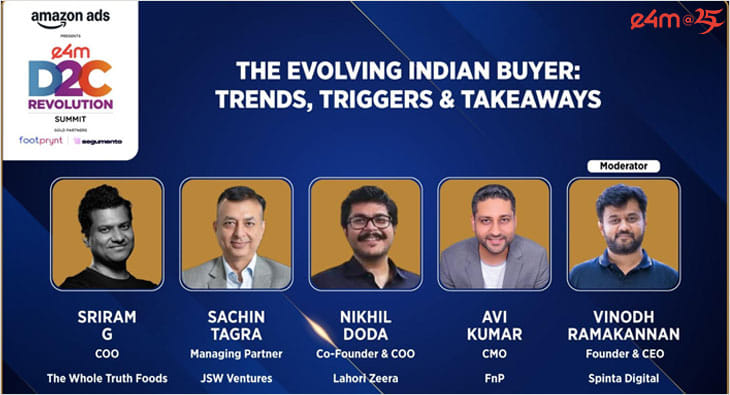

Indian consumers may be value-driven at heart, but their growing appetite for premium experiences is reshaping brand strategies. At the e4m D2C Revolution Summit, industry leaders came together to decode these shifting triggers in a session titled “The Evolving Indian Buyer: Trends, Triggers & Takeaways.” The discussion, moderated by Vinodh Ramakannan, Founder & CEO, Spinta Digital, featured insights from Avi Kumar, CMO, FNP; Nikhil Doda, Co-Founder & COO, Lahori Zeera; and Sachin Tagra, Managing Partner, JSW Ventures.
Setting the tone, Ramakannan highlighted the paradox in Indian buying behaviour. “With many of our clients, we see Indian buyers fiercely value-conscious when it comes to daily staples. But the very same audience will pay five times more for coffee, skincare or phones that give them status. They are looking at aspiration,” he said, asking panellists what drives this shift from value to premium.
Opening the discussion, Kumar stressed that value sits at the heart of every purchase, regardless of the ticket size. “India is a very unique market, and it is always a value-conscious market. Whether you’re buying a product worth ₹399 or splurging ₹3.99 lakh on a gift, you want value on both sides,” he said.
He explained that at FNP, gifting spans both mandatory, customary occasions and impact-driven gestures where “money is no bar.” In either case, Kumar emphasised, customers expect value for money, whether it is an entry-level bouquet or an elaborate floral arrangement worth over three lakh. “The minimum quality of service has to be maintained to delight the customer. At both ends, value needs to be there,” he said.
Doda built on this point by linking affordability with aspiration. “As Indians, we are very value-conscious,” he said. “But from our journey, we’ve learnt that if you add aspiration to affordability, you can do magic. Even with small purchases, people want to perceive higher value in every decision they make.”
Tagra noted that this pattern holds true across categories, from low-cost essentials to high-ticket items. “We have businesses that sell products worth ₹50 on Purplle, our second-largest beauty commerce platform, to Homeland, which sells kitchen and home furnishing products at around ₹10 lakh,” he said. “Everybody across the price points keeps looking for value.”
However, he added that social media is increasingly influencing where consumers choose to splurge. “Consumers are ready to spend on products and services they can talk about on social media. It’s driving a big change,” he said.
Citing JSW Ventures’ investments, Tagra explained how premiumisation is also reaching smaller towns. “We are investors in CureSkin, an AI dermatology platform where the minimum product is worth ₹1,700. Interestingly, 80% of our sales come from tier-two and below,” he said. The willingness to spend, he added, stems from limited access to dermatologists and specialised products in smaller markets. “Even in tier-three and tier-four India, there is a propensity to spend, provided the right value is given,” he said. Payment access through UPI and cash on delivery, he noted, has further enabled this trend.
The discussion then shifted to influencer marketing and its role in shaping consumer choices. Kumar described it as central to brand discovery, consideration and even purchase. “The Shah Rukh of Bollywood and the Shah Rukh of Kanpur are both influencers, influencing at different levels,” he said. “Gone are those days when one huge celebrity influenced everybody else’s purchasing behaviour. Today, you want to hear from people like you and me. Real voices are winning over paid voices.” He pointed out that paid influencer ads often see lower engagement than organic content, making authenticity the decisive factor.
He also stressed that the choice of influencer must be aligned with brand objectives. “If it is just awareness, then you choose an influencer with a large reach. If it is ‘consideration’, you look at how well they fit with the brand. And if it is ‘purchase’, then you need a focused group of people who not only see the content but believe in what the influencer is saying,” Kumar explained. “The influencer landscape is fast evolving and will continue to gain importance.”
Doda added that influencer marketing allows brands to adapt communication to India’s diverse audience. “One standard communication might not cut it for the brand. India is a heterogeneous country,” he said. “Influencer marketing and user-generated content, organic or sponsored, give you leverage to be local, to be more relatable to specific cohorts. It’s a wonderful way to leverage the trust an influencer has built with his audience and upsell your product.”
Tagra highlighted the rising weight of influencer spends in marketing. “Out of four campaigns, generally three have influencer budgets in them,” he said. “Ten years ago, the amount was hardly anything. Now, in our portfolio, some brands spend as high as 25% of their marketing budget on influencers.”
He noted that around 65% of purchasing behaviour is determined by some form of social media influence. “If that is the kind of revenue being impacted, marketers need to be present there,” he said, pointing to user-generated and brand-sponsored content alike. Within JSW Ventures’ portfolio, Purplle ranks as the third-largest content creator for beauty in India, while CureSkin spends nearly 30–35% of its marketing budget on influencers. “That’s the kind of impact they have on our business,” he said.
The conversation then shifted to vernacular content. Citing statistics that 93% of content consumed in India is in regional languages, the moderator asked if campaigns needed to adapt across geographies. Kumar argued that the lines between regions have blurred. “Just don’t look at customers based on regions. Those lines have dissolved to a large extent,” he said.
Using the example of Labubu cakes trending across metros and small towns alike, he explained that psychographics often matter more than geography. “Information today is democratic. OTT, social media, the internet and AI have put information in everyone’s hands. It’s about the choice the customer wants to make, and you need to understand that behaviour. Then you connect in the language they like the most.”
Doda described the balance brands must strike between standardised messaging and hyper-local targeting. “It’s a very thin-line decision for a brand; either to standardise or get that edge of dissecting data, which is now possible,” he said. With granular data available by region, age or cohort, brands could build business sustainably through focused marketing. “For us, it works both ways. Largely, we keep communication standardised. But for a few festivals celebrated in particular regions, we channelise our marketing locally,” he explained.
Artificial intelligence was the next area of discussion, with panellists weighing in on its role in marketing and customer journeys.
Kumar was emphatic: “I don’t think we have a choice now to adopt or not. Either adopt or perish.” He described AI as “unlimited interns” across departments with brainstorming, ideating and executing at scale. “It’s like a partner you can co-create with, across operations, HR, marketing, design, copy and media planning. You can do the analysis much faster, gain insights quicker, and even drive execution through AI pilots,” he said.
Kumar added that AI had democratised brand-building. “Earlier, you needed heavy budgets to create a big brand film. Now, one person sitting at home can create an entire brand film,” he said, citing FNP's AI-driven campaign Rakhi Banai Khas, created by just two team members.
“You can be nimble and reach audiences with the same effectiveness, sometimes even more, than with millions of dollars.”
Tagra echoed the inevitability of adoption. “There is no choice but to adapt AI, though businesses are doing it for different reasons,” he said. At CureSkin, AI identifies skin conditions; at Homeline, it reduces time-to-market with better designs; at Purplle, it helps identify the right influencers.
He also shared an anecdote of a CMO who presented three AI-generated ad films to his board without disclosure. “There was no consensus. At the end, he revealed that all three were AI-driven,” Tagra said. “Even the board couldn’t identify which was AI and which was conventional. That’s the way AI is going to play a role in our lives.”
As the discussion turned to Gen Z, the moderator noted their inquisitiveness and reliance on search before making purchase decisions. Doda stressed the importance of presence across touchpoints. “For a brand, it is very important to be available where your consumer is, be it online or offline,” he said. While Lahori Zeera continues to rely on kirana stores and traditional outlets, he acknowledged the rapid rise of quick commerce. “It is relevant for us to be there as well. Being present at the point of sales is unavoidable. It’s not a choice a brand has,” he concluded.
Read more news about Marketing News, Advertising News, PR and Corporate Communication News, Digital News, People Movement News
For more updates, be socially connected with us onInstagram, LinkedIn, Twitter, Facebook, YouTube & Google News