Fashion’s Super Bowl: How the Met Gala became a $500 million marketing machine
Met Gala has evolved into an unsponsored advertising arena — a cultural moment where luxury labels, tech billionaires, meme admins, and fast-food chains compete for attention
 by
by
Published: May 9, 2026 9:01 AM | 7 min read
 Follow Us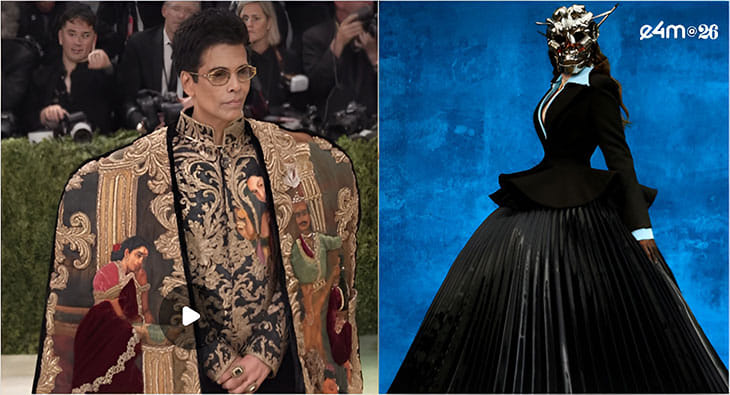

- The Met Gala has evolved into a major unsponsored advertising event, generating significant Earned Media Value (EMV) for brands, with the 2026 edition reportedly generating nearly $250 million in EMV within hours of its start.
- While luxury fashion houses still play a key role, many brands outside the traditional fashion sphere leveraged the event for real-time meme marketing, capitalizing on social media's instant reaction culture.
- Bad Bunny's choice to wear a custom Zara outfit instead of a luxury brand highlighted a shift in cultural impact, suggesting that fast fashion can also generate significant visibility and engagement.
- The presence of tech figures at the 2026 Met Gala marked a shift towards a broader cultural intersection of fashion, technology, and internet culture, while India's representation underscored ongoing discussions about cultural ownership and appropriation in the fashion industry.
Every first Monday in May, a few hundred celebrities walk up the steps of the Metropolitan Museum of Art dressed in outfits worth more than luxury cars. The rest of the world watches through Instagram Reels, TikToks, meme pages, livestreams, and reaction threads — and brands have learned how to turn that attention into one of the most valuable marketing opportunities on the internet.
The Met Gala is no longer just fashion’s biggest night. It has quietly evolved into the world’s largest unsponsored advertising arena — a cultural moment where luxury labels, tech billionaires, meme admins, and fast-food chains all compete for the same thing: attention.
In 2025, the Gala generated a staggering $552 million in Earned Media Value (EMV), according to influencer analytics platform Lefty. This year’s 2026 edition, themed “Costume Art,” reportedly generated nearly $250 million in EMV across a tracked reach of more than 523 million users within hours of the carpet opening.
The scale is no longer comparable to a fashion event. It resembles the Super Bowl — except nobody officially owns the advertising inventory.
From Couture to Content Strategy
For decades, the Met Gala operated as a prestige machine for luxury fashion houses. Brands like Louis Vuitton, Chanel, Prada, Dior, and Versace invested months into designing custom looks for celebrities, knowing a single red carpet appearance could dominate fashion coverage globally.
That model still works.
This year, LISA generated nearly $19.7 million in EMV from her custom Robert Wun appearance, while the designer himself reportedly crossed $31 million in brand EMV from the night. Kylie Jenner added another major spike for Schiaparelli, while Jisoo and Sabrina Carpenter helped Dior dominate social conversation through sheer fandom power.
Fashion houses still understand the equation: celebrity plus craftsmanship equals visibility.
But the real transformation of the Met Gala is happening outside the museum walls.
Meme Economy Has Entered Luxury Fashion
The most disruptive brands at the Met Gala in 2026 weren’t necessarily the ones dressing celebrities. Many were never invited at all.
More than 50 brands reportedly used the Gala as a real-time meme marketing opportunity this year — reacting to outfits, creating joke posts, inserting themselves into trending conversations, and capitalizing on the internet’s obsession with commentary culture.
For marketers, the Met Gala has become a free attention event: millions of people watching simultaneously, reacting instantly, and rewarding the fastest brands with massive organic reach.
The playbook traces back to Oreo’s legendary “You can still dunk in the dark” tweet during the 2013 Super Bowl blackout — a moment that proved reactive internet humor could outperform expensive ad placements.
Today, that strategy has become standard operating procedure.
Fast-food brands compared avant-garde outfits to menu items. Fintech companies joked about luxury excess. Lifestyle brands turned celebrity fashion into meme templates within minutes. Some even riffed on the internet discourse surrounding Jeff Bezos and Lauren Sánchez’s involvement with the Gala, tapping into conversations around wealth, power, and exclusivity without explicitly naming them.
The internet did the amplification for free.
When Bad Bunny Wore Zara
Perhaps the most unexpected fashion-business moment of the night came from Bad Bunny.
Instead of appearing in a traditional luxury label, the global star arrived in a custom look by Zara — complete with prosthetics, grey hair, and a cane that transformed him into an older version of himself.
The move instantly went viral.
In a space traditionally dominated by heritage couture houses, the choice of Zara felt deliberate: a statement that cultural impact no longer belongs exclusively to luxury brands. The fast-fashion retailer reportedly generated over $1 million in EMV from the appearance alone, proving that internet conversation often matters more than exclusivity.
Luxury fashion may still own prestige. But social media increasingly rewards surprise.
Welcome to the ‘Tech Gala’
The 2026 Met Gala also revealed another shift: Silicon Valley has officially entered fashion’s front row.
With Bezos involved, and figures like Sergey Brin, Adam Mosseri, and executives connected to Meta and OpenAI attending or hosting tables, social media quickly renamed this year’s event the ‘Tech Gala’.
That evolution matters because it changes what the Met Gala represents.
The event is no longer purely about luxury fashion houses showcasing craftsmanship. It is becoming a broader cultural power arena where entertainment, technology, fashion, internet culture, and consumer brands all intersect in real time.
The modern Met Gala isn’t just a red carpet anymore. It is a live internet ecosystem.
India’s Fashion Moment — And the Debate Around Cultural Ownership
Amid all the meme marketing and celebrity spectacle, India’s presence at the 2026 Met Gala carried a deeper cultural significance.
Isha Ambani, Manish Malhotra, and Karan Johar represented Indian fashion and craftsmanship on one of the world’s most watched cultural stages. Their appearances highlighted embroidery traditions, handwoven textiles, intricate silhouettes, and artisanal detailing deeply rooted in Indian design heritage.
But their visibility also arrived during a growing global conversation around cultural appropriation in fashion.
In recent years, luxury brands have repeatedly faced criticism online for repackaging South Asian aesthetics without acknowledging their origins — whether through expensive “Scandinavian scarves” resembling the Indian dupatta, or luxury reinterpretations of Kolhapuri chappals presented as global runway discoveries.
The internet has become increasingly vocal about this disconnect: Indian craftsmanship is often referenced, replicated, or commercialized internationally, while the original cultural context gets diluted or erased.
That is why India’s presence at this year’s Met Gala felt larger than celebrity attendance. It symbolised a broader shift in global fashion power — one where Indian craftsmanship is no longer merely inspiration for luxury houses, but increasingly recognized as a cultural force in its own right.
At a time when the fashion industry is being pushed to answer harder questions around authorship and credit, representation itself becomes a statement.
Numbers Behind Meme Marketing
The business logic behind this shift is hard to ignore.
According to data from Pulse Advertising, meme-based campaigns generate significantly higher organic engagement than traditional branded posts. Industry reports suggest memes can outperform standard campaign graphics by massive margins across Instagram and Facebook, while click-through rates often exceed those of email campaigns.
Brands like Duolingo have already built entire social identities around this strategy. Their chaotic green owl mascot became one of the internet’s most recognizable brand personalities precisely because it behaves less like a corporation and more like a meme account.
The lesson for marketers is simple: internet fluency now matters as much as media budgets.
At the Met Gala, the winning brands are not always the ones spending the most money. Often, they are the ones reacting the fastest.
Fashion’s Biggest Night Is Now Everyone’s Playground
The Met Gala’s transformation into a half-billion-dollar earned media phenomenon reveals something bigger about modern marketing.
Luxury fashion houses still dominate prestige and craftsmanship. Designers like Robert Wun proved that artistry can still command enormous global attention.
But the broader cultural conversation — the memes, the TikTok breakdowns, the reaction posts, the satire, the discourse — is increasingly shaped by brands that never stepped onto the carpet at all.
The first Monday in May is no longer just fashion’s biggest night.
It is the internet’s biggest open-call marketing brief.
And increasingly, the brands that understand online culture best are the ones walking away with the most attention.
Read more news about Marketing News, Advertising News, PR and Corporate Communication News, Digital News, People Movement News
For more updates, be socially connected with us onInstagram, LinkedIn, Twitter, Facebook, YouTube & Google News