Experts decode scale, speed & the fight to stay human as AI transforms retail
The panel discussion at e4m RetailEX Conference 2026 made it evident that AI is pushing retail marketing into overdrive, but not without consequences
 by
by
Published: Apr 17, 2026 11:36 AM | 11 min read
 Follow Us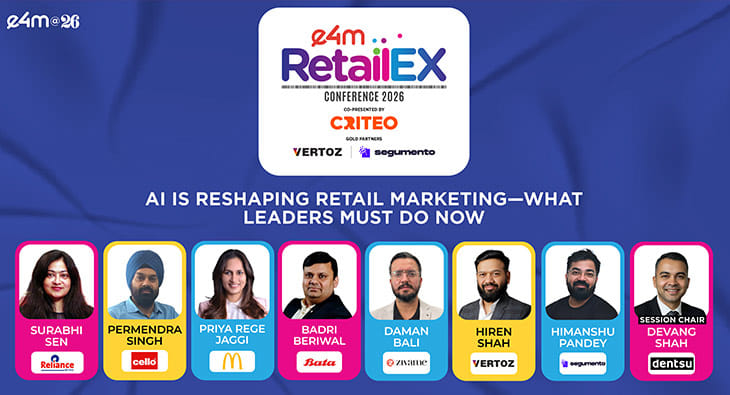

At the e4m RetailEX Conference 2026, marketing and business leaders gathered to examine how artificial intelligence is transforming retail, from consumer personalisation to internal culture change, and where the human touch must hold its ground.
Moderated by Devang Shah, Chief Business Officer – Consumer, Industrials & Commerce, dentsu India, the session brought together Surabhi Sen, Chief Marketing Officer, Reliance Retail Supermarkets & Hypermarkets; Permendra Singh, Chief Business Officer, Cello World; Priya Rege Jaggi, Head of Marketing, McDonald's; Badri Beriwal, Chief Strategy & Business Development Officer, Bata India; Daman Bali, Head – Brand Marketing, Zivame; Hiren Shah, Founder & Managing Director, Vertoz; and Himanshu Pandey, Founder and CEO, Segumento.
Where AI Becomes Essential at the Reliance Scale
Kicking off the discussion, Devang Shah turned to Sen, asking how a business of Reliance Retail's scale was making sense of AI. For Sen, the answer began with data. "We look at AI as a massive data aggregation and integration platform from which come insights, plans, and programmes," she said. With thousands of stores generating actual behavioural data, not just stated or intent-driven data, the challenge is building a unified view of the customer. "How do you really understand a person and then serve that customer?" she asked.
Beyond personalisation at the individual level, Sen pointed out that the same intelligence benefits brand partners who sell through Reliance's stores. AI helps them understand where they are performing, where they are not, and why. AI connects dots that would otherwise be humanly impossible to join across such volumes of data.
She also described a more immediate, real-time use case. "If IPL is in season and we know you are watching, we can prompt you on JioMart to order a snack right then. AI is watching on your behalf and doing the marketing on your behalf."
On the operational side, she added, AI is equally critical in managing inventory, demand forecasting, and ensuring that both the physical and online customers are served seamlessly. "And specifically for marketing, if we are opening a new store in a city my team has never heard of, AI helps us read that consumer and build a marketing plan, because the depth of India can be quite unnerving."
Data Usability, Not Data Availability
The conversation moved to Pandey, who was asked how companies can remain compliant with frameworks such as the Digital Personal Data Protection (DPDP) Act while still harnessing the power of consumer data. As a data processor, Pandey explained, Segumento operates within a chain where data consent has already been established by the data fiduciaries. "We are SOC 2 Type 2 compliant and GDPR compliant, given our presence across India, Indonesia, the UAE, and Saudi Arabia," he said.
But compliance, he noted, is only one half of the challenge. "The primary problem we see in India is not data availability but data usability." Teams within organisations operate in silos, be it online, offline, app-based, or events. They each generate data that never speaks to the others. "The moment this data is consolidated and consents are in place, clients are able to solve for their purpose altogether."
Build or Buy the AI Stack
Devang Shah then put a question to Hiren Shah asking if marketers should build their own AI stack or simply buy what is available. "Brands can definitely create their own stack, work on top of internally built LLMs (Large Language Models), and use their existing data," he said, noting the particular value of integrating CRM (Customer Relationship Management) with media campaigns. "The idea is to build your campaign based on the CRM, not to create a campaign and then push it into the CRM."
What has genuinely changed, he argued, is the ability to optimise in real time. "Earlier, we created a campaign and then optimised it. Now, AI allows us to optimise a campaign even as it goes live." That said, he was pragmatic about reinvention. "Why reinvent the wheel when it is already invented? There are plenty of stacks available to leverage."
He did, however, caution about data hygiene recalling a 2018 campaign where a user on social media was served an ad stating their exact insurance premium due. "There was no privacy framework in place then. Things are maturing, thankfully, and we have to take care of how we work with data."
Changing Organisational Culture
The panel then turned inward, to the harder question of how legacy organisations adapt culturally to AI adoption. Singh of Cello World, a business rooted in decades of manufacturing and distribution, was candid about where they stand. "Legendary brands use technology rather than being used by it. The question is always how you make what is already working far more effective."
Cello began its AI journey with marketing, where 15 to 20 per cent of content is now AI-generated. "Any function that is slightly front-end can adapt faster and that is where we are beginning."
He was equally honest about where the integration was yet to deepen. "When we start adapting AI to forecasting at the demand-supply level, that is when we will say true integration has happened. Right now, we are at the periphery."
Beriwal of Bata India described a different set of internal voices that typically slow adoption, naming things like finance questioning additional costs on top of existing SaaS spends, legal concerns about exposure, and functional teams wondering whether AI output matches human quality.
Bata's response has been threefold in this regard, i.e. drive it from the top, create a review council for AI proposals, and crucially, hold an open-door leadership day. "We brought in vendors and partners for all employees across all levels at the head office, by function, to understand what is actually possible," he said. From that came agreed pilots, and an unwritten rule that any function wanting to try a pilot gets to, no questions asked. "From those successes comes transformation."
When asked whether the resistance was more about awareness or human reluctance, Beriwal put a number to it. "It is 80% awareness. This is similar to when social media was just emerging, agencies and brand managers were learning together, and the world was changing every three months. The same thing is happening now." The key is the snowball effect. Once people realise what AI can do for their specific function, they want in. "Enable them with a proof-of-concept budget, the right legal framework, and finance backing and the resistance falls away."
Bali of Zivame offered a more nuanced take, arguing that human resistance is itself a significant deterrent, and not simply a product of ignorance. He described a real situation within his design team where designers who already conduct extensive research on trends and forecasts are now required to additionally interact with an AI model to validate their decisions. "It adds a layer of work in certain departments, and that is something I have personally seen," he said. "I have already done all the research so should I just proceed based on what the trends have already shown me, or must I do this as well? That is where the resistance comes from. It is a mix of both."
Where the Human Touch Cannot Be Automated
The moderator pressed Jaggi on McDonald's, a brand synonymous with standardisation, on where it draws the line with AI. For her, the human touch is the beauty of McDonald's. “A large part of the consumer experience is the service they receive, and that cannot be automated." In a category as emotionally charged as food routing a consumer complaint through an agentic AI path would only create friction. "Those parts we are not touching."
Where AI has delivered clear wins, she said, is in performance marketing and content generation. "Earlier, if I had ten use cases, I could perhaps budget for five or six. Today, I do not have to make that choice." Speed and scale in content creation, particularly where it is rules-based, have improved markedly. However, McDonald's works with what it calls "fan truths" which is basically content capturing what a fan would say to another fan if the brand were not in the room. "Those are very human moments that can only happen at a McDonald's. When I put them into AI, it just looks too fake, too perfect, and impersonal. The human touch in service and in storytelling will be kept real for as long as possible, because you simply cannot get that anywhere else."
Bali, in turn, addressed the specific sensitivities of her category. "For an industry like mine, AI still has a lot more to offer me than it already has," he said. The fundamental challenge is with imagery. AI remains restrictive when it comes to lingerie visuals.
"Zivame was built on the truth of making an intimate, relatable, everyday product out of something that was over-sexualised. We have come a long way in making that happen. When you move to AI-generated imagery, you risk losing that human touch all over again." The category's biggest current problem, he noted, is hyper-realism where images that look too polished, too perfect, causing teams to pull back at the point of launch.
Yet the returns are real. Production costs have reduced by nearly 60 per cent, CTRs have improved on key products, and sell-through rates on certain collection lines have risen from around 13 per cent to 15 to 15.5 per cent in a month. "We have seen improvement. But can I use AI for anything and everything from a brand perspective? No. Storytelling still needs to be real, natural, and human because the category demands it."
Sen added a complementary perspective, drawing on Zivame's presence within Reliance's hypermarkets. "Look at this use case. Someone is buying Cerelac, baby diapers, maternity food, and alongside that, a maternity bra. AI empowers the customer to decide what she wants to see." The customer, she argued, already inhabits an AI-shaped world through social media, and tweaking the back end to serve her at an individual level, an N=1 approach, is simply meeting her where she already is.
She pointed to product design as another frontier. "With AI, you can do research in minutes to get quantitative feedback that helps you design products differently for Indian body types. But it is still nascent and the tools are very much under development."
Bali echoed this, recounting how Zivame's proprietary Fit Code technology, developed eight years ago to help women find the right fit at home, has evolved significantly with AI. "The corpus of data fed into the system now allows us to target women at a hyper-personalised level, with exactly the kind of product she has bought before or is looking for. That used to be difficult. Now it is considerably easier."
Singh brought the conversation back to the pace of change itself, noting that six months ago, agencies were struggling to produce AI-based videos longer than fifteen seconds. "Now we can create fifty-five-second films seamlessly. I have personally witnessed this shift in about four months." Looking ahead, he said, "It will not be a bad assumption that six months from now, we are discussing an ad that targets Priya specifically, and she sees herself as the model in it. That is the kind of leap AI is making in personalisation, especially with Gen Z."
Will Marketing Be Commoditised?
As the session drew towards its close, the moderator asked the panellists if AI will eventually commoditise marketing altogether?
Beriwal reframed it with a creativity index analogy. "If your team was operating at a creativity level of 65%, AI will take you to 85%. But across the market, there are many companies operating at 30%. They are doing little more than copying the creative work of larger brands. They will move up significantly." The real challenge, he argued, is what leaders do with that new baseline. "Average marketing levels will rise. If you are a leader, you have to stay a step ahead and that is where human creativity comes in."
Jaggi said, "The brands that win will be the ones that keep their identity the strongest." At McDonald's, those identities are the golden arches, the fries box - things that hold meaning in the consumer's mind that cannot be replicated. "More than ever before, strong branding is needed. In a sea of sameness, that is the only way to stand out."
She drew on her time at Instagram. When everything on the platform became too picture-perfect, what broke through was people speaking directly to the camera and being authentic. "When there is a sea of sameness, anything that breaks the mold creates the next wave and big brands should be the ones doing that."
Hiren Shah closed with a note of caution that cut through the optimism in the room. His R&D team, working with AI, had created a persona of the CFO of a listed company and through it, managed to extract unpublished financial data. "We as marketers need to understand where we place our guardrails. The technology is extraordinary, but it has an adverse side as well." Every three months, he noted, new capabilities emerge but so do new security threats. "Whenever you use AI, make sure your guardrails are firmly in place and your data is safe."
Read more news about Marketing News, Advertising News, PR and Corporate Communication News, Digital News, People Movement News
For more updates, be socially connected with us onInstagram, LinkedIn, Twitter, Facebook, YouTube & Google News