AI gets personal, but only the right context wins
Panellists at e4m iDAC 2025 were in agreement that hyper-personalisation works best when grounded in cultural context and supported by human insight
 by
by
Published: Oct 16, 2025 8:43 AM | 8 min read
 Follow Us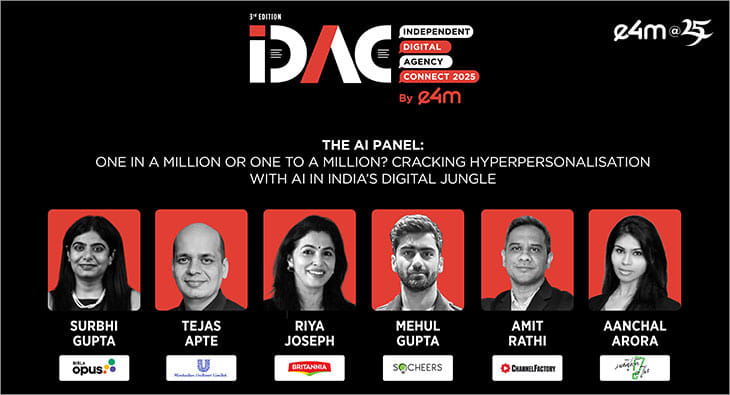

At the e4m iDAC 2025, industry leaders gathered to decode one of marketing’s most discussed frontiers: hyperpersonalisation powered by AI.
Moderated by Mehul Gupta, Co-founder and CEO of SoCheers, the session titled “One in a Million or One to a Million? Cracking Hyperpersonalisation with AI in India’s Digital Jungle” featured insights from Surbhi Gupta, Head of Digital, Birla Opus Paints; Tejas Apte, General Manager – Media DMC, HUL; Riya Joseph, Head of Media, Britannia; Amit Rathi, Managing Director, Channel Factory; and Aanchal Arora, Founder & MD, 1702 Digital.
Setting the tone for the conversation, Mehul Gupta noted that every brand today is in pursuit of “the one right customer, the one right message, or the one right moment.” He invited the panellists to define what hyperpersonalisation truly means in the context of their respective industries.
Opening the discussion, Surbhi Gupta said that for her brand, hyperpersonalisation begins with data and consumer understanding. “We’re a paint brand, and our customers usually come to us during their painting cycle, which happens once every three or four years,” she said. As a relatively new brand, the initial focus was on reach rather than deep personalisation. “But as we see more repeat visitors on our website, that’s where the journey starts. Using tools and technology, we identify who’s coming back, what their past behaviour was, and accordingly customise the content or banner they see,” she explained.
For Gupta, the goal is to enhance engagement and stickiness. She added that even during the painting service process, communication becomes more personalised. “Until the order is won, our effort is to keep the customer engaged with sharper, relevant content that makes the journey smoother and more effective,” she said.
Offering a fast-moving consumer goods (FMCG) perspective, Apte of HUL described hyperpersonalisation as “a means to an end.” He said, “We sell everyday products like soaps, soups, and shampoos. Our objective is to drive penetration, not frequency.” He explained that the company’s approach to personalisation lies in “de-averaging” based on consumer or business needs.
“For example, if a consumer in a particular state prefers a stronger toothpaste because of the local cuisine, we’d tweak the product accordingly,” Apte said. However, he cautioned that personalisation must be balanced with business logic. “We’re all profitable companies, we can’t afford to hyperpersonalise for 1.4 billion individuals,” he remarked.
Riya Joseph of Britannia echoed that sentiment, adding that hyperpersonalisation can easily cross a fine line. “If it goes too far, it becomes creepy,” she said. “Even if you know everything about your consumer, you don’t want them to know that you do.”
Joseph explained how Britannia uses its product packaging as a base for consumer engagement. “We sell around 18 billion packs a year, that’s about 1.5 billion every month. For us, our packs are ground zero media,” she said. By integrating QR codes on products like Good Day, Marie, and 50-50, the brand connects consumers directly to digital platforms. “For 50-50, we’ve used cricket as a platform. At one point, we had an engagement with Ravi Shastri where users could ask him questions and get responses in his style,” she shared. The collected data, she noted, helps the brand continue engaging consumers with relevant trivia and content.
From a media and technology lens, Rathi of Channel Factory highlighted the complexity of applying hyperpersonalisation in India. “It’s a very touchy topic,” he said. “On social platforms, nearly 65–70% of media spends happen today. Hyperpersonalisation is important, but the question is: are brands using the right content and media metrics?” He pointed out that with the diversity of 17 languages across the country, ensuring creative relevance at scale remains a major challenge.
Adding an agency perspective, Aanchal Arora spoke about the dual experience her teams face with AI and hyperpersonalisation. “We work with over 60–70 brands, and we’ve seen both the advantages and limitations,” she said. “When you’re creating content at scale, AI helps. But think of the last AI ad you remember. It probably didn’t have a brand personality.”
She explained that while AI enables quick content generation, it often results in generic outcomes. “After a point, it hits a ceiling. It can’t bring out the brand’s uniqueness,” she said. However, on the media buying and performance marketing side, Arora acknowledged that hyperpersonalisation has been more effective. “We’ve been able to go beyond demographics, not just target a 35-year-old, but a 35-year-old father from a tier-three city, for instance,” she said, adding that while India’s diversity offers opportunities, AI tools still need to evolve to become more India-specific.
Turning to Apte again, Mehul Gupta asked whether decision-making at HUL leaned more on data precision or cultural intuition. Apte responded that both play distinct roles. “For our business-as-usual ideas, it’s hardcore data-driven. AI helps us turn around measurement models faster and deliver more actionable insights,” he said. But when it comes to larger campaigns or activations, culture plays a crucial part. “We possibly tie up with the largest number of movies and influencers in India,” he shared.
He reiterated that technology should serve the larger business goal. “Whether it’s AI or work done on pen and paper, it all starts with the marketing objective,” Apte concluded.
Speaking about leveraging AI for deeper engagement, Joseph shared how Britannia integrated personalisation into its Milk Bikis campaign in Tamil Nadu.
“We don’t do too many hyper-personalised creatives,” he said. “But for Milk Bikis, which has over 95% market share in Tamil Nadu, we wanted to make it more relevant and current. So, instead of the usual mom-and-child narrative, we made the dad the hero.”
Explaining the idea, he added, “We created an interactive experience where consumers could scan the pack and then scan any object in their room, be it a lamp or a bottle, and they instantly got a story built around that. The model was trained to generate endless stories, even improvising if it doesn’t know an object. Over 500,000 people in Tamil Nadu have already created stories this way. AI-driven personalisation helped us connect more meaningfully with that audience.”
Rathi weighed in on whether AI-generated creatives flooding social media are truly adding value. “Let me tell you,” he said, “I live in Mumbai, but I’m not a Marathi speaker. I often see Marathi creatives on my TV, which suggests that the industry operates under the assumption that everyone in Mumbai understands Marathi. That’s media wastage.”
He emphasised that hyper-personalisation works only when paired with contextual relevance. “If the content is in Marathi and you’re targeting Marathi speakers, it’s effective. But YouTube alone manages 14 languages in India, and language targeting remains a big barrier.”
Hyperlocalization is important, but only if you’re using the right tools. If your relevance score is 90 or 100, brand recall increases. “For me, content is primary; creatives are secondary.”
On the agency side, Arora discussed how AI is being used to optimise costs and reduce ad wastage. “For a QSR brand during fasting periods like Navratri or Ramadan, we noticed impressions going to waste since people weren’t consuming the product then. Tools couldn’t filter that out, so we had to rely on human intervention,” she said.
Sharing another case, she explained, “We use Seltra, a tool that breaks down a video into relevant parts and serves snippets based on demographics and interests. For instance, a 45-year-old who loves to travel will see the section that appeals to that lifestyle. We’ve used AI extensively for content creation, but for ad delivery, human judgment is still key.”
She added that AI has significantly cut production costs for clients. “For a recent product launch video with ID Fresh Foods, we used 50% AI-generated CG images and 50% real footage. Earlier, such a shoot would cost ₹10–20 lakh. Now, costs have dropped drastically, making frequent product launches viable for CPG brands.” Media wastage has also reduced, but it still requires human oversight.
Closing the discussion, Surbhi Gupta highlighted how AI supports conversions and channel engagement rather than repeat sales. “We’re only a year into the business, so repainting cycles haven’t begun yet,” she said. “Our focus is on improving conversions. AI helps us stay connected with potential customers through the journey, from seeing our creatives to taking action.”
She explained how AI enables real-time intervention: “If someone is on the verge of checkout but hasn’t completed payment, we can instantly offer a discount or added value to push conversion. Similarly, we’re building tools for our channel partners so they can create localised creatives for their networks. Technology-driven personalisation at that level is where we see real impact.”
Read more news about Marketing News, Advertising News, PR and Corporate Communication News, Digital News, People Movement News
For more updates, be socially connected with us onInstagram, LinkedIn, Twitter, Facebook, YouTube & Google News
