‘Ad tech can offer powerful tools but advertisers must ask the right questions’
Ashwin Padmanabhan, Chief Operating Officer-South Asia, GroupM, shared key insights on ‘Building a Transparent Future for Programmatic Media’ at the e4m Real Time 2024 conference
 by
by
Published: Sep 19, 2024 9:07 AM | 5 min read
 Follow Us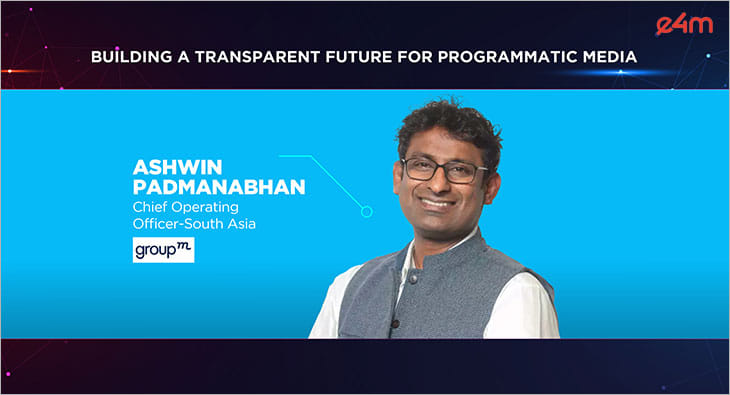

At the e4m Real Time 2024 conference, Ashwin Padmanabhan, Chief Operating Officer-South Asia, GroupM, captivated the audience with his insights on a crucial-yet-often-overlooked aspect of digital advertising: transparency in programmatic media.
As the digital landscape continues to evolve, Padmanabhan addressed important questions about the effectiveness of digital advertising and the promises it holds for brands. He was speaking on the topic - Building a Transparent Future for Programmatic Media.
He began by addressing the foundational promise of digital media — enhanced audience understanding, precise targeting, and reduced wastage compared to traditional media. Despite advancements in technology, he emphasized that the journey toward fulfilling this promise is fraught with challenges. It’s not just about the technology itself but also about a philosophical approach to how we use it.
Padmanabhan took the audience through the evolution of programmatic advertising, recounting how, over 15 years ago, it started as a method to automate campaign requests without a focus on audience insights. He said, “As the industry progressed, advertisers began to buy audiences based on attributes, leading to real-time bidding (RTB) for price discovery. However, with this evolution came significant challenges, particularly the emergence of ad fraud. This ongoing battle often leaves advertisers playing catch-up, ultimately inflating costs in a landscape that lacks transparency.”
Throughout his talk, he highlighted several key questions that advertisers should consistently ask to navigate this complex ecosystem. How much of the budget is genuinely contributing to working media? Are we engaging with real audiences, or are we falling prey to bots and fraudulent sites? Where are the ads actually being displayed, and are those environments safe for brands? Are we paying for genuine ad views, or merely fleeting seconds of exposure? How reliable is the data informing our targeting decisions? Are we truly reaching our intended demographics?
Padmanabhan also shared that while ad tech can offer powerful tools, it is ultimately the responsibility of advertisers to ask the right questions. “Transparency in programmatic media is not just a technical issue; it is a philosophical one that requires continuous reflection and diligence. As the digital advertising landscape evolves, embracing these challenges will be essential for building a more transparent and effective future for programmatic media.”
Padmanabhan emphasized that while advertisers are already paying transparent fees for ad tech and demand-side platforms (DSPs), this additional 36% adds to the complexity. He challenged the audience to consider why digital media, unlike other forms of advertising, operates with such opacity. He highlighted that advertisers have a right to clarity about where their investments are truly going.
He also shared a troubling insight: about 23% of digital advertising investments are lost to fraud. This figure, while conservative, illustrates a significant issue—money intended for real audiences often ends up wasted on non-genuine impressions or environments that don’t provide value. As he delved into these statistics, it became clear that advertisers are often left in the dark about where their ads are placed and who is seeing them. Despite the availability of tools for managing block lists and ensuring brand safety, the risk of associating ads with harmful content remains high.
Padmanabhan urged advertisers to reflect on what constitutes a meaningful ad view. He pointed out that many are charged for fleeting impressions—sometimes as short as half a second. He questioned the efficacy of communicating a brand message in such a brief time frame and underscored the need for standards in evaluating ad exposure.
He cautioned against taking the growing digital ad spend for granted, emphasizing that while digital is indeed thriving, the mechanisms for reaching audiences lack transparency. "Let's not kill the golden goose," he implored. Instead, we should confront these issues head-on, demanding clarity and accountability.
He also shared a GroupM study, which revealed that nearly 50% of the impressions paid for are not meaningful. This staggering waste drives home the urgency of understanding where advertising dollars are being spent. He prompted the audience to consider how much time they devote to analysing the data used for targeting audiences. Is that data ethically sourced? Does it truly reflect the consumers they aim to reach? Such questions remain largely unanswered, further complicating the landscape.
To address these challenges, Padmanabhan discussed GroupM's initiative in supply path optimization (SPO), a project launched nearly six years ago. SPO aims to streamline the process of reaching publishers, reducing the number of intermediaries involved in the purchasing journey. By minimizing these steps, GroupM seeks to enhance transparency and ensure that advertisers know exactly where their money is going.
He also stressed the importance of data fidelity, explaining that the effectiveness of targeting depends heavily on the quality of the data used. If the data is flawed, advertisers risk making poor decisions that lead to wasted resources. GroupM is actively working to ensure that the data powering their campaigns is reliable and sourced responsibly.
Furthermore, Padmanabhan highlighted GroupM's commitment to establishing stringent standards for brand safety and viewability. These standards are designed to ensure that impressions are genuinely valuable, based on rigorous testing and results. While adhering to these standards may require effort from partners and publishers, the long-term benefits include building trust with brands and improving advertising outcomes.
He concluded, “Honestly, these are areas that I believe are of strategic importance. We tend to get lost in jargon and become excited by shiny new toys that come our way, but we often forget the basics and neglect to ask fundamental questions. Let's not be enamoured with what surrounds us. Instead, let’s leverage the strengths of the technology available to us to address these questions. This approach will lead to building the trust and transparency we all seek.”
Read more news about Marketing News, Advertising News, PR and Corporate Communication News, Digital News, People Movement News
For more updates, be socially connected with us onInstagram, LinkedIn, Twitter, Facebook, YouTube & Google News