'Collaboration is required – between media, creative and martech like never before'
e4m Confluence 2024 saw industry experts discussing the potential of integrated campaigns that bridge traditional and digital media
 by
by
Published: Nov 12, 2024 1:11 PM | 7 min read
 Follow Us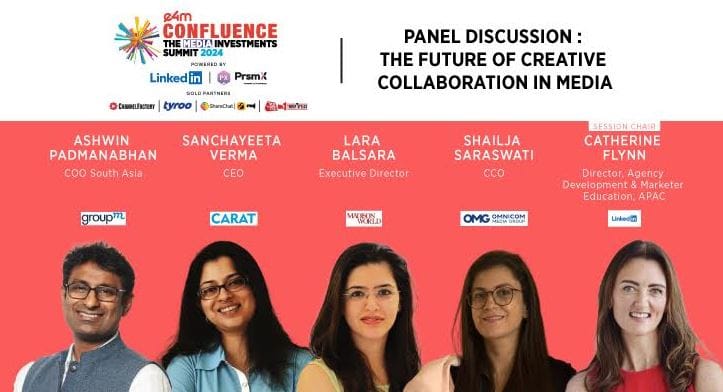

At the e4m Confluence 2024, industry leaders delved into the future of creative collaboration in media, discussing the vital role of cross-industry partnerships in fostering innovation and driving value for brands, agencies, and media platforms.
The session brought together Ashwin Padmanabhan, COO of South Asia at GroupM; Sanychayeeta Verma, CEO of Carat; Lara Balsara, Executive Director at Madison World; and Shailja Saraswati, CCO at OMG India, with Catherine Flynn, Director of Agency Development and Marketer Education, APAC at LinkedIn, serving as session chair.
Flynn opened the discussion by setting the stage for the importance of cross-industry collaboration as the media landscape evolves, particularly in India. She asked the panellists, “In today's media landscape has collaboration among brands, agencies, and platforms changed? And what trends do you see shaping the future of these partnerships?"
Taking up the question, Saraswati observed a dramatic shift in collaboration dynamics within the industry, noting the increased speed of decision-making. “It’s a seller's market, right? Nobody is stopping the publishers or the platforms from going directly to clients. So, from an agency perspective, we need to be agile and completely on top of our game in terms of data insights and the timelines we can deliver ideas in.”
Padmanabhan addressed the need for stronger collaboration in today’s media environment. "We don’t have enough collaboration right now," he remarked. "So, really, even if we talk about change, it's irrelevant. Bringing collaboration in would be the challenge, I would say." Reflecting on the collective responsibility within the industry, he emphasised, "For all the reasons Shailja just spoke about, collaborating has become imperative to get it right. And I think all of us in the room and outside, it's a responsibility that we have."
Answering Flynn’s question next, Verma described the evolution of the media landscape, pinpointing a new "algorithmic era." She explained, "Firstly, we were in a broadcast era; we moved to the precision era, but now we are in the algorithmic era." Verma spoke about the importance of "algorithmic availability," where brands must navigate content challenges brought by AI. "The problem is of mediocrity and redundancy in content...how from a mental availability perspective you’re going to be navigating that."
Verma also discussed the area of focus, “How do I get content into the right context to cut through the incredible clutter we have, and create the right connections with all the right audiences? Collaboration is required – between media and creative like never before, but also with MarTech. It’s about building the bridges we need to navigate this brave, amazing world.”
Next Flynn posed a key question to the panel, asking how agencies can encourage more creative risks when collaborating with brands and media platforms.
Padmanabhan responded by emphasising the unique position agencies hold in fostering collaboration. “I think as agencies, we're probably perfectly placed to drive this collaboration,” he said. “There’s an insight into the brand and its objectives, a deep understanding of platforms, publishers, partners, and access to audience data. All of us work with large entities where the creative and the media are coming together again.”
He pointed out the need for a shift in how agencies approach collaboration. “Do we see this as a responsibility and do it intentionally, or is it just a campaign exception, an example of collaboration?” he questioned. “I think it needs to happen as a process. It needs to happen intentionally. And that's when we’ll see magic coming up.”
Flynn then steered the conversation toward common challenges agencies face when working with partners, particularly media platforms. “What are the common challenges when working with partners? And I think, probably, platforms outside of the agency-client landscape would be top of mind here,” she asked. “What can we do practically to make the collaboration smoother?”
Balsara shared her perspective on one major challenge - the platforms’ need to understand brands better and offer more customised solutions. “One of the challenges would be for the platforms to understand the brand better and come up with customisable solutions that work for the brand—not just trying to sell what they want to sell,” she explained.
Balsara added that international platforms often exhibit rigidity, sometimes deferring to global policies that limit flexibility. “More than the local platforms, international platforms can be very rigid. We get pushbacks, like, ‘No, that can't be done,’ or, ‘That's a global policy.’ So there’s not much that can be done. Those are a few challenges I see.”
Agreeing with Balsara, Verma called for greater inspiration and engagement from platforms. “The help that we require from platforms is actually more of inspiration,” she said. “A lot of times, we sit together and say, ‘Hey, this is something that we really need to do.’ But taking that inspiration and bringing it to the entire team is tough. We’re so busy that we finish one project and move on to the next.”
She emphasised the importance of platforms collaborating closely to explore new possibilities. “How can platforms come together, and how can we jam together to push boundaries? From the enjoyment perspective and the ability to achieve more, that would be quite helpful for us.”
“How do you foster or train that within your teams, this ethos of better collaboration?” Flynn inquired next.
Saraswati shared how agencies can encourage collaboration through cross-pollination and sharing best practices. “I think it’s in every agency or group dynamic; we do have certain clusters of categories which we are familiar with,” she said. “That’s the piece that requires exchange in terms of best-in-class use cases, which we can then apply across different clients within the same category.” Saraswati explained how this approach had led to successful outcomes, such as when they worked on premium luxury clients and the automobile portfolio. “We’ve seen that when we do that cross-pollination, there’s inspiration in the same category, and clients get inspired,” she said.
She gave an example from a recent project: “We just launched the Skoda Kylaq with Rohit Shetty. The entire launch was done like a movie release. Normally, car brands do media drives, events, and customer engagement, but this time we took it to the big screen. This way the campaign becomes pop culture, and you get into people’s minds.” Saraswati added that the campaign's success was due to everyone being aligned and working fast. “The output was great because we looked at all the checklists in terms of input, output, and outcome. Everything was aligned, and it happened very fast.”
Flynn then turned to the topic of real-life examples. “I know everyone’s probably really keen to hear some real examples. So, let’s look at a specific campaign or a broader example where collaboration with different parties led to something groundbreaking. What made it work?” she asked.
Balsara shared an insightful example from a recent campaign for Saffola, a cooking oil brand known for promoting heart health. “I wanted to share an example of a campaign that recently concluded for Saffola. Every year on World Heart Day, we come up with interesting ideas and innovations and partner with platforms and media partners to come up with something engaging,” she explained.
Balsara highlighted how the campaign evolved over the years, mentioning a past campaign where they worked with radio stations to broadcast the sound of a beating heart. “A few years ago, we tied up with six radio stations, and for one hour, all the stations just played the sound of a beating heart. At the end of that, we would air a brand message.”
She continued, “Cut to today, in October, we launched a campaign around the idea that the ability to climb stairs is an indicator of heart health. We launched this on digital and created a microsite where consumers could download an app. They could then interact with the lead model, who would talk to them while climbing stairs. The app measured how good their heart health was.” The campaign, according to Balsara, demonstrated the power of creative collaboration with various media platforms.
Read more news about Marketing News, Advertising News, PR and Corporate Communication News, Digital News, People Movement News
For more updates, be socially connected with us onInstagram, LinkedIn, Twitter, Facebook, YouTube & Google News