A insight guide for food brands: The Intangible Ingredient
Guest Column: Gaurav Gopal Verma says people don’t just buy food; they buy how it makes them feel. Once you see that, everything about building a food brand changes
 by
by
Published: Aug 25, 2026 12:18 PM | 11 min read
 Follow Us

- Consumers often choose snacks and food based on emotional connections rather than just practical reasons like price and convenience; feelings play a crucial role in brand loyalty.
- Successful food brands evolve from selling basic products to owning specific emotional moments, transforming consumer perceptions and experiences associated with their offerings.
- Shoppers categorize food products by occasion rather than brand, indicating that brands must align their messaging with the specific moments they aim to serve.
- The tension between indulgence and health consciousness presents an opportunity for brands to create products that satisfy cravings while alleviating guilt, emphasizing the importance of taste alongside health benefits.
Picture someone at their desk at four in the afternoon. It's been a long day. They open a drawer, take out a snack, and eat it without really tasting it.
Ask them later why they keep snacks in that drawer and they'll say something sensible: they're cheap, they're handy, they fill a gap. All true. But that's not why they ate one today. Today it was a tiny break. A small kindness to themselves. One minute that belonged to them.
This happens everywhere in food. The reason people give and the reason people buy are almost never the same. The reason they give is easy to say out loud — fast, cheap, tasty. The real reason is a feeling they can't quite put into words.
If you build food brands, that gap is the whole game.
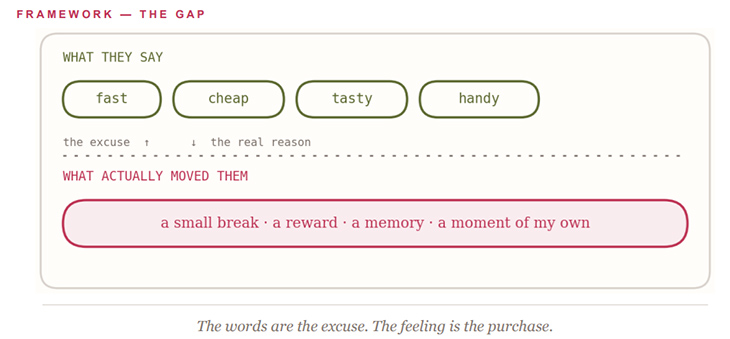
You can watch this play out in any taste test. People rate a new snack out of ten — crunchy, nice colour, good aftertaste — and then decide it with a throwaway line that has nothing to do with the scores: “I just can't see myself eating this.” The score sheet is about the food. That last line is about the feeling. The feeling wins.
Tried, or kept
FEATURES EARN A TRIAL · FEELINGS EARN A HABIT
Two famous brands show how this works.
One began as a plain fizzy drink. Cold, sweet, refreshing — nothing more. Over the years it stopped selling refreshment and started selling attitude: bold, strong, a little cheeky. The drink barely changed. The feeling changed completely. That feeling is what people buy now.
Another started out making simple namkeen, the stuff you snack on between meals. Slowly it became the brand you gift at festivals and the name you go out to eat under. The food stayed familiar. What changed was the moment it owned.
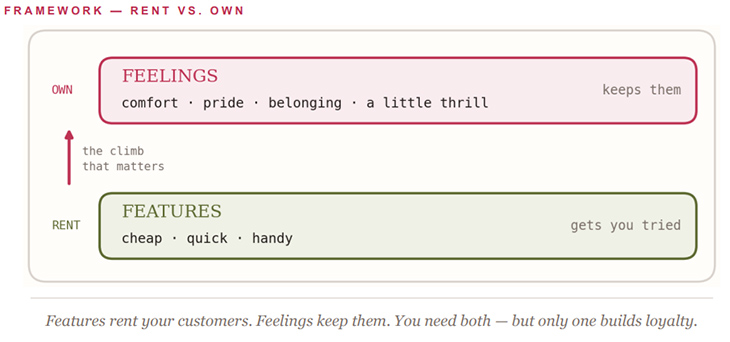
Here's the rule underneath both stories. Useful things — cheap, quick, handy — get people to try you once. Feelings are what bring them back. Sell only on price and convenience and you're renting your customers; someone cheaper can take them tomorrow. Own a feeling — comfort, pride, belonging, a little thrill — and you keep them.
One quick warning about “awareness,” because it fools a lot of people. Plenty of shoppers can say your brand's name and still not tell you one true thing about it — what it stands for, when they'd pick it, why it and not the thing beside it. That's not real awareness. It's a name floating in someone's head with no feeling attached. Being remembered is not the same as being wanted.
One shelf, three shoppers
THE “AVERAGE CUSTOMER” IS USUALLY NOBODY
Walk up to almost any shelf and you'll find three different people standing there for opposite reasons.
The first shops for adventure. Younger, curious, always after the new thing. For them, trying is the fun part.
The second shops for safety. They like what they already trust, and only take a chance on something new when the occasion calls for it.
The third — usually the biggest group — sits in between. They want to move up in life without leaving the familiar behind. They watch the price. They're pulled by ambition and by habit at the same time.
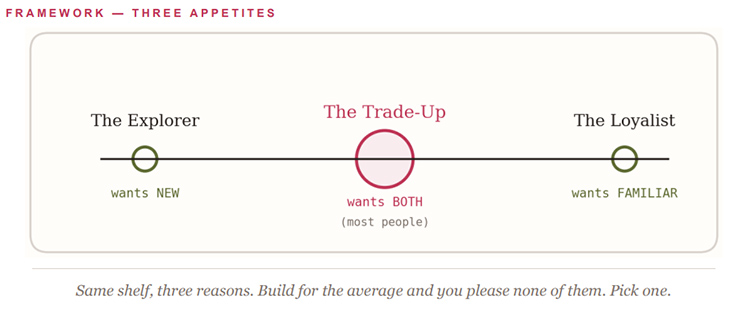
And notice the thread running through all three: people want the new and the familiar at the same time. That's why an old favourite, remade in a modern way, so often wins. It hands you a memory and a surprise in the same bite.
It's the moment, not the food
PEOPLE SORT A CATEGORY BY OCCASION, NOT BY BRAND
Ask people to make sense of a food category and they don't line it up by brand. They line it up by moment.
In their heads there are two drawers. One is for everyday: close by, easy, for the whole family, the thing you grab without thinking. The other is for special: the choice you make when the buying itself is meant to say something — I care, I've arrived, this is a treat.
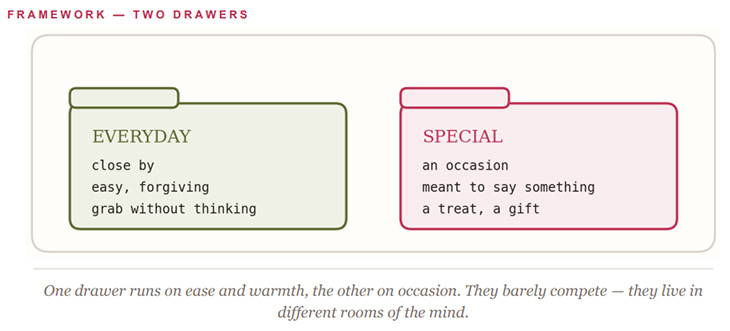
So the real question isn't “is my product good?” It's “which drawer am I in?” And here's the part people get wrong: premium isn't a price. It's a set of small signals people read — a sense that this is special, a little hard to get, a signature you can't find elsewhere, care you can feel. Charge a high price without those signals and you don't feel premium. You just feel expensive. (More on that in a moment.)
People keep wanting more
EXPECTATIONS RISE — AND IN A SET ORDER
Wants don't sit still. They climb, and they climb in a fairly fixed order.
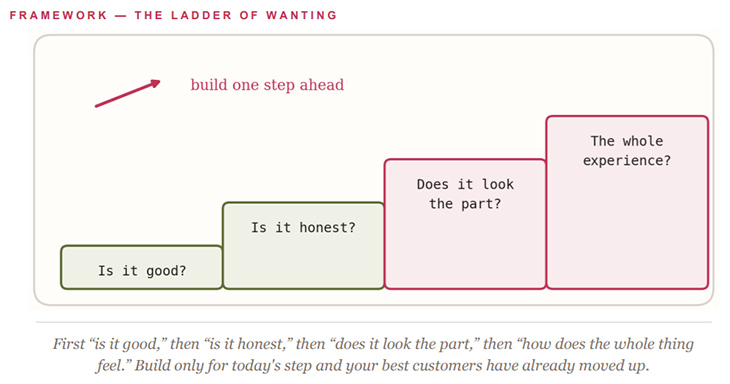
The more people see, the more they expect — expectation only ever moves up. So don't build for the step people are on today; build for the one they're climbing to. Take them from full to satisfied.
Taste tells people where you're from
FLAVOUR IS A FLAG
Flavour isn't only flavour. It's a signal about where something comes from and who it's for.
A mild, gentle taste often reads as “foreign” — and, strangely, as “healthy,” as if whoever made it must care more about such things. A loud, spicy, tangy taste reads as “ours.” Neither is really about the tongue. Both are about belonging. Give people a soft version of a dish they love and many will quietly decide it wasn't made for them.
Long before anyone decides whether it's delicious, the flavour has already told them whether it's for people like them.
So choose your flavour like you're choosing a flag — on purpose, not by accident. And whatever the first bite promises, the rest of the bite has to keep it. A taste that shines at the start and fades by the middle leaves a small feeling of being cheated — one people rarely name but never forget.
The picture is the first taste
SHOW, DON'T TELL — BUT MIND THE LOCAL ACCENT
Food took over our phones for a simple reason: taste is almost impossible to describe, so we show it instead.
On a shelf, a menu, an app, the picture isn't decoration around the product. For the first second, the picture is the product — the only taste someone gets before they buy. Colour, plating, the mood of the shot: that's the message, not the wrapping.
But be careful, because looks are a language, and languages are local. “Luxury” doesn't look the same everywhere. In some places, rich means warm, golden, full. Drop a cool, bare, minimal look into a market that reads wealth as warmth and it can flip on you: you meant “exclusive,” they see “cold.” You meant “understated,” they see “empty, and probably overpriced.” A spotless, quiet shop with no life in it often just says not for me. Even the name does this — one nobody can say, place, or picture won't stick, however pretty the logo.
And there's a newer twist: a lot of food is now eaten twice — once in the mouth, once on the feed. People half-choose where to go by how the visit will look afterwards: the photo, the story, the neat cross-section. That turns your brand into something people use to say something about themselves. If it isn't worth showing, you've lost a whole layer of value that has nothing to do with taste. Design for the photo as carefully as the plate.
Expensive is not the same as premium
THE TRAP THAT CATCHES THE MOST BRANDS
Say this one out loud: a good product wins a first try. It does not build a brand.
The pattern repeats endlessly. Before people try you, they have no picture of you — no story. After they try you, they happily agree you're good: tasty, fresh, well made. And still, the feeling never turns from “nice” into “I want this.” They respect you. They don't reach for you. They can't say what you're for.
The reason is nearly always the same. There's a product, but no story — so the price has nothing to lean on.
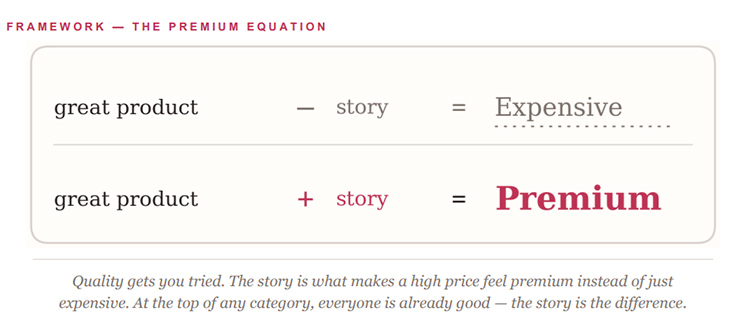
The way out is freeing once you accept it: pick a feeling and own it. The same excellent product can become three very different brands.
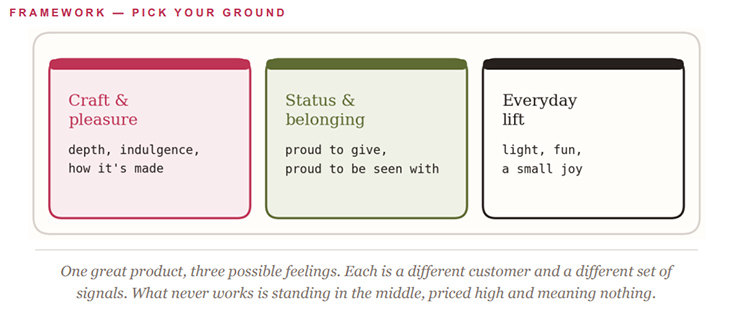
Price is a feeling before it's a number. People don't pay what a thing cost to make. They pay what the feeling is worth to them.
The treat and the guilt
THE BIGGEST OPEN SPACE IN THE MARKET
Every food brand today lives inside one tension.
On one side, a treat has become a way people look after themselves — a small reward after a hard day. On the other, worry about health has never been higher, and it comes with guilt. The same person wants the treat and feels bad about wanting it.
Don't try to remove the tension. It's the biggest open space in the market. You win by giving people permission — sensible portions, a sourcing story they believe, “better stuff, less frying” instead of heavy and deep-fried. Lift the guilt without killing the joy.
One catch: the good-for-you feeling fades fast. People pick the healthier option on the day they've decided to be good — then admit the feeling doesn't last, and that if it isn't actually tasty, they won't be back. Health earns the first buy. Taste earns the second. A brand so busy being healthy that it forgets to be a pleasure has handed people a permission slip and forgotten the treat.
Quick notes for three kinds of brand
THE SAME IDEA, APPLIED
- The pack does everything at once — product, salesperson and ad — on a busy shelf and again as a tiny thumbnail. Put a feeling on it early. Sell a moment, not a slot. Smaller packs and an honest back-story carry the guilt away.
- Quick-service. Speed and price only get you in the door. The photo decides the order before anyone tastes anything — and it has to still look like the photo after a long delivery ride. Own a part of the day. Let one photogenic hero dish be your cheapest ad.
- Bakery & café. Almost nothing sells on hunger. It sells on celebration, gifting, comfort, a first date, a photo worth posting. Sell the occasion, not the cake. Give people one thing worth the And remember: a warm, lively room feels premium in a way a perfect, empty one never will.
IDEAS TO ACTION
FIVE MOVES
- Build for feelings and moments, not just
- Pick who you're for and which moment you own — then make everything carry that one meaning.
- Earn the signals of the level you're charging
- Lead with how it looks, make it worth showing, and offer the treat without the
- Write the story before you defend the price — because without a story, “premium” quietly turns into “expensive.”
None of this means the basics stop mattering. Food still has to taste good, cost something sensible, and survive the trip home. But those just get you into the game. The brands that win next won't be the cheapest, or the fastest, or even the best-tasting. They'll be the ones that read the mood early, pick a feeling people are proud to be seen with, and turn up right when that feeling arrives.
Because no one ever really bought a snack. They bought the feeling — and let the snack come along for the ride.
Gaurav Gopal Verma is a leading insights & foresight expert and fractional Chief Insights Officer, advising organisations on translating consumer and social insights into strategic business implications. He also mentors and advises insights organisations, bringing over decades of cross-sector experience.
Read more news about Marketing News, Advertising News, PR and Corporate Communication News, Digital News, People Movement News
For more updates, be socially connected with us onInstagram, LinkedIn, Twitter, Facebook, YouTube & Google News
