Women make up just 20% of top creators: Masoom Minawala
At the World Economic Forum meet in Davos, entrepreneur and creator Masoom Minawala Mehta put the spotlight on a structural imbalance in the creator economy
 by
by
Published: Jan 24, 2026 9:33 AM | 4 min read
 Follow Us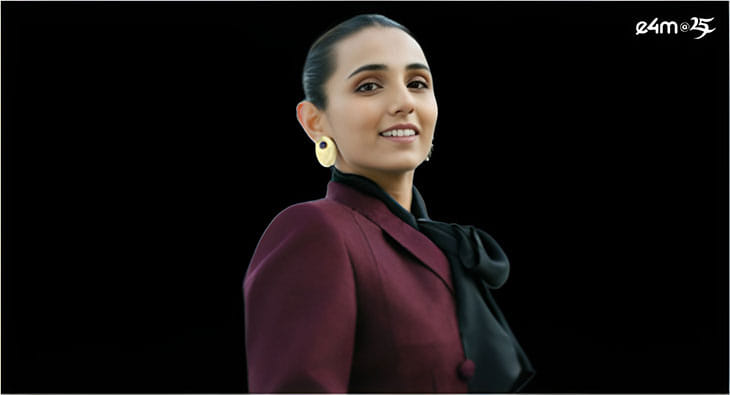

At the World Economic Forum Annual Meeting 2026 in Davos, entrepreneur and global creator Masoom Minawala Mehta argued that women creators were being systematically held back from scaling economically despite their cultural and commercial influence.
Speaking at a panel, Minawala framed gender equity in the creator economy not as a social issue, but as an economic growth imperative. She called for reforms in capital access, platform monetisation and care infrastructure to unlock the next phase of creator-led growth globally.
“Fashion and digital influence are powerful economic engines, yet women struggle to scale globally,” Minawala said. “What structural changes in capital access, supply chains or platform governance are needed to unlock growth?”
View this post on Instagram
Citing industry figures, Minawala highlighted that women account for just 20 percent of top earners, while men make up the remaining 80 percent. However, she stressed that the gap is not a question of capability.
“Women aren’t less capable of building scale, they’re penalised more severely when they try,” she said.
Sharing a personal experience from early in her career, Minawala recalled pitching an e-commerce business idea to investors at the age of 21, after building a community of over 50,000 young women.
“I told them I had the readers, that they read every word I said, and that this business would help turn those readers into customers. It was a foolproof concept,” she said. “But I was told, ‘What about scale? You’ll be married in three years, have children after that. A woman’s life changes in India.’”
She added that the moment shook her confidence and temporarily rewired her belief system. “My social infrastructure as a woman didn’t allow risk,” she said. “I did build the business anyway, but what haunts me is how many women heard that same ‘no’ and didn’t build.”
Minawala outlined three structural shifts she believes are necessary to correct this imbalance. The first is access to patient capital, not just larger upfront cheques, but long-term funding that accommodates life cycles. This includes first-loss guarantees backed by institutions, access to Series B funding and beyond, and flexibility in milestones.
The second, she said, is platform monetisation that does not punish depth. “Content monetisation today rewards volume and virality, not influence and community,” she said. “A creator who drives purchasing decisions for 50,000 people should be valued as much as one with five million passive followers.”
The third pillar, according to Minawala, is treating care infrastructure as economic policy, not social policy. “When childcare collapses, ambition collapses,” she said. “You cannot scale a business on two hours of sleep and a collapsing support system.”
Minawala also spoke about the perception gap creators continue to face in institutional spaces. Recalling an interview for one of India’s most prestigious leadership forums, she said she was told 11 times in 30 minutes that she did not come from a “serious business”.
“To me, a serious business is one with a strong P&L or a clear path to one, predictable economics, ownership, governance and the ability to compound,” she said. “Which one of these does my business not have?”
Asked what single decision global leaders should take in the next 12 months to unlock equality and economic value in the creator economy, Minawala offered a clear answer: reclassify creative IP as an asset class.
“Factories get financed. Patent portfolios get financed. Even future subscription cash flows get securitised,” she said. “But a creator’s audience, a musician’s catalogue, a designer’s brand equity are still treated as too intangible unless you’re Taylor Swift.”
Her call to action was direct. “If I were advising a head of state or a CEO, I’d say this: work with financial institutions to create standardised frameworks for valuing and financing creative IP. Until then, we’re leaving massive economic value, and women-led growth, on the table.”
Read more news about Influence Zone, Marketing, PR and Corporate Communication, Internet Advertising, People Movement
For more updates, be socially connected with us onInstagram, LinkedIn, Twitter, Facebook, YouTube & Google News