Influencer content holds attention 2.2x longer than branded ads: Kantar report
Kantar data also reveals that influencer content enjoys 1.4 times higher visibility duration
 by
by
Published: Jul 11, 2025 8:57 AM | 2 min read
 Follow Us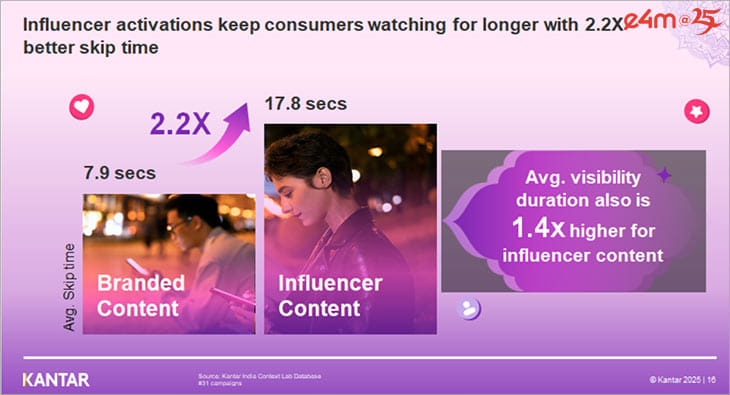

Influencer-led content keeps users watching for over twice as long as branded content, according to new findings from Kantar’s India Context Lab. The average skip time for influencer content stands at 17.8 seconds—more than double the 7.9 seconds recorded for traditional branded assets. This 2.2X lift in attention signals a critical edge for influencer marketing in today’s cluttered digital landscape.
In addition to longer skip times, Kantar data reveals that influencer content also enjoys 1.4 times higher visibility duration. These metrics make influencers a compelling choice for advertisers aiming to maximise engagement and storytelling depth, especially in mobile-first campaigns.
“Influencer activations are proving to be more sticky in terms of audience hold,” the study notes. While branded content tends to be skipped within seconds, influencer videos retain viewers far longer—creating more opportunities for message absorption and product discovery.
But this high engagement comes with trade-offs. Despite better skip and visibility performance, influencer ads still underperform in top-funnel impact areas. Compared to all-digital ad formats, influencer content drives just a 3% lift in aided brand awareness and a 2% lift in message association. In contrast, traditional digital ads register 8% improvements in both metrics.
Where influencers score higher is in mid- to lower-funnel performance. Influencer campaigns lead to a 10% lift in brand attribute recognition (versus 7% for digital ads) and 7% growth in purchase intent (compared to 6%).
Meanwhile, only 7% of influencer-led campaigns make it to the top 30% of ads that build long-term brand equity. This figure is significantly lower than the 32% benchmark observed across general digital advertising.
Audience trust also remains a key factor behind the engagement levels. As per a separate global influencer study by Kantar, 67% of respondents trust influencer recommendations more than traditional advertisements. A further 26% say they prefer influencer suggestions but remain cautious. Only 4% said they trusted traditional ads more than influencer content.
These insights suggest that while influencer marketing may not yet deliver long-term brand equity at scale, its ability to grab and hold attention offers a strong value proposition for marketers prioritising engagement and short-term conversions.
Read more news about Influence Zone, Marketing, PR and Corporate Communication, Internet Advertising, People Movement
For more updates, be socially connected with us onInstagram, LinkedIn, Twitter, Facebook, YouTube & Google News