How Zepto gave a live demonstration of India’s prowess at India AI Impact Summit
Guest Column: Vinay Dhanani, President, Zepto, writes on how the AI Summit was a quieter demonstration of AI in action
 by
by
Published: Mar 4, 2026 11:44 AM | 4 min read
 Follow Us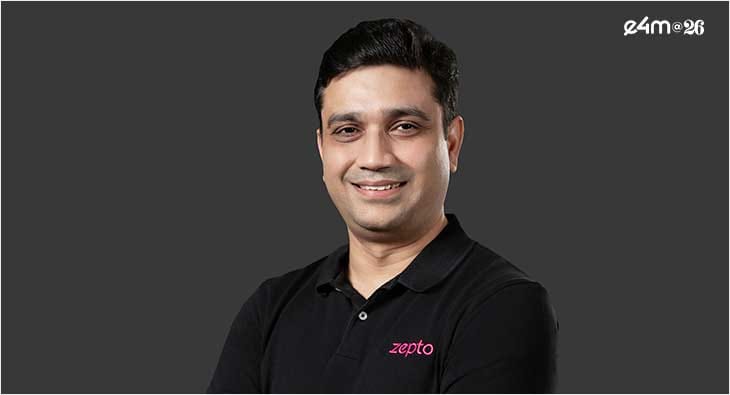

For the longest time, operational excellence meant predictability—lean processes, cost efficiency, incremental optimisation. In the age of artificial intelligence, that definition feels increasingly outdated. Today, operational excellence is about doing things in real time, at scale, under complexity and making it look effortless. Nowhere was this more visible than at the India AI Impact Summit at Bharat Mandapam. Beyond the panels and policy conversations, what stood out was a quieter demonstration of AI in action.
Just outside the main halls, a live quick commerce setup operated seamlessly through the day. Not as a concept or showcase, but as functioning infrastructure. Orders placed between sessions were fulfilled within minutes and collected across multiple points in a venue that mirrored the density and unpredictability of an Indian city. What powered this wasn’t just logistics. It was intelligence layered across every decision. Forecasting models anticipated demand in a non-traditional environment. Picking systems optimised movement in constrained spaces. Real-time routing adapted to crowd flows. Context-aware inventory was designed not for households, but for thousands of delegates navigating long, high-intensity days. This is where operational excellence begins to shift from control to adaptability.
Globally, some of the most defining technology-led transformations have emerged from constraint. Estonia’s story is an example of it, in 1991, it emerged from the collapse of the Soviet Union as a newly independent nation with limited resources and almost no digital infrastructure to build upon. Instead of catching up, it chose to leap ahead. It rebuilt itself as a fully digital society from the ground up—where voting, healthcare, taxation, and even citizenship could exist online. This wasn’t just governance reform. It created an entirely new economic layer—fueling startups, attracting global talent through e-Residency, and embedding technology into the everyday lives of its people. In just a few decades, Estonia transformed from a resource-constrained state into one of the most advanced digital economies in the world.
If we take a close look at this, a local restraint turned into a global capability. India’s constraint is different. It is scale, density, and constant variability. And its response is beginning to take shape through systems that can think, learn, and execute in real time.
Quick commerce, subtly demonstrated at the summit, is one such system. It is not just a logistics innovation, but an AI problem solved at scale. The ability to predict, position, pick, and deliver within minutes across hyperlocal ecosystems has, so far, remained uniquely Indian.
And like Estonia’s digital state, the second-order effects are where the real story lies.
This model is already driving large-scale job creation, from delivery partners and dark store operators to supply chain planners and AI engineers. It is building new economic layers through advertising, brand partnerships, and hyperlocal commerce networks. It is creating a generation of operators and builders working on real-world, high-frequency problems at scale.
Perhaps more importantly, it is beginning to shift where opportunity lies. For years, ambition pointed outward. The best talent left in search of structured ecosystems and frontier innovation. But what happens when the frontier starts to emerge here?
When AI is not just being researched, but deployed daily, solving millions of real-world interactions. When building in India means working on problems that few other markets can replicate in complexity or scale. The success of quick commerce may well be an early signal. Not just of a new category, but of a new kind of capability.
This is not to suggest a reversal overnight. But it does point to a shift.
From brain drain to brain circulation. From looking beyond, the seas for opportunity to recognizing it at home. Because operational excellence in the AI era is no longer defined by stability. It is defined by how systems respond to chaos. How quickly they learn. How seamlessly they execute. And how they make something incredibly complex feel simple.
What played out at Bharat Mandapam was not a glimpse of the future. It reflected India’s present. Built, deployed, and operating at full speed.
If this continues, India may not just be participating in the global AI conversation. It may be quietly rewriting it.
Disclaimer: The views expressed here are solely those of the author and do not in any way represent the views of exchange4media.com.
Read more news about Industry Briefing, Internet Advertising, Marketing, PR & Corporate Communication, Television Media
For more updates, be socially connected with us onInstagram, LinkedIn, Twitter, Facebook YouTube & Google News
