Brands eye India’s fastest-growing running community as Pinkathon returns to Delhi
For marketers, events like these are experiential platforms blending fitness, community engagement, and purpose-driven messaging
 by
by
Published: Mar 9, 2026 11:45 AM | 5 min read
 Follow Us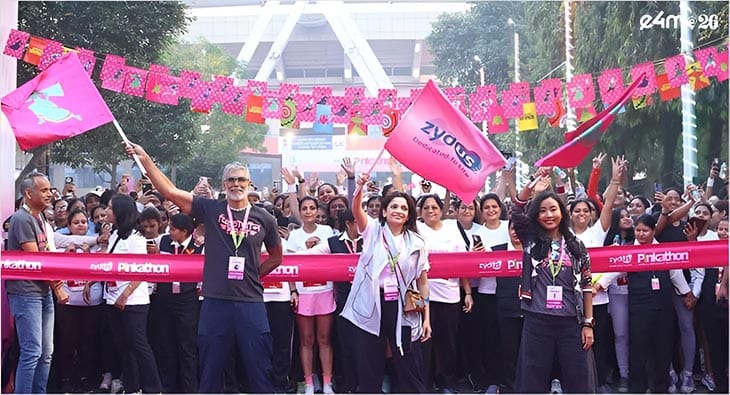

Nearly 6,000 women gathered before sunrise at Jawaharlal Nehru Stadium as the eighth edition of Pinkathon returned to the capital after a gap of more than six years. Held on International Women’s Day and backed by title partner Zydus Lifesciences and two dozen brands, the event highlighted how brands are increasingly aligning with community-led wellness initiatives as India’s running culture expands.
The women-only run featured race categories ranging from 3 km to ultradistances of 100 km, drawing everyone from first-time runners and young participants to grandmothers, cancer survivors and visually impaired athletes. For marketers, such events are increasingly becoming experiential platforms that combine fitness, community engagement and purpose-driven messaging.
Founded by model, actor and fitness advocate Milind Soman, Pinkathon originally emerged as an attempt to address the low participation of women in endurance sports. “When I started running, I saw that participation of women in running events was just four or five per cent,” Soman said. “If so many men were starting to run, I wondered why women were being left behind. We created a space just for women and the response was overwhelming.”
Earlier this year, ASICS renewed its association with the Cognizant New Delhi Marathon for the third consecutive year, highlighting how brands are investing in community-driven endurance sports to deepen consumer connect. The trend is also fuelled by the rise of urban running clubs and grassroots fitness communities.
Brands ride India’s wellness wave
In the last 14 years, Pinkathon has grown into a large-scale wellness platform attracting partners across healthcare, fitness and lifestyle sectors.
The race was powered by Aspect Sports as the Race Sports Partner, with wellness partners including Lotus Herbals (Sunscreen Partner), Lifelong (Fitness Partner), and Sirona (Hygiene Partner). Hospitality was extended by Hyatt Regency Delhi, while healthcare initiatives were strengthened through Fujifilm (Breast Health Partner) and Fortis (Medical Partner).
The event experience was enhanced by Tasty Nibbles (Tasty Meal Partner), Milld (Flour Partner), and Bisleri (Hydration Partner), along with Zivame (Activewear Partner), 3Tenx (Hair Wellness Partner), and Inc.5 (Gifting Partner). The movement was further supported by Accenture, SAI, and FIT India, with Maitrayana as the Philanthropy Partner and Big FM as the Radio Partner. The event was executed by Smiling Tiger Experiences.
According to Soman, the increasing corporate presence reflects a broader global shift toward wellness-focused branding. "Today, there is an entire wave of wellness and health and fitness across the world, not just India,” he said. “Brands see that encouraging running is helping society, and they want to be seen as supporting something good.”
View this post on Instagram
According to a Kantar report, the Indian wellness market is experiencing rapid growth, valued at approximately $156 billion in 2024 and projected to reach $256.9 billion by 2033. Driven by rising health consciousness, urbanization, and increasing disposable income, the market is growing at a 5.3% annual rate.
Soman noted that the country has one of the fastest-growing running populations globally, with community running clubs and social fitness groups emerging across cities. This growth has also attracted younger audiences, including Gen Z runners who increasingly treat marathons as both fitness and social experiences.
“I think it’s great if running communities also help people connect with like-minded partners,” Soman said. “If you have someone who believes in health and wellness the same way you do, it can create a very strong relationship.”
Personal brand values and endorsement choices
While Pinkathon has grown into a major branded IP, Soman says his personal brand partnerships remain guided by strict principles. One of his long-standing rules is refusing endorsements that conflict with his health philosophy.
“Even when I started modelling in the late 1980s, there were certain things I decided I would never promote,” he said. “I don’t promote alcohol, tobacco, sugary drinks, chips or products that I don’t think should be encouraged from a health perspective.”
The same approach often extends to Pinkathon partnerships as well. According to Soman, brands are considered only if their messaging aligns with the broader goal of improving women’s health and well-being.
“If a brand wants to associate with the movement, it has to genuinely contribute to women’s health in some way,” he said. “It could be menstrual health, cancer awareness, mental health or preventive healthcare, but it should add real value.”
Pinkathon has steadily expanded beyond a race day event into a year-round wellness community supported by social media groups and local running networks. Soman said the initiative now operates hundreds of digital community groups across cities, helping women motivate each other and track their fitness journeys.
User-generated content, he added, is also becoming central to the movement’s digital strategy. Participants frequently share their personal running journeys online, which in turn inspires others to take up fitness.
“We want women to talk about their own journeys, how they started running and where they want to go,” Soman said. “When one woman shares her story, it inspires many others to begin.”
The Delhi edition alone has historically drawn more than 50,000 participants across its earlier runs, and the 2026 turnout signals renewed momentum for the city’s running community. With wellness continuing to emerge as a powerful cultural and marketing theme, events like Pinkathon are increasingly sitting at the intersection of sport, community building and brand storytelling.
For Soman, however, the larger mission remains unchanged. “It’s about creating a journey,” he said. “Someone might begin with a three-kilometre run, but eventually they can start thinking about much bigger goals. The first step is simply believing that your health matters.”
Read more news about Industry Briefing, Internet Advertising, Marketing, PR & Corporate Communication, Television Media
For more updates, be socially connected with us onInstagram, LinkedIn, Twitter, Facebook YouTube & Google News