The Evolving Canvas of MarTech
Guest Column: Media industry veteran Sanjay Trehan explores how AI, first-party data and unified MarTech stacks are reshaping marketing, moving brands towards hyper-personalised customer experiences
 by
by
Published: Sep 21, 2026 10:12 AM | 7 min read
 Follow Us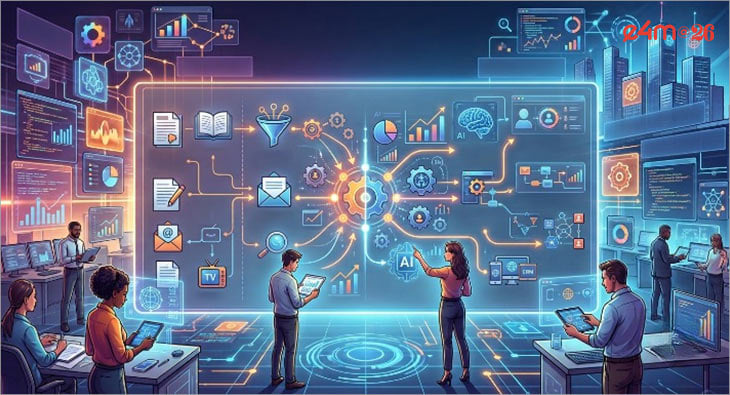

One: Stop painting the crowd. Start painting the person.
Here’s why I think Painter’s analogy goes well with MarTech.
The average customer may not exist. Yet, most campaigns are built for them. The finest artist would rarely paint the crowd first. They understand the individual before bringing the larger canvas to life.
MarTech, I believe, is following a similar path.
There was a phase of marketing when scale was considered the measure of success. A well-crafted campaign carried the same message to millions, hoping it would resonate with enough of them.
But the canvas is changing, transforming.
Every interaction with a brand now leaves a small but meaningful impression. The journey, preferences, or any kind of engagement with the audience adds another brushstroke to this canvas.
The growth of first-party data, intelligent automation, and AI-driven decisioning is allowing marketers to move beyond broad audience segments.
Intelligent systems in MarTech today help interpret these signals enabling marketers to understand their audience in far more depth than ever before. Personalisation was thought of as a tactic, but today, it sits at the heart of marketing. It is influencing recommendations, creative experiences, timing, channels, and the journeys that follow.
Interestingly, the goal of marketing has always remained the same: understanding the customer. What's changed is our ability to predict individual behaviour so precisely that every response can now feel personal. Perhaps, this is the new canvas of MarTech, where experiences are individual rather than average.
The finest art is found in the details, which make the customer feel like the only one on the canvas, and that is hyper personalisation.
Two: Customer data is the sketch of every portrait.
One can admire a finished portrait but only the artist knows the real sketch beneath it. In MarTech, that sketch is customer data.
There is considerable discussion today around AI, automation, and hyper-personalisation. These technologies have already been reshaping how brands engage with their customers. Yet, behind every meaningful customer experience lies something far more fundamental: a trusted understanding of the customer. That understanding is increasingly being built through unified first-party data.
This is what brings together consented interactions, product behavioural signals, purchase history, and preferences into a single, reliable view that allows marketers to see the individual as they really are, rather than as disconnected fragments spread across multiple systems.
A web of signals resolved in one view.
This is where unified first-party data becomes the real asset of modern marketing. It lays the foundation that enables personalisation to become relevant. Otherwise, even the most sophisticated recommendation engines, predictive models, or AI-driven journeys risk creating experiences that are remarkably detailed, yet unfamiliar to the customer they are intended for.
The portrait may eventually be admired for its colours, its aesthetic appeal, but it is always remembered for how truthfully it captures the person. And customer data, I believe, is where that truth begins.
I wonder, do most brands know their customers, or they just think they do?
Three: When every stroke aligns, the picture becomes clear.
Imagine multiple artists working on different canvases, each putting their own creativity into it, yet somehow hoping to bring it all together and call it one painting. Strange right?
For a long time, Marketing, Sales, and IT often had their own view of the customer. Each team had its own systems, its own data, and sometimes even its own understanding of what the customer needed. The result? A picture with many strokes, but rarely one that felt like a complete portrait.
As MarTech grows and customer experiences become increasingly personalised, the need for these strokes to align is becoming more important. Unified MarTech stacks are helping teams connect customer data, platforms, and workflows across functions, creating a more consistent view of the customer.
A campaign interaction can now provide useful context for a sales conversation. Customer feedback can inform future campaigns. Data from different touchpoints can come together to give teams a clearer understanding of what the customer has experienced so far.
This may sound like a technological shift but there is a deeper construct of human understanding underneath this. Teams that once worked around separate systems can now work from a shared understanding of the same customer. Technology connects the pieces, but it is the shared picture that helps people make better decisions. One clear picture, and far less confusion!
Four: The masterpiece is still human. The precision is AI.
There is always a moment when the artist will put his brush down and look at the picture as a whole. The moment when all the strokes come together!
Marketing has always involved a great deal of detail. Finding the right audience, deciding when to reach them, choosing the right message, testing what works, and making adjustments along the way. For years, much of this happened manually, campaign by campaign. As the audience grew, customer journeys became more complex and keeping up with every signal became nearly impossible.
This is where AI is beginning to change the way marketers work. AI automation can now handle many of the finer, repetitive decisions that once required constant human attention. AI agents can interpret signals, predict behaviour, adjust execution, and respond to changing customer patterns as they emerge.
But a good marketing portrait needs something more foundational than precision. Someone still needs to understand the person behind the data. Someone has to decide what the brand should stand for, what the customer should feel, which message is worth telling, and when a certain interaction simply does not feel right.
These are decisions shaped by context, expertise, gut, creativity and human judgment. That is where the marketer continues to matter. AI may help refine the brushstrokes but the direction of the painting still comes from the person holding the vision.
Five: MarTech and AdTech share the same canvas.
What happens when two canvases finally become one?
MarTech and AdTech have often been assumed to be living in different parts of the marketing ecosystem. One focussed on understanding the customer. The other focussed on reaching her.
Yet, when you think about the customer journey, you realise how integrated these two are!
A customer discovers a brand through an ad. She visits the website, explores a product, engages with content, perhaps leaves, returns later, and eventually makes a purchase. Each moment of the journey creates a piece of the picture.
When customer data, behaviour, and advertising signals work together, marketers gain a more connected understanding of that journey. The result is a marketing ecosystem where different parts begin to speak to one another.
This is where the MarTech and AdTech canvases start to overlap. For marketers, the opportunity is quite meaningful. Instead of looking at acquisition, engagement, and conversion as separate chapters, they begin to see them as parts of the same customer story.
Clearly, the MarTech canvas is becoming more individual, more connected, and increasingly precise. Perhaps, the final observation is that the canvas itself is getting bigger! Martech and AdTech, when they share the same canvas, create an opportunity for the artist to finally step back and see the whole picture as one complete image.
So, folks, after all these impressions on the new MarTech canvas, what picture do you think the next stroke of marketing will paint?
Read more news about Digital Media, Internet Advertising, Marketing News, Television Media, Radio Media
For more updates, be socially connected with us onInstagram, LinkedIn, Twitter, Facebook, YouTube & Google News