‘AI was central to Nielsen’s measurement models long before it became a buzzword’
In this edition of TechTalk, Anil Goel, Global Chief Technology Officer at Nielsen talks about audience measurement has evolved from a passive exercise to an active intelligence function
 by
by
Published: Jul 30, 2025 9:20 AM | 3 min read
 Follow Us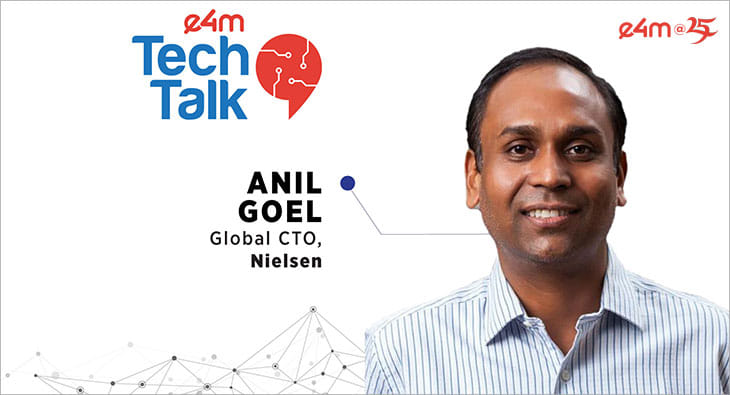

In an increasingly fragmented content ecosystem, where viewers consume entertainment across connected TVs, smartphones, laptops, and short-form platforms, audience measurement has evolved from a passive exercise to an active intelligence function. Leading this transformation is Anil Goel, Global Chief Technology Officer at Nielsen, a company long synonymous with media measurement and now rapidly emerging as a full-stack media technology platform.
“AI has actually been at the heart of Nielsen’s measurement models long before it became a buzzword,” said Goel during a recent episode of exchange4media TechTalk. “We’ve been using sophisticated machine learning for over two decades to create representative panels and extrapolate insights.”
Today, Nielsen generates more than 100 terabytes of data daily. Historically, this data was interpreted by analysts using custom reporting and analytics tools. The challenge, according to Goel, is that such volume makes it easy to miss key signals. “With that amount of data, it’s very easy to overlook important trends. AI helps us connect the dots that humans might miss. It’s the difference between reacting to behavior and anticipating it.”
The conversation also addressed the tension between personalization and privacy. As marketers seek ever more granular insights into consumer behavior, privacy concerns have grown in parallel. Goel emphasized that privacy remains a core value for Nielsen. “We never share personally identifiable information. Our clients receive insights based on high-level demographics like age or region but never anything that identifies individuals.”
Over the years, Nielsen has scaled its operations from measuring around 100,000 households to now gathering data from more than 70 million homes globally. This transformation has been powered by a blend of software-based panels, big data integration, and partnerships with CTV providers, DTH platforms, and streaming services. “We now get data from connected TV providers, satellite operators, and first-party platforms like Amazon Prime,” Goel explained. “We apply advanced machine learning to fuse this data, assign the correct weights and produce a single source of truth.”
This infrastructure forms the backbone of Nielsen’s next-generation advertising tools. Among the most significant is Nielsen ONE Ads, a cross-platform measurement solution that offers brands a unified view of advertising performance. “It delivers a full view of advertising across platforms—broadcast, digital, streaming and beyond,” said Goel. Importantly, the platform extends beyond reach and frequency metrics to include outcome-based measurements, enabling advertisers to track whether exposure leads to real-world actions such as store visits or product purchases.
Nielsen’s innovation is not limited to measurement technology. The company has also invested significantly in developing its India operations into a global innovation centre. “India is absolutely core to our AI and engineering roadmap,” said Goel. “The talent here is second to none. Our teams are developing next-gen analytics tools that power everything from predictive media planning to real-time content feedback.”
Goel noted that Nielsen’s approach to AI remains platform-agnostic and results-driven. The company actively evaluates tools across the AI landscape, including ChatGPT, Gemini, Claude and Groq. “We rigorously test everything to find the best fit for each use case. No one model is best for everything. It’s about the right tool for the right job and the right ROI,” he said.
The broader aim is clear: to help clients move beyond simple measurement toward actionable intelligence. In an environment where viewer behavior is fluid and content distribution is limitless, real-time insights are no longer optional. They are essential.
“The goal is not just to tell clients what happened,” said Goel. “It’s to help them decide what to do next.”
Read more news about Digital Media, Internet Advertising, Marketing News, Television Media, Radio Media
For more updates, be socially connected with us onInstagram, LinkedIn, Twitter, Facebook, YouTube & Google News