AI era may need a new rulebook, says Vaishnaw as India reassesses digital laws
The IT minister has signalled a fresh legal framework for artificial intelligence while balancing innovation, safety and economic growth
 by
by
Published: Jun 10, 2026 1:12 PM | 3 min read
 Follow Us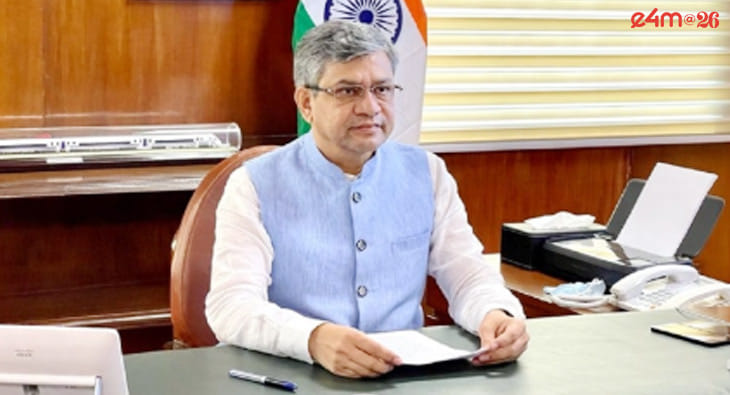

- India is considering a dedicated legal framework for artificial intelligence (AI) as existing digital laws, particularly the Information Technology Act of 2000, may not adequately address the complexities of modern AI technologies.
- Union Minister for Electronics and Information Technology Ashwini Vaishnaw emphasized the need for new legislation to balance innovation with public safety, highlighting ongoing consultations with industry stakeholders.
- Current regulations include tightened compliance requirements for online platforms regarding AI-generated content, with mandates for swift removal of deepfakes and clearer labeling of AI content.
- The discussion on AI regulation is occurring alongside the implementation of the Digital Personal Data Protection Act, 2023, which addresses data privacy but does not directly regulate AI systems, indicating a need for comprehensive governance in this rapidly evolving sector.
India may be heading towards a dedicated legal framework for artificial intelligence as the government evaluates whether existing digital laws are equipped to handle the rapid evolution of AI technologies.
Speaking to a news agency, Union Minister for Electronics and Information Technology Ashwini Vaishnaw said the Information Technology Act, 2000 was enacted in a vastly different technological era and may no longer be sufficient to address the opportunities and risks emerging from artificial intelligence.
"It is a very complex topic. Certain things have been done under the IT Act framework, but I do think there is a requirement for a new law because the world of AI is very different from the world when the IT Act was enacted in 2000," Vaishnaw was quoted as saying.
The minister said consultations with industry stakeholders are underway as policymakers attempt to strike a balance between enabling innovation and ensuring public safety. "We are discussing this with the industry. As always, our objective and approach will be to balance innovation and regulation in a manner that innovation keeps happening, while our citizens remain safe," he said.
The comments come at a time when governments around the world are grappling with the consequences of generative AI, ranging from misinformation and deepfakes to questions around accountability, intellectual property and algorithmic transparency. For India, the debate is particularly significant as the country positions itself as both a major digital economy and an emerging AI innovation hub.
While India does not currently have a standalone AI law, the government has increasingly relied on amendments and advisories under existing digital regulations. Earlier this year, the Centre tightened compliance requirements for online platforms dealing with AI-generated and synthetic content. Platforms including X and Instagram are now required to remove deepfake content within three hours if directed by courts or competent authorities.
The government has also amended the Information Technology Rules, 2021 to formally define AI-generated and synthetic content. In parallel, it has proposed stricter disclosure requirements that would mandate clear and continuous labelling of AI-generated content.
The broader regulatory conversation is unfolding alongside the implementation of the Digital Personal Data Protection Act, 2023, which established a framework for personal data processing and user consent. While the DPDP Act addresses privacy and data governance, it does not directly regulate AI systems, leaving a growing policy gap around issues such as model accountability, bias, deepfakes and AI-driven harms.
Vaishnaw's remarks suggest that India may be moving beyond piecemeal amendments towards a more comprehensive AI governance framework. The challenge for policymakers will be designing rules that protect citizens without slowing innovation in one of the fastest-growing sectors of the digital economy. As AI becomes increasingly embedded across industries, the question is no longer whether regulation is needed, but what shape it should take.
Read more news about Digital Media, Internet Advertising, Marketing News, Television Media, Radio Media
For more updates, be socially connected with us onInstagram, LinkedIn, Twitter, Facebook, YouTube & Google News