Cannes Voices: Josy Paul on what Cannes must say to the world in 2026
The man who won the inaugural Glass Lion from a Delhi living room at 2 AM, and built BBDO India from the backseat of a car, returns to the Croisette as a speaker
 by
by
Published: Jun 19, 2026 9:00 AM | 12 min read
 Follow Us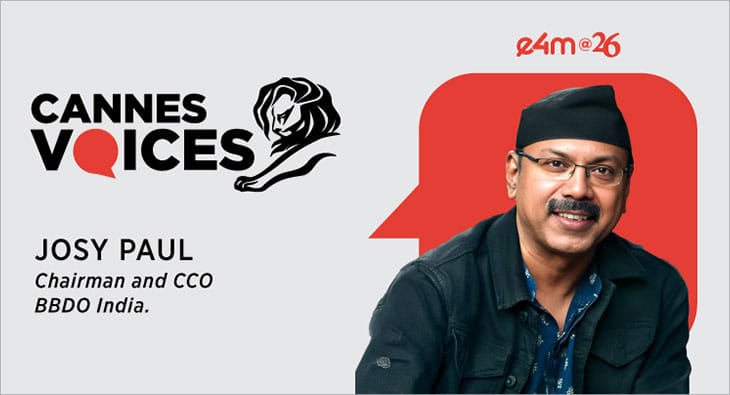

- Josy Paul, founder of BBDO India, will speak at Cannes Lions 2026, focusing on the theme "How to Move at the Speed of Asia," highlighting the importance of listening and adapting to cultural changes in creative work.
- Paul gained recognition for the impactful campaign "Touch the Pickle," which addressed menstruation in India, and has consistently advocated for a philosophy of "acts, not ads" in advertising.
- He emphasizes the shift from an economy of attention to an economy of affection, where brands must create meaningful connections rather than just compete for visibility.
- Paul views artificial intelligence as a tool that can enhance creativity but insists that human judgment remains essential in determining the significance of creative outputs.
It was two in the morning in Delhi when the call came. Josy Paul and Ajai Jhala, then CEO of BBDO India, were not on the French Riviera. They could not be: Paul's visa had just expired. The Palais des Festivals, the beach, the rosé, the entire machinery of Cannes Lions 2015, all of it was happening without them, six thousand kilometres away. And then the phone rang, and the voice on the other end told them that they had just won the most significant Grand Prix of the festival. The inaugural Glass Lion, for work that had not existed two years earlier, for a campaign called ‘Touch the Pickle’, built for P&G's Whisper, that had taken a taboo about menstruation in India and turned it into a national conversation. They were wanted on stage in twenty-four hours.
Paul could not make it. His BBDO colleague Chris Thomas (then CEO of BBDO Americas) went up to collect the award wearing a mask of Paul's face. It is the kind of story that could only happen to someone whose entire relationship with Cannes operates on the register of myth and pilgrimage. Paul has been attending the festival since 1996. He calls it his other birthplace. He has said, with the kind of sincerity that is either disarming or embarrassing, depending on your disposition toward the industry, that he goes there as a pilgrim, to worship at the altar of creativity. This year, he goes as a speaker.
On 22 June, the opening day of the Cannes Lions International Festival of Creativity 2026, Paul will take the stage for a roundtable titled 'How to Move at the Speed of Asia', alongside Sonal Chajerh, National Creative Director of Leo India; Adams Fan, Chief Creative Officer of F5 Shanghai; and Shilpa Sinha, Chief Strategy Officer (Global Markets) for L'Oreal at McCann Worldgroup UK and Europe. It is a panel that positions the Asian creative voice at the centre of a conversation that the global industry has historically held elsewhere.
Paul's credentials for that conversation are extensive. He founded BBDO India in 2008 from the backseat of his car, with a philosophy that the industry has since absorbed but has not always credited: acts, not ads. The idea was that a brand's most powerful expression was not a message but a behaviour: something a company actually did, in the world, that changed the terms of its relationship with its audience. ‘Touch the Pickle’ was of that kind. Ariel's ‘Share the Load’ was of that kind as well, the campaign that won BBDO India Cannes Gold Lions in 2015, 2016, and 2017, and was ranked by the WARC 100 as the world's most effective campaign in both 2017 and 2018. So was Gillette's ‘Women Against Lazy Stubble’, which won the inaugural Black Lion at Cannes for creative effectiveness in 2011. The pattern is consistent enough to be a philosophy rather than a streak of luck: social tension, genuine brand commitment, creative expression that changes a behaviour rather than describing one.
The decade since those campaigns has not diminished his standing; it has extended it. Campaign Magazine named him Asia-Pacific Creative Leader of the Year in 2023. In 2025, he served as Jury President for the Sustainable Development Goals Lion at Cannes and was simultaneously named Jury Chair for Public Relations at the 2026 Clio Awards. His agency was named South Asia Agency of the Year at Adfest in 2025. Across all of it, the central conviction has not changed: that creativity is not an industry function but a moral position, the belief that ideas can, and should, change things that matter.
When we spoke to him ahead of the festival, the conversation moved from the devotional to the analytical, which is where the most interesting version of Josy Paul tends to live.
The pilgrim's agenda
Paul's framing of what Cannes is for (and what kind of work and conversation he expects to define it this year) is characteristically personal and characteristically precise. He does not talk about categories or submission volumes or jury methodology. He talks about what ideas do to the people who encounter them.
"I go to Cannes to be inspired," he says. "To find new energy. Great ideas do good things for your skin. They make you feel younger, more alive, more hungry. So I go as a pilgrim. To worship the work. To bow before the god called ideas."
This framing, which might sound indulgent from someone with fewer credentials, carries weight from Paul because his own career is evidence for it. The work that BBDO India has produced over 17 years has been consistently animated by a genuine belief in the idea, in the audience, in the capacity of a brand to intervene in something real. The pilgrim's disposition is not aesthetic; it is productive. It produces work that takes risks that optimisation-minded agencies would not sanction.
"This year, we will continue to witness interesting conversations around 'What can creativity change?' — not just 'What can creativity make?'" he says. "This will include discussion around truth, taste, beauty, possibility, usefulness, ambition, re-imagination, and human creativity." The distinction between making and changing is the same one that has animated his philosophy since the beginning. Making is a craft question. Changing is a moral one. Cannes, at its best, has always tried to honour both.
What moving at the speed of Asia actually means
The roundtable Paul will join on the opening day of the festival is built around a phrase that could easily become a cliché if handled carelessly. 'Moving at the speed of Asia' is the kind of formulation that invites grand statements about agility, disruption, and the East's rising influence on global creative culture. Paul declines to make those statements. His answer is more interesting and more useful.
"I don't know enough about Asia to make grand claims," he says. "But from what I've experienced, Asia feels less like one market and more like many civilisations connected by extraordinary energy. Commerce, conversation, creators, culture — all flowing together. Moving at the speed of Asia doesn't mean moving faster. It means listening faster."
The distinction between moving faster and listening faster is the most practically significant thing in this conversation. The Western creative model has, historically, been built on a broadcast logic: you develop the idea in the agency, you test it, you produce it, you distribute it. Listening is something that happens before the brief, in research, and then the agency takes over. What Paul is describing (and what the best work coming out of Asian markets increasingly demonstrates) is a different model, one where the brand's creative expression is in constant dialogue with the culture it is trying to participate in. Where the brief is never fully closed. Where the campaign adapts because the culture moves, and the brand has the intelligence and the humility to move with it.
"The strongest brands arrive with strong values and flexible expressions," he adds. "A great brand in Asia behaves more like water. Its essence remains. Its shape adapts." This is, in compressed form, a theory of brand identity in markets defined by diversity and speed. The brands that succeed in the Indian Subcontinent are not the ones that impose a global template with local executions bolted on. They are the ones that have a clear enough sense of what they stand for to be able to express it differently across communities, languages, and moments. That clarity of identity combined with flexibility of expression is what the Speed of Asia roundtable is really about. The insight is Indian as much as it is pan-Asian.
What AI must learn to do, and what it cannot
Cannes has spent the last two years absorbed in conversations about artificial intelligence in creativity: what it enables, what it threatens, what it changes about authorship, originality, and craft. Paul's position on this is not one of the industry's more familiar arguments. He does not frame AI as either saviour or villain. He frames it as an instrument, and asks the question that instrument-makers have always had to answer.
"Every generation receives a new instrument," he says. "The question is never whether we use it. The question is: what music do we make with it? AI can accelerate output, but creativity was never output alone. It is empathy, timing, contradiction, and meaning. If AI removes repetition and creates more room for imagination and craft, something beautiful can happen. AI can scale expression. Humans recognise what matters."
The phrase 'humans recognise what matters' is doing the most important work in this answer. It is a claim about where the creative judgment lives; not in the model, not in the prompt, but in the human decision about which of all the possible outputs is the true one, that lands, that changes something. AI is, in this framing, an extraordinary tool for generating options. It is not a tool for choosing between them. That choice still requires the kind of cultural knowledge, emotional intelligence, and lived experience that no training corpus has yet been able to substitute for. In the advertising context, where the goal is not just to produce something but to produce something that moves a specific audience in a specific moment, that judgment is everything.
Identity as the only remaining scarcity
The broader argument Paul is building across this conversation arrives, in its clearest form, in his answer to the question of how brands protect their voice in an age when the tools of content creation are becoming universal. His answer is not a content strategy. It is a philosophical position.
"As tools become available to everyone, distinctiveness becomes more valuable," he says. "But distinctiveness doesn't come from prompts or visual systems. It comes from belief — knowing what a brand stands for. People don't remember brands because they were efficient. They remember how they made them feel. The future belongs to brands that use technology to become more themselves. More useful. More generous. More unmistakable. Because when everything becomes easier to create, identity becomes everything."
This is the argument that underlies the acts-not-ads philosophy, stated at a higher level of abstraction. When every brand can produce a film, a post, a campaign at scale, the differentiator is not production quality or distribution reach. It is the specificity of the brand's point of view, its particular way of seeing and responding to the world. Brands that have that point of view can use AI to express it more fluently, at more points of contact, with more precision. Brands that do not have it will use AI to produce more noise. The jury room, in this sense, will become an increasingly reliable detector of which kind of brand is in the room.
From attention to affection
Paul's final answer is the one that will be repeated in conversations at Cannes long after the festival is over. It is, in its essentials, a reperiodisation of where the industry stands and where it is heading; a shift significant enough to be called structural.
"I think we are moving from an economy of attention to an economy of affection," he says. "For years, brands competed to be noticed. The next era belongs to brands that are remembered. Technology will make creation easier. Meaning will become harder. The brands that matter won't be the ones that create the most. They'll be the ones that understand the deepest and create the most meaning."
The attention economy is a framework the industry knows well: a world in which the finite resource is human time and the primary competition is for a share of it. Programmatic targeting, personalisation, and reach optimisation are all of it is built on attention as the currency. What Paul is describing (an economy of affection) is a different game entirely. Affection is not purchased by being seen. It is earned by being felt. It requires the brand to do something, over time, that the audience genuinely values, not because it was served to them at the right moment, but because it mattered to them in a way they will carry forward.
The brands that have built that kind of relationship (and Paul has spent his career making the argument through the work, not just with words) are the ones that took the harder road: the ones that built campaigns rooted in genuine human truth, that made brand commitments publicly and kept them, that treated creativity not as a production function but as the primary mechanism of relationship. Ariel's ‘Share the Load’ is now 11 years old and still producing work that the industry stops to take notice of. That longevity is not a marketing strategy. It is the consequence of a belief, held consistently, expressed through every iteration of the campaign, that a brand can change something about how people live. The economy of affection, if that is what is coming, will reward exactly that kind of belief, and the courage to act on it.
Josy Paul arrives at Cannes Lions 2026 as he always has: as a pilgrim, as a practitioner, and as someone who has, more than once, made the industry feel something it did not expect to feel. The roundtable he opens the festival with on 22 June is the right conversation for the moment, one about what it means to move with culture rather than behind it, to build brands that endure rather than impress, to use the extraordinary tools now available to the industry in the service of something genuinely worth saying. If the festival responds to that conversation the way the best Cannes moments always have, by making the people in the room feel younger, more alive, and more hungry, then it will have served its purpose. Josy Paul would call that a miracle. He has been collecting them since 1996.
Read more news about Cannes Lions Festival, Advertising, Marketing, Digital Media, PR & Corporate Communication News
For more updates, be socially connected with us onInstagram, LinkedIn, Twitter, Facebook YouTube , WhatsApp & Google News