When brand message gets lost in the look: GIVA’s Rakhi campaign sparks debate
The ad drew flak for the actor’s Indo-Western styling in a rakhi campaign, but many defended it by calling it a contemporary expression
 by
by
Published: Aug 25, 2026 11:42 AM | 5 min read
 Follow Us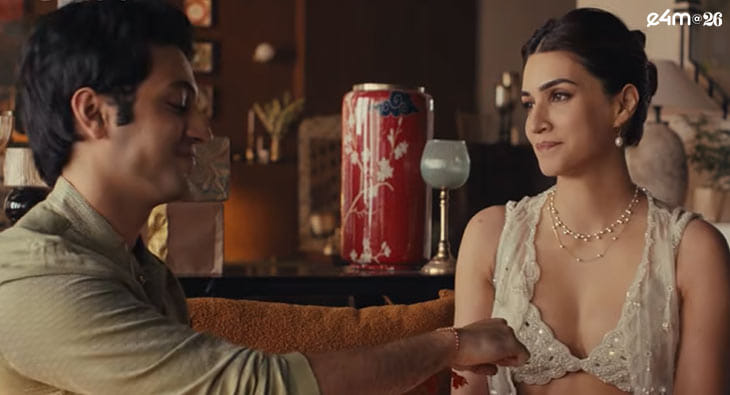

- GIVA's Raksha Bandhan campaign featuring Kriti Sanon has ignited a social media debate regarding her Indo-Western attire, with some questioning its appropriateness for a traditional festival while others defend the modern interpretation.
- The campaign, titled 'Furever Sibling: The Pawfect Bond, Crafted in Silver,' aims to broaden the concept of siblinghood to include pets, reflecting the evolving dynamics of family in urban settings.
- Critics focused on Sanon's outfit, arguing that it overshadowed the campaign's message, while supporters contended that a woman's clothing choice should not dictate her celebration of the festival.
- The controversy highlights the challenges brands face in balancing contemporary styling with cultural expectations during festive advertising, as social media amplifies diverse perspectives on such campaigns.
GIVA’s Raksha Bandhan campaign featuring Kriti Sanon has sparked a debate on social media over the actor’s Indo-Western styling. While some questioned its fit with a traditional festival, others defended the campaign’s contemporary expression.
The conversation, however, has also drawn attention to a larger aspect of the campaign: GIVA’s attempt to expand the idea of siblinghood to include pets.
Titled ‘Furever Sibling: The Pawfect Bond, Crafted in Silver’, the campaign was launched to promote GIVA’s new Pet Collection and positions Raksha Bandhan as a celebration of relationships that extend beyond conventional family definitions.
In the film, Sanon first ties a rakhi to her brother before including a pet in the ritual, reflecting the growing tendency among urban pet parents to view their animals as family members.
Nevertheless, the campaign generated online criticism, with several people focusing on Sanon’s outfit rather than the film’s central message. The actor is seen wearing a bralette-style blouse, paired with a cape and a draped skirt, an Indo-Western look that some social media users described as inappropriate for a festival associated with family rituals and traditional celebrations.
Some questioned whether fashion styling had overtaken cultural context in the campaign, arguing that brands should retain more familiar visual representations when advertising around occasions such as Raksha Bandhan. The criticism quickly became part of the campaign conversation, with comments shifting attention from GIVA’s jewellery and pet-focused narrative to questions of tradition and “decency”.
However, the backlash was met with an equally strong defence. Several users argued that a woman’s choice of clothing should not determine her ability to celebrate a festival and pointed to what they saw as a recurring double standard in the scrutiny faced by female celebrities. Others said the criticism missed the campaign’s larger message, which was centred on broadening the definition of family and siblinghood.
GIVA’s campaign itself makes that positioning explicit. The brand said it wanted to celebrate siblings “whether they walk on two legs or four”, while launching jewellery and accessories for pet parents.
Resha Jain, Chief Brand Officer, GIVA, said the campaign was inspired by changing definitions of family and the increasingly important place pets occupy in households.
“At GIVA, we’ve always believed jewellery is more than an accessory, it’s a symbol of the relationships that shape our lives. With Furever Sibling, we wanted to honour this timeless bond while recognising that, for many today, siblinghood extends to the furry companions who become an inseparable part of our families,” Jain said.
The campaign is therefore doing two things simultaneously. On one hand, it uses Raksha Bandhan, traditionally associated with the bond between siblings, to create a new occasion for GIVA’s Pet Collection. On the other, it uses Kriti Sanon’s styling to retain a fashion-forward, contemporary visual identity, a choice that appears to have become more controversial than the campaign’s actual proposition.
For jewellery brands, festive campaigns are increasingly about building emotional narratives around relationships, gifting and identity rather than simply showcasing products. GIVA’s film follows this approach by using the festival to introduce a new category and connect its jewellery proposition with the growing culture of pet parenting.
But the reaction also underlines the risks of occasion-led advertising in India. Festivals come with deeply embedded cultural imagery and audience expectations, meaning even relatively small creative choices, including costume and styling, can influence how the larger campaign is received.
The central question raised by the GIVA campaign is whether brands can modernise the visual language of traditional festivals without alienating audiences who expect recognisable cultural cues. In this case, the festive setting and rakhi ritual remained intact, but Sanon’s contemporary wardrobe became the focal point for a section of viewers.
For others, that very choice represented the changing nature of Indian celebrations. Supporters of the campaign argued that there is no single way to dress for Raksha Bandhan and that contemporary fashion does not make a celebration less authentic.
The controversy also demonstrates how social media has changed the lifecycle of festive advertising. A campaign’s meaning is no longer controlled entirely by the brand or its creative agency. Comments, reposts and creator reactions can quickly create parallel narratives, sometimes shifting attention away from the intended product message altogether.
In GIVA’s case, the debate has arguably given the campaign an additional layer of visibility. What was designed as a Raksha Bandhan campaign around pets as “furever siblings” is now also being discussed as an example of the tension between tradition and personal expression in modern advertising.
The brand has said the campaign is being amplified through digital platforms, creator collaborations, social storytelling and festive gifting experiences across its online and offline channels. Its core proposition remains the expansion of Raksha Bandhan beyond biological siblings, with personalised pet charms and other products aimed at consumers who increasingly see pets as part of the family.
For GIVA, the styling debate has become part of the campaign’s story, demonstrating once again that in festive advertising, the creative execution can sometimes generate as much conversation as the product or message itself.
e4m reached out to GIVA for a response on the social media debate around the campaign and Kriti Sanon’s styling but had not received a response at the time of publishing. This story will be updated if the brand responds.
Read more news about Internet Advertising India, Marketing News, PR and Corporate Communication News, Digital Media News, Television Media News
For more updates, be socially connected with us onInstagram, LinkedIn, Twitter, Facebook YouTube & Google News