The Creative Question: Can you sell emotion in a second? Ram Madhvani answers
Ram Madhvani, Creative Director and founder of Equinox Films, decodes with e4m the complexities of telling stories under creative pressure, return on investment in creativity and more
 by
by
Published: Oct 9, 2025 9:18 AM | 7 min read
 Follow Us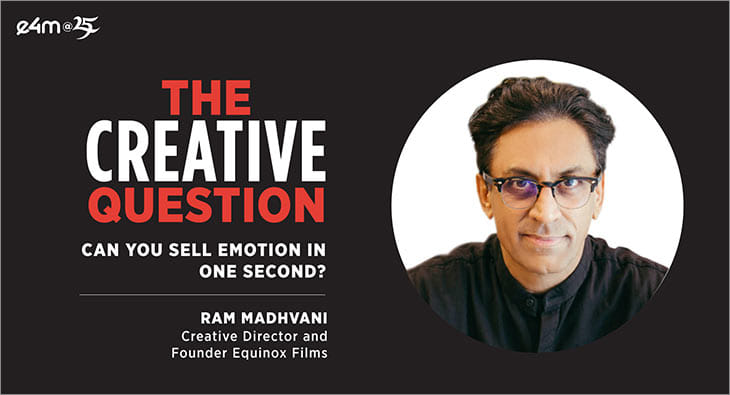

In a space increasingly driven with numbers, seconds, and scroll rates, Ram Madhvani still talks about feelings. The celebrated Creative Director and founder of Equinox Films doesn’t rush through thoughts the way the digital world rushes through ads, he pauses, reflects, and often laughs at the irony of it all.
“I’ve been waiting for the one-second ad my entire career,” he says. “Where they tell you, in that one second, you have to put in emotion, a song, a story, everything. But I’m okay with it. Whether it’s 20 seconds, 10, or 6, it should still hold what I have to say.”
That line, half in jest, half in truth, captures the creative tension of our times. How do you preserve the soul in an ecosystem that rewards speed?
Madhvani has never believed creativity can be boxed by metrics. Yet he doesn’t dismiss the data either, he respects it. “Many years ago, someone told me, ‘You only sell oil and shoes,’” he recalls. “And I had to ask myself, do I sell oil and shoes, or do I sell emotion and feeling?”
That question, he says, changed everything. “Now I believe I sell feelings. Of course, we must look at every matrix and every feedback, because we’re in that business. But if there’s no feeling, there’s no sale.”
It’s an elegantly simple truth in a time when ads are tested, tracked, and re-edited based on engagement drops. Madhvani refuses to see data as the enemy. “Even though I'm in the market where people need to buy me,” he says. “Clients and agencies buy me only if I’m a good tracker. And the only way they can buy that product is if there’s return on investment.”
The balance, for him, lies in emotionally intelligent advertising, work that satisfies the spreadsheet and the heart at once.
Despite his legendary status, Madhvani speaks like someone deeply aware of his place in the creative chain. “There’s the client, there’s the agency, and then there’s me,” he says. “By the time it comes to me, people have been through six or eight months of work. My first audience is actually my client, in that conference room.”
He describes his role as both interpreter and inspirer. “I can smell a room,” he says. “I’m very sensitive to what’s required. My job is to deliver that, and hopefully, do more.”
At the same time, he doesn’t shy away from the emotional toll of creation. “I don’t think there’s anything wrong with self-doubt or fear,” he admits. “Creative anxiety is a good thing. That queasy feeling in your stomach, when you don’t know if it’ll land or crash, that’s when you know you’re doing something good.”
That “feeling in the stomach,” as he calls it, is what guides his decisions. Not metrics. Not mood boards. Just that unmistakable moment of uncertainty that tells him he’s alive, and creating something honest.
Talking about India’s festive season, Madhvani draws an unexpected comparison. “Our Diwali is like America’s Super Bowl,” he smiles. “Those are our two big seasons, IPL and Diwali. Earlier, summer used to be one, but not anymore.”
Equinox Films has been behind several high-profile campaigns this year, from Hilton with Deepika Padukone to Aldo and Airtel. But even after decades of success, his fascination remains the same, how emotion translates through time, format, and technology.
“I think my best work is when you can recognize my signature,” he says. “But how do I have a signature when someone else is holding my hand? That’s the director’s journey, to find your voice while sharing it with others.”
For someone rooted in storytelling, Madhvani is surprisingly excited about technology. “The word ‘technology’ comes from the Greek word techne, which means art,” he says. “All technology is meant to liberate art. Fast lenses, digital cameras, even vertical screens, all of these have freed us.”
That belief gave birth to Equinox Virtual, a startup exploring Virtual Reality storytelling. “VR has been suffering from something called shelving,” he says. “You buy the glasses, and then they just sit there. So we decided to do something about it.”
Over the past few years, the team developed a five-minute VR film based on the Bhagavad Gita, which received a tremendous response in an Ormax survey. “It’s a traditional story told through new technology,” he says. “If I can use tech to reach the youth with our philosophy and roots, that’s a nice mixture.”
The long-term plan is to screen such films at cultural centres and monuments like the Taj Mahal, Ajanta Ellora, Red Fort, and temples such as Tirupati and ISKCON. “It’s about blending culture with innovation — about retelling who we are through new eyes.”
As talk of AI-driven production grows louder, Madhvani remains level-headed. “I haven’t released any AI ads yet,” he clarifies. “We’ve done some tests, but it’s not in full use. For me, AI is an enhancement tool.”
He explains that creative cost isn’t about technology, it’s about intent. “Everything we do is budget-driven. Once we know how much you have, we decide the tools. It’s not a forward conversation; it’s a backward one.”
Even in classic Equinox projects, the illusion of grandeur often hid a pragmatic core. “For example, that palace ad everyone thought was big-budget? We shot it in Palwal, not Rajasthan,” he reveals. “It looked expensive, but it wasn’t. We’ve always been responsible with what clients spend.”
Then he says something that distills his entire philosophy into one line: “I’ve always felt that the only power I have is the power to lose money, not to make it. When I decide something is worth doing, I go make it. That’s what gives you returns over the next twenty years.”
Between campaigns and innovations, Madhvani has been quietly building something deeply personal, a spoken-word series called MadVaani. “Just me talking, no guests, about different subjects. Maybe seven or eight minutes each. It’s like a space where I can ramble," he explains.
He laughs, remembering how his personal journal is titled Ramblings from Ram. “It’s one more way to see where the world is going, to distract myself, to inspire myself. I watch it with interest and anxiety, both.”
In the end, Madhvani doesn’t talk like a man fighting time. He talks like someone negotiating with it, with patience, humour, and honesty.
“We’re not here to keep money,” he says. “We’re here to spend it wisely, to make something that lasts.”
That might just be the quietest rebellion in modern advertising: To believe that emotion still sells, even when the world gives you only one second to prove it.
Read more news about Internet Advertising India, Marketing News, PR and Corporate Communication News, Digital Media News, Television Media News
For more updates, be socially connected with us onInstagram, LinkedIn, Twitter, Facebook YouTube & Google News