The Amul Ad: Partisan statement, brand tradition or nation-building instinct?
Guest Column: Adman Prabhakar Mundkur explores the third dimension to the discussion about Amul congratulating PM Modi on becoming India's longest-serving Prime Minister
 by
by
Published: Jun 16, 2026 11:47 AM | 3 min read
 Follow Us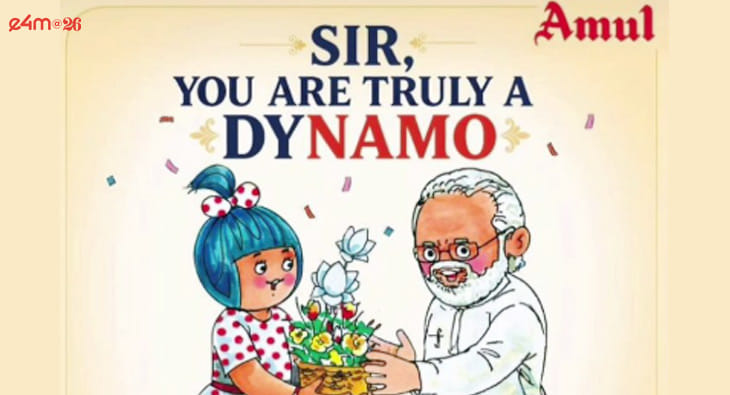

- The Amul advertisement congratulating Prime Minister Narendra Modi on his record tenure has ignited a debate over the brand's perceived partisanship versus its tradition of commenting on national events.
- Amul, a cooperative institution owned by farmers, has played a significant role in India's transformation into the world's largest milk producer and has historically celebrated national achievements across various domains.
- Critics argue that the advertisement crosses the line from commentary to endorsement of a political leader, while supporters suggest it acknowledges a significant national milestone rather than a political act.
- The discussion highlights Amul's unique position in Indian society, as it engages with politics and public life differently than conventional brands, raising questions about the boundaries of political acknowledgment versus endorsement.
The recent Amul advertisement congratulating Prime Minister Narendra Modi on becoming India's longest-serving Prime Minister has sparked considerable debate. Some see it as evidence of a brand becoming partisan. Others view it as a continuation of Amul's long tradition of commenting on public events and personalities.
Both arguments have merit. Yet there may be a third dimension to the discussion that is being overlooked.
To understand the advertisement, one must first understand what Amul represents.
Unlike most brands, Amul is not merely a commercial enterprise. It is one of independent India's great nation-building institutions.
Born out of the cooperative movement and inspired by the vision of leaders such as Verghese Kurien, Amul transformed India from a milk-deficient nation into the world's largest milk producer. Today India contributes roughly a quarter of global milk production, a remarkable achievement built largely on the cooperative model pioneered by Amul.
More importantly, Amul is not owned by a corporate house. It belongs to millions of farmers. Its success is, in many ways, a story of rural India, self-reliance and collective effort.
For decades, therefore, Amul has celebrated national achievements. It has celebrated sporting victories, scientific breakthroughs, cultural milestones and political events. The famous Amul Girl has never confined herself to entertainment and consumer products. She has commented on the national mood.
This is why the current debate is so interesting.
Those who criticise the advertisement argue that a full-page congratulatory message to a serving Prime Minister goes beyond commentary and enters the realm of endorsement. They see a distinction between witty topical observations and a formal celebration of a political leader's achievement.
That concern deserves consideration.
However, there is another perspective.
If Amul sees itself not merely as a butter brand but as a participant in India's nation-building story, then recognising a milestone achieved by the country's elected Prime Minister may not necessarily be viewed internally as a political act. It may instead be viewed as the acknowledgement of a significant national milestone.
Whether one agrees with that judgment or not is a separate matter.
The important point is that the motivation may be more complex than simple partisanship.
Critics interpret the advertisement through the lens of politics. Amul may have viewed it through the lens of nationhood, institutional achievement and historical significance.
This does not automatically make the advertisement right. Nor does it make the criticism wrong.
But it does remind us that context matters.
Amul is not just another FMCG brand seeking relevance on social media. It is a cooperative institution that has been intertwined with India's economic and social development for over seven decades. Its relationship with national events has always been different from that of conventional brands.
The real question, therefore, is not whether the advertisement was political. Amul has always engaged with politics and public life.
The question is whether this particular communication crossed the line between acknowledging a national milestone and endorsing a political leader.
Reasonable people can disagree.
What is beyond dispute is that the debate itself reflects the unique place Amul occupies in the Indian imagination. Few brands could provoke such a discussion. Fewer still have earned the right to be part of it.
Disclaimer: The views expressed here are solely those of the author and do not in any way represent the views of exchange4media.com.
Read more news about Internet Advertising India, Marketing News, PR and Corporate Communication News, Digital Media News, Television Media News
For more updates, be socially connected with us onInstagram, LinkedIn, Twitter, Facebook YouTube & Google News