Stub the Habit: The Hindu on World No-Tobacco Day
The campaign was also timed to extend beyond World No-Tobacco Day, resonating with broader conversations around public health and environmental responsibility
 by
by
Published: Jun 12, 2025 3:17 PM | 4 min read
 Follow Us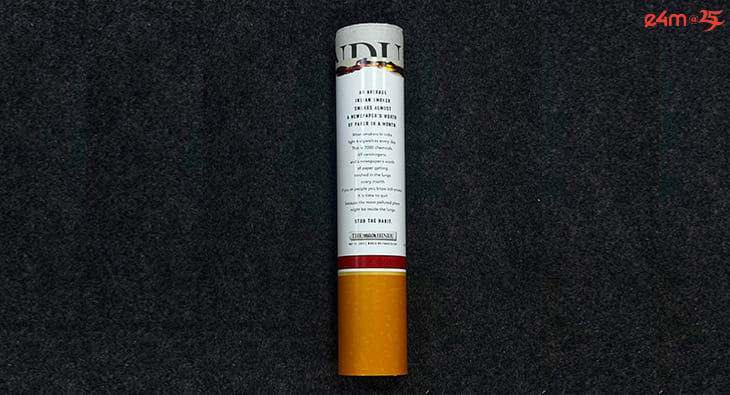

This World No-Tobacco Day, The Hindu and Ogilvy South launched a striking campaign titled “Stub the Habit”, a creative collision of air quality data, visual metaphors, and habit disruption designed to jolt readers into rethinking smoking.
At the heart of the campaign was a headline that did the heavy lifting: “From Chennai/Coimbatore/Bengaluru/Kochi… to Delhi in a smoke.” It accompanied a stark image of a burning cigarette filled with smoke, juxtaposed against some of India’s worst Air Quality Index (AQI) readings. The message was clear: smoking a single cigarette can do to your lungs what a day in Delhi’s air might, or worse.
The campaign didn’t stop at print. In a dramatic physical extension, newspapers in select Chennai areas were delivered rolled up in a sleeve resembling a giant cigarette. This activation came with a confronting fact: an average smoker consumes six cigarettes a day, equivalent to roughly the amount of paper in a newspaper each month, not to mention the chemicals and carcinogens inhaled along the way. “It all started when someone joked about Delhi’s AQI being worse than cigarette smoke,” said Puneet Kapoor, Chief Creative Officer, Ogilvy South. “That thought led to the idea of equating city-level air pollution with what we willingly inhale through cigarettes. The cigarette-wrapped newspaper came later, we realized the folded paper looked like a stub. It clicked immediately.”
For The Hindu, the campaign served as a reminder of its deeper mission. Aparajita Biswas, Head of Marketing at The Hindu Group, said the team wanted to build something “hard-hitting” and insight driven. “We built the campaign on two truths,” she explained. “First, that a cigarette’s impact on your lungs can rival the worst city air. Second, that the amount of paper smoked in a month is nearly a newspaper’s worth. We used a powerful daily habit, reading the newspaper, to confront a deadly one.”
The AQI framing wasn’t incidental. According to Biswas, anchoring the message in air quality brought local relevance and scientific credibility, especially in regions that often assume their air is cleaner. “We wanted to challenge that perception. Just because the air feels cleaner doesn’t mean smoking is any less harmful. By using AQI, we found a relatable and trusted way to highlight the invisible damage,” she said.
The campaign was also timed to extend beyond World No-Tobacco Day, resonating with broader conversations around public health and environmental responsibility. Kapoor pointed out that simply saying “quit smoking” doesn’t cut through anymore. “People want a fresh point of view,” he said. “We try to find ways to reframe the conversation. For Environment Day, we did another campaign asking people to rate food delivery platforms not just for taste, but for the waste they create with plastic packaging.”
Rather than standalone gestures, these campaigns signal a long-term direction for The Hindu’s brand communications, one rooted in public interest and responsible messaging. “Our journalistic integrity is core to everything we do,” Biswas emphasized. “Any campaign we run must be rooted in fact, and in public service. Cause-based communication isn’t a marketing trend for us; it’s part of our strategic vision.”
Even the more provocative creative choices are run through a tight filter for accuracy and credibility. Kapoor recalled an early version of the ad that included specific AQI figures, but the team decided to remove them to avoid misinterpretation. “The Hindu takes its editorial standards seriously,” he said. “So, naturally, our creative work also undergoes rigorous fact-checking.”
What makes “Stub the Habit” stand out isn’t just its creative execution but the way it was rolled out across touchpoints. The campaign lived in print, physical activations, and digital platforms, picking up traction through media outlets and social media by mid-morning on launch day. “Once you crack a strong platform idea, it becomes media-agnostic,” said Kapoor. “Print was the spark, but digital made it travel.”
For The Hindu, the success of this campaign has also reinforced the power of cause-based marketing to go beyond traditional audience engagement. “These initiatives bring together our four pillars, editorial integrity, marketing innovation, audience engagement, and meaningful brand participation,” Biswas said. “It’s about doing work that matters, not just to sell, but to shift conversations.”
While many brands stop at intent, Kapoor insists the goal here is behavior change, even if it starts small. “We can’t force people to quit smoking,” he said. “But we can make them stop and think.” And sometimes, that’s enough to start something.
Read more news about Internet Advertising India, Marketing News, PR and Corporate Communication News, Digital Media News, Television Media News
For more updates, be socially connected with us onInstagram, LinkedIn, Twitter, Facebook YouTube & Google News