Remembering Piyush Pandey: The storyteller who breathed life into Brand India
Sanjay Tripathy, Co-Founder & CEO of BRISKPE, remembers Piyush Pandey as a creative legend who gave Indian advertising its soul
 by
by
Published: Oct 25, 2025 10:31 AM | 7 min read
 Follow Us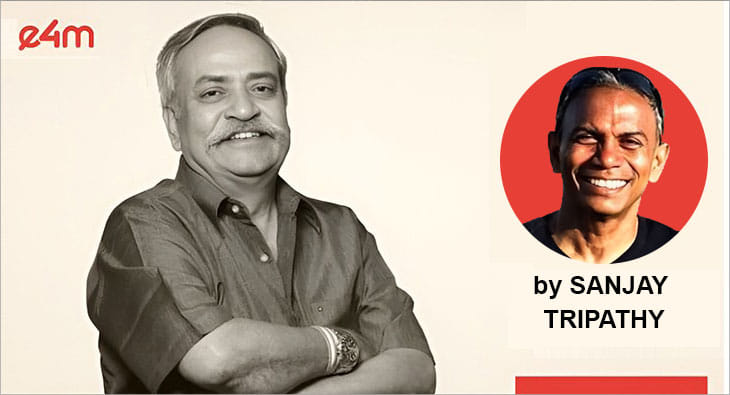

I first met Piyush Pandey around the year 2000, during the launch of Mattel India. Those were the early days when global brands were trying to understand Indian consumers and their habits and hopes.
Piyush walked into our meeting room with his trademark calm and that unmistakable sparkle in his eyes and a presence that immediately commanded attention. He didn’t start with charts or marketing jargon. Instead, he looked around the table and asked, “What does a toy mean to an Indian child when her parents can’t afford many? What story is she living when she picks up that doll?”
That one line changed the tone of the meeting. Suddenly, it wasn’t about positioning or pricing. It was about people. About emotion. About India.
That was Piyush, always starting from the heart. He didn’t look for the global narrative; he looked for the human one.
When I heard that Piyush Pandey was no more, it felt like the end of an era. For me and for so many across the worlds of marketing and advertising, it wasn’t just the loss of an icon. It was the loss of a teacher without a classroom, a mentor without a title, and a mirror that reflected India’s heart back to itself.
The Man Who Gave India Its Voice
Piyush’s genius lay in how instinctively he understood India; its contradictions, humour, warmth, and aspirations. Moneycontrol once rightly called him ‘the architect of Indian advertising’s soul.’ That’s exactly what he was.
Before Piyush, Indian advertising often looked West for inspiration. After Piyush, India found its own voice. He gave us stories that didn’t imitate, they resonated. For instance, Fevikwik’s ‘Todo Nahin, Jodo’ was so rooted in Indian wit, it became a proverb. Cadbury Dairy Milk’s ‘Kuch Khaas Hai Zindagi Mein’ with its carefree dance on the cricket field, redefined what joy looked like. And who can forget Fevicol’s unforgettable campaigns that turned glue into a symbol of India’s unbreakable bonds.
These ads were cultural moments where Piyush didn’t sell products. He told stories that belonged to all of us.
In 2002, I had the privilege of working with Piyush again, this time on the launch of Reliance Mobile. It was a defining moment in India’s telecom story. The challenge was to speak to millions experiencing mobile connectivity for the first time.
Piyush reframed the entire conversation in a single line. “Imagine a father in a small town hearing his daughter’s voice from miles away, not from a landline, but while he’s on the road. That’s not technology, Sanjay. That’s freedom.”
That was his brilliance, turning functionality into feeling. He made technology human. He helped us see that this campaign wasn’t about SIM cards or tariffs; it was about connection, about emotion, about hearing love and longing through a phone line for the first time.
Over the years, I met Piyush often; at Ad Club events, industry forums, and especially Goafest. Those were the moments when he was most himself, sitting on the lawns after a long day, a beer in hand, surrounded by young creatives and seasoned leaders alike.
One evening, I asked him if creativity was becoming too mechanical, too focused on awards and algorithms. He laughed, that unmistakable, booming laugh, and said: “India doesn’t need cleverness. It needs honesty. Don’t run away from what’s real. The more Indian you are, the more universal your work becomes.”
That one line stayed with me. It summed up his entire philosophy. For Piyush, Indianness wasn’t a limitation, it was the wellspring of originality.
His insights came from life — the chatter at a paan shop, a mother’s scolding, the rhythm of a wedding band, the humour of a tea stall. He didn’t just understand consumers; he understood people.
At Goafest, he was never the celebrity creative director. He was everyone’s friend. He listened, he teased, he encouraged. He was a legend who carried himself like a colleague.
The Man Behind the Moustache
Behind that iconic moustache was a man of warmth, humility, and razor-sharp clarity. As NDTV once described him, he was “the man behind Fevicol and Cadbury’s most loved ads,” but those who knew him saw more; a human being who valued humour, empathy, and simplicity.
He carried his Padma Shri and Cannes Lions with quiet dignity. Fame never changed him. He could talk cricket, politics, or life with equal passion. He made everyone, from a CEO to a nervous intern, feel heard.
Once, after a session, a young creative nervously asked him how to find great insights. Piyush smiled and said, “They’re everywhere. In your family, your street, your memories. Don’t look for them in data. Look for them in people.” That was his genius. He elevated simplicity to an art form.
At Ogilvy India, he built more than an agency, he built a culture. He made Hindi and Hinglish, once dismissed as non-premium, the language of aspiration. He proved that emotion outlasts cleverness, and that authenticity connects deeper than perfection.
He inspired a generation of marketers to stop chasing trends and start chasing truth. Under his leadership, Ogilvy became synonymous with storytelling that’s real, rooted, and unforgettable.
When he became Worldwide Chief Creative Officer of Ogilvy in 2019, it was a moment of pride for every Indian creative. He showed that ideas born in Indian streets could rule global boardrooms. Yet even at that height, he remained unchanged and still started every conversation with a story, a laugh, and a question that went straight to the heart.
The Lasting Imprint
For those of us who were lucky enough to know him, his passing leaves a quiet void. The industry will move on, technology will evolve, AI will write copy but what Piyush taught us can never be replicated.
He reminded us that great advertising doesn’t shout; it connects. It doesn’t manipulate; it moves. It doesn’t sell; it celebrates.
That was Piyush Pandey the man who gave Indian advertising its heartbeat.
As I look back on my own journey, from Mattel to Reliance and beyond, I realise how much of my thinking carries his imprint. My ‘Sar Uthake Jiyo’ campaign for HDFC Life was born from that same philosophy: think Indian, feel Indian, speak Indian.
Like him, I come from a small town. Perhaps that’s why his worldview resonated so deeply. His way of finding truth in the ordinary, of observing people and turning emotion into insight, became part of how I think and work.
Piyush didn’t teach through lectures. He taught through laughter, stories, and example. Even now, when I see an ad that feels both fresh and familiar, I can sense his spirit behind it.
He gave Indian advertising its soul and in doing so, gave all of us the courage to tell our own stories.
Rest in peace, Piyush.
You made us laugh, think, and believe.
You made us proud to be Indian.
You’ll always be the headline, never the footnote.
Read more news about Internet Advertising India, Marketing News, PR and Corporate Communication News, Digital Media News, Television Media News
For more updates, be socially connected with us onInstagram, LinkedIn, Twitter, Facebook YouTube & Google News