GST reforms spark festive cheer: Ad spends set to jump 8-10%
Experts believe combination of higher disposable income, simplified tax structures, and improved consumer sentiment will unlock a fresh growth cycle for advertising, led by FMCG, auto, and insurance
 by
by
Published: Sep 5, 2025 8:54 AM | 7 min read
 Follow Us

India’s media and advertising ecosystem — reeling under global economic uncertainties, inflationary pressures, weak consumer sentiment, and the 50% US tariff impact — has finally received a much-needed morale boost ahead of the festive season. The 56th Goods and Services Tax (GST) Council on Tuesday approved a major reform, transitioning from a four-tier structure (5%, 12%, 18%, 28%) to a simplified two-rate regime of 5% and 18%, effective September 22.
The media and advertising industry hopes that the revised structure would work as a potential consumption catalyst reviving demand across key sectors which will unlock higher advertising spends during India’s biggest festive window — Navratri and Diwali — and help businesses offset US import duty pressures.
A near-term surge in ad spends is expected as brands are likely to double down on consumer sentiment to drive volume growth. It has already started building momentum in the advertising industry. “Many advertisers, who had paused campaigns following Prime Minister Narendra Modi's hint in this regard in his Independent Day speech, are now fast-tracking festive launches to leverage the GST-driven sentiment shift,” several industry executives told e4m.
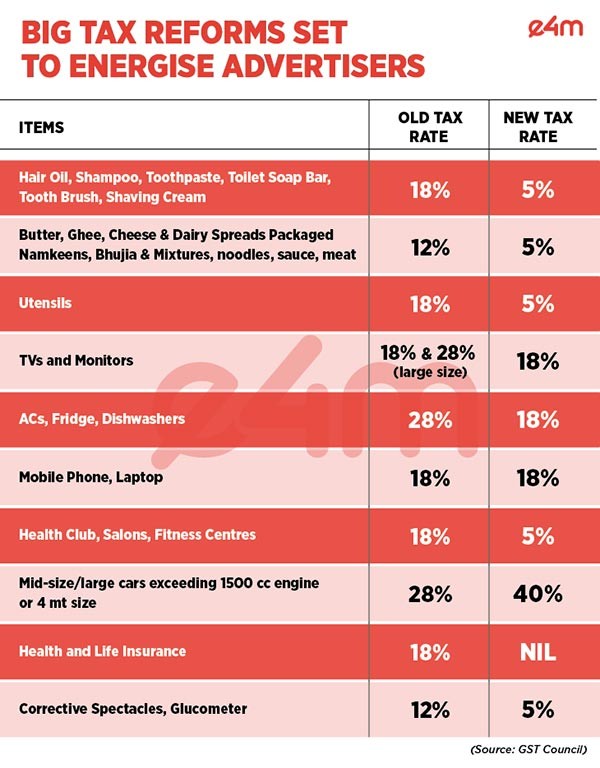
As per the new norms, essential food items like UHT milk, paneer, Indian breads like chapati and paratha have zero tax, while GST on butter, ghee, dry fruits, condensed milk, jams, confectionery, juices, milk-based drinks, biscuits, cereals, and more- drops from 18% to 5%.
GST on packaged foods such as sauces, noodles, chocolates, bhujia, preserved meats, toiletries, household goods, bicycles, kitchenware, leather goods, stone blocks also falls to 5% (from 12% or 18%). However, high-end vehicles, tobacco, and cigarettes will continue to attract a special 40% rate.
As expected, top advertisers hailed the reforms, saying the move will put more money in consumers’ pockets and boost both rural and urban demand.
Harsha Vardhan Agarwal, Vice Chairman & MD, Emami Limited, called it a “game-changing move.” He said, “The government’s proactive step to reduce GST will significantly boost consumption across rural and urban India. GST rate cuts, combined with income tax relaxations, lower repo rates, and a good monsoon, create a powerful ecosystem to drive growth. At Emami, our priority now is to pass on these benefits to consumers quickly so they translate into greater value.”
Manish Bajoria, Chief Financial Officer, bigbasket, echoed similar sentiments: “This festive gift of GST rationalization is a welcome step toward making daily essentials more affordable. It will strengthen the agricultural supply chain, improve cost efficiencies, and empower our farmer partners. We believe this will encourage greater consumption and contribute to building a stronger, more resilient India. We are fully prepared to work with partners and authorities to manage the transition and pass on the benefits to customers.”
Ahmed Abdel Wahab, General Manager, Mars Wrigley India, said the tax cuts will enable the industry to “restore value in packs, innovate new formats, support retailers nationwide, and reinforce our ‘Make in India’ commitment by building a stronger manufacturing ecosystem.”
The auto sector is equally upbeat, as small cars and two-wheelers will now enjoy the 5% GST slab. FADA President CS Vigneshwar called it “a watershed moment for India’s automobile retail industry,” adding, “We warmly welcome these bold reforms, which simplify the tax structure, lower rates for mass mobility, and bring consensus across states. This decisive step will boost affordability, spur demand, and strengthen India’s mobility ecosystem.”
The FMCG sector remains the top spender in India’s advertising market, accounting for nearly one-third of total ad expenditure — about ₹31,000 crore in 2024 — out of the ₹1 lakh crore-plus overall ad spend. Over half of FMCG marketing budgets are now allocated to digital media. The ecommerce and auto sectors are the second and third-largest advertising spenders with a 11% and 9% share respectively.
8-10 % ad growth expected
India remains a sentiment-driven market, and the reforms are expected to unlock confidence across sectors. With GST rationalization kicking in just ahead of the festive season, brands are gearing up to capture India’s biggest consumption window. Experts believe the combination of higher disposable income, simplified tax structures, and improved consumer sentiment will unlock a fresh growth cycle for advertising, particularly in FMCG, auto and insurance segments.
Experts believe FMCG players are likely to double down on mass media and regional activations, driven by strong price elasticity and GST-driven savings. Several veterans project 8–10% growth in ad spends during the current festive season compared to last year — with the potential for even higher gains if the ongoing US tariff issues are resolved. Festive season in India drives 30-40% of the total ad spend for most advertisers.
Veteran adman Ashish Bhasin, Founder, Bhasin Consulting, calls the reforms “a decisive moment” for the economy and advertisers alike. “This is one of the biggest GST reforms so far, and the timing couldn’t be better. Coming on the back of the US tariff situation, these changes are expected to simplify taxes, reduce prices, and leave more money in consumers’ hands. With RBI infusing liquidity, a good monsoon, and improved sentiment, we’re likely to see strong buoyancy, particularly in the FMCG sector. Advertising spends could see a healthy 8–10% growth over last year, driven by affordability and positive consumer sentiment,” he said.
Shradha Agarwal, co-founder and CEO of Grapes Worldwide agrees. “The 10–15% price drop acts as a natural catalyst for consumer spending, especially with the reforms kicking in on September 22, right before the festive season. As prices drop, purchase volumes go up — and marketing spends usually move in direct proportion to rising sales.”
When costs come down, marketing budgets often open up, especially in high-volume categories like FMCG and Confectionery. These sectors thrive on seasonal campaigns, and any fiscal relief is quickly reinvested to capture share. With Navratri, Durga Puja and Diwali round the corner, this season is set to see a surge in advertising spends, Sayak Mukherjee, Founder of Brandwizz Communications and Creator Cult, explains.
Marketing strategy
These sweeping changes in tax structures are not incremental; they’re a thought-through reform aimed at boosting long-term growth. It sends a strong message to industries and investors alike — India has entered the next rung of reforms, experts say.
Brands are gearing up for the festive rush with sharper offers, hyper-local campaigns, and aggressive regional activations, as experts predict a surge in mass media and digital spends to capture sentiment-driven buying this Navratri, Durga Puja, and Diwali.
“Brands will now focus on driving visibility and winning market share, making this a significant boost for consumerism and advertising alike this festive period,” Agarwal noted.
Echoing the sentiments, Mukherjee shared, “FMCG products, especially confectionery and chocolates could amplify festival-led campaigns with sharper promotional offers. Automobiles will need to pivot messaging — with small cars and bikes becoming more affordable, advertising will highlight accessibility and value, while SUVs in the 40% slab may need to lean on premium storytelling. Insurance players will likely shift to trust-building and scale campaigns, positioning themselves as more accessible with the removal of GST.”
The price cuts could also drive a wave of first-time purchases and upgrades, especially in underpenetrated segments of FMCG, FMEG, and consumer durables, as consumers reassess affordability, believes Nimesh Shah, Head Maven, Windchime Communications.
With festive demand expected to spike, Shah predicts a reshaping of advertising timelines: “If these campaigns take off as expected, we could see advertisers pulling Q4 spends into Q3 to ride the festive wave. In some cases, brands may even raise their overall ad budgets to maintain sales momentum well into 2025.”
He highlights that luxury brands—despite moving to the higher 40% GST slab—are also set to benefit: “Earlier, luxury players paid a combined burden of nearly 50% due to GST plus consumption tax. With the simplification, their effective outgo drops, leaving more room to reinvest in marketing. I won’t be surprised if luxury advertising sees a noticeable bump in the coming quarter.”
Read more news about Internet Advertising India, Marketing News, PR and Corporate Communication News, Digital Media News, Television Media News
For more updates, be socially connected with us onInstagram, LinkedIn, Twitter, Facebook YouTube & Google News