AI will remain your co-creator and not your competitor: Abhishek Das, EY
At e4m iDAC 2025, Abhishek Das, Partner at Ernst & Young, urged brands to move beyond AI hype and rebuild consumer trust through transparency, cultural sensitivity, and authentic storytelling
 by
by
Published: Oct 17, 2025 3:52 PM | 4 min read
 Follow Us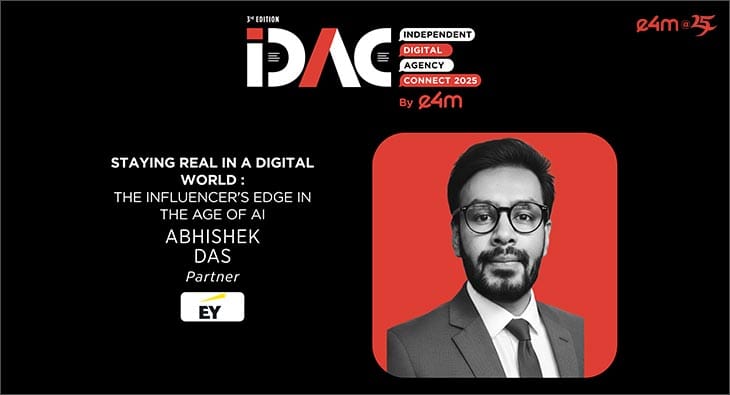

At the e4m iDAC 2025 summit, Abhishek Das, Partner at Ernst & Young (E&Y), delivered a thought-provoking standalone session on “Staying Real in a Digital World: The Influencer’s Edge in the Age of AI.” Moving beyond the hype, Das emphasized that while artificial intelligence has become central to modern marketing, brands must remember that authenticity and not automation will define the next phase of digital influence.
Opening his session with a wry observation about how AI has dominated nearly every panel discussion in recent months, Das admitted that the subject can get monotonous. “The only conversation we’ve been having across eight different sessions is about AI,” he said. “So, I decided to focus on balance, the fine line between human creativity and machine efficiency.”
Drawing from global data and E&Y’s own research, Das noted that nearly 73% of business leaders, including CMOs and brand owners have already integrated AI into their marketing strategies. Yet, while 68% of brands are exploring AI to reach audiences more effectively, consumer skepticism continues to rise. “Almost 215 million people are engaging with AI-driven content, but what’s equally significant is how wary they’ve become about the authenticity of what they consume,” he explained.
Das stressed that this growing trust deficit poses one of the biggest challenges for marketers. From deepfake impersonations to algorithmic bias, the darker side of AI has started to influence consumer perception and purchase behavior. Sharing a light anecdote, he said, “My father was amazed to see a video of me scaling Mount Everest, when in reality, I was sitting at a restaurant in Mumbai. That’s how convincing AI-generated content has become.”
The consequences, however, are no joke. Citing recent examples of brand breaches in the beauty and restaurant sectors, Das pointed out how unverified AI content, left unchecked, can spiral into reputation crises. “These incidents weren’t about bad intent. They were about missing the human layer of verification, the step where someone asks, ‘Is this real?’,” he said.
For Das, the erosion of trust goes deeper than misinformation. It challenges the emotional connection between consumers and brands. “AI can amplify and replicate, but it can’t empathize,” he said. “That limited emotional connection is where the human touch becomes irreplaceable.”
He reminded marketers that the fundamentals of trust haven’t changed and only the mediums have. Whether a customer is questioning the freshness of a sandwich or the authenticity of a product review, it all comes down to credibility. “Consumers haven’t changed. Brands haven’t changed either. What’s changed is how we consume and sell information,” Das said.
Looking at the regulatory landscape, Das observed that while Europe has taken early steps toward AI governance, India still lacks a unified framework. “We don’t have a standard AI policy yet. But the starting blocks are clear — transparent disclosures, ethical guidelines, verification mechanisms, accountability, and most importantly, a human touch,” he outlined.
He urged brands to disclose when content is AI-generated, especially on platforms like Instagram or YouTube. “It’s as simple as stating, ‘This video was created using AI.’ Transparency is not a weakness but it’s a strength that builds credibility,” he said.
Das also highlighted the cultural sensitivities unique to India’s market. “What works in the US or Europe might backfire here. From colors to cultural symbolism, context matters deeply,” he cautioned, referring to past global brand controversies that sparked local outrage.
As he moved toward the future of influencer marketing, Das identified key shifts already underway — hybrid influencer models, trust verification systems, and a growing need for ‘authenticity at scale.’ He predicted that by late 2026, global markets would begin to see more structured AI policies and brand disclosure norms taking shape.
“AI is not going anywhere. It will remain your co-creator and not your competitor,” he said. “But you must be clear where human judgment ends and machine generation begins.”
Das closed his session with three takeaways that resonated with the audience. First, he urged marketers to treat authenticity as their competitive advantage. Second, he encouraged them to localize strategies instead of mimicking global trends. And finally, he reinforced that trust remains the ultimate currency of branding.
“If brands lose trust, their equity collapses in minutes,” he warned. “The future belongs to influencers who use AI to amplify their humanity, not replace it.”
As applause filled the room, Das ended on a thought-provoking note, leaving the audience with one final question; whether the presentation itself had been AI-generated or entirely human-crafted. “I’ll let you decide that,” he smiled.
Read more news about Internet Advertising India, Marketing News, PR and Corporate Communication News, Digital Media News, Television Media News
For more updates, be socially connected with us onInstagram, LinkedIn, Twitter, Facebook YouTube & Google News
