Women in comms: Progress made, but has India truly broken the glass ceiling?
At e4m PR and Corp Comm 30 Under 30 2025, women leaders debated progress, bias, and leadership challenges at the session
 by
by
Published: Dec 17, 2025 1:08 PM | 5 min read
 Follow Us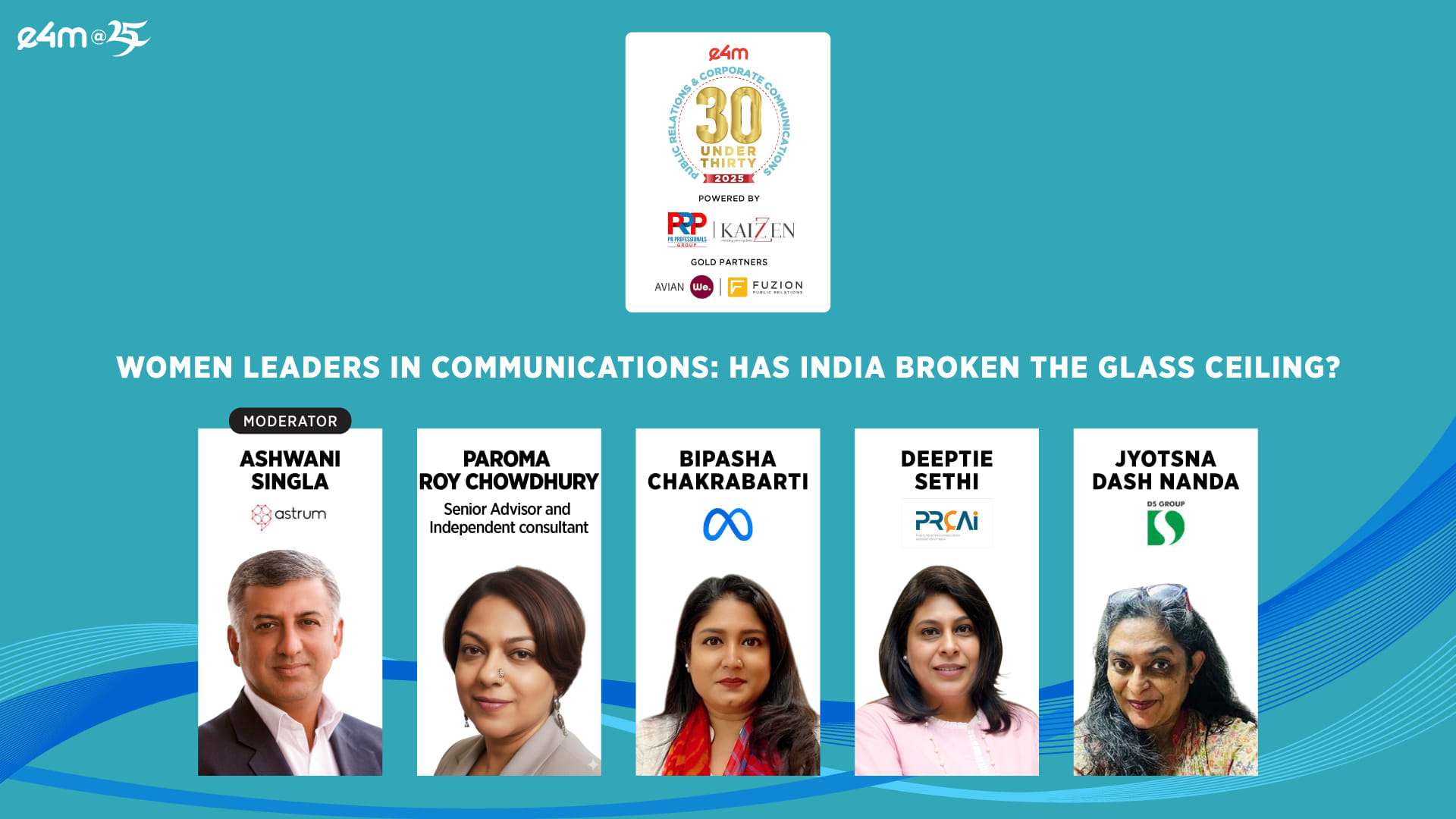

Even as India’s communications industry speaks the language of inclusion and progressive leadership, questions around who truly makes it to the top remain unresolved. Women today lead marquee agencies, shape reputations of powerful brands and influence public discourse, but their rise has not been linear or equal. It is against this backdrop of visible progress and lingering bias that senior women leaders gathered at the E4M PR and Corp Comm 30 Under 30 2025.
The women leaders from India’s communications ecosystem came together for a candid discussion on the session titled “Women Leaders in Communications: Has India Broken the Glass Ceiling?” The session examined progress, persistent challenges, and the uncomfortable truths surrounding leadership, meritocracy, and gender bias in the industry.
The panel featured Paroma Roy Chowdhury, Senior Advisor and Independent Consultant; Bipasha Chakrabarti, Director – Corporate Communications, Meta India; Deeptie Sethi, CEO, PRCAI; and Jyotsna Dash Nanda, AVP – Corporate Communications, DS Group. The session was chaired by Ashwani Singla, Founding and Managing Partner, Astrum.
Opportunity has expanded, but the climb remains uneven
Opening the discussion, Sethi highlighted that while PR and communications today offer far wider opportunities than before, women still tend to exit the leadership pipeline too early.
Quoting global industry data, she noted that male dominance in PR boardrooms has reduced from 61% to 51% in the past year, signalling progress. However, she cautioned that women often “give up too easily,” emphasising that the conversation should not be framed as men versus women.
“High performers, irrespective of gender will always move up. Merit, resilience, and the ability to stay the course are what truly matter,” Sethi said.
A reverse diversity argument
Chowdhury offered a contrarian perspective, arguing that PR and public affairs are among the few sectors where women already dominate leadership roles.
“In PR and corporate communications, there are more women in leadership than men. In some cases, there’s even an argument for reverse diversity,” she said, while clarifying that gender should never be treated as a success credential.
She also pointed to self-created barriers, particularly among women who hesitate to ask leadership-focused questions.
“Men ask how to build influence and personal brand. Women ask whether they can balance home and work. That hesitation becomes a silent barrier,” Chowdhury noted.
Structural biases still persist
While resilience was a recurring theme, the panel agreed that structural challenges continue to disadvantage women.
Nanda spoke about microaggressions and the need to navigate them without losing sight of personal goals. “Giving up is easy. Finding a way forward is the real challenge,” she said.
Chowdhury shared stark personal experiences, including being denied professional benefits due to assumptions about her husband’s income, and encountering workplaces without basic infrastructure like women’s washrooms at senior leadership floors.
“These are not individual issues. They are structural failures,” she said, while acknowledging that multinational organisations with strong processes often create more enabling environments.
Processes over intentions
Sethi drew a sharp contrast between multinational corporations and domestic agencies, arguing that robust processes reduce discrimination.
“In MNCs, decisions are driven by rulebooks, not biases,” she said. However, she added that Indian PR firms must evolve from founder-driven businesses to professionally run organisations with succession planning, global exposure, and clear growth pathways.
“If we don’t professionalise in the next five years, we risk missing the bus entirely,” Sethi warned.
DEI: Culture, not a checkbox
Chakrabarti stressed that while merit must remain paramount, diversity and inclusion exist for a reason.
“The glass ceiling may be cracked, but it’s far from shattered,” she said, recounting instances where women were discouraged from global roles due to personal life assumptions, advice rarely given to men.
Chakrabarti also highlighted subtler barriers such as networking norms and the lack of sponsorship.
“Women ask for mentors, men ask for sponsors. You need someone advocating for you in rooms you’re not in,” she said. She added that inclusion should be a CEO-led cultural mandate, not an HR-driven checklist.
Are women holding each other'sback?
Addressing a difficult question, the panel reflected on whether women themselves sometimes limit other women’s progress. While all agreed that support systems for women exist, participation and proactive engagement remain uneven.
“We talk about ‘lift as you rise,’ but we need to practice it far more deliberately,” Nanda said.
Chowdhury added that growth ultimately lies in personal accountability. “If you’re not asking, not networking, and not working on your skill gaps, no forum can help you,” she said.
Chakrabarti referenced the concept of the ‘likability penalty’, where assertive women are judged more harshly than men, often by other women as well.
Lessons from the top
In closing, the panellists shared personal reflections:
Sethi emphasised pushing beyond comfort zones and wished she had learned self-advocacy earlier.
Chakrabarti cited resilience and assertiveness as critical to her journey, while acknowledging the challenge of navigating uncertainty.
Chowdhury pointed to resilience and directness as strengths, while reflecting on the need to manage ambiguity better.
Nanda shared that her biggest lesson was learning to speak for herself early in her career. “Your work won’t always speak for itself. You have to,” she said.
Read more news about PR and Corporate Communication News, Internet Advertising, Marketing News, Digital Media News, People Movement News
For more updates, be socially connected with us onInstagram, LinkedIn, Twitter, Facebook YouTube & Google News