The differentiator is no longer volume, it is voice, specificity, and emotional resonance
Poonam Nikam, Head of Communications – India & SEA, Snap Inc., explains why narrative capital is the true currency of modern communication
 by
by
Published: Apr 27, 2026 5:41 PM | 3 min read
 Follow Us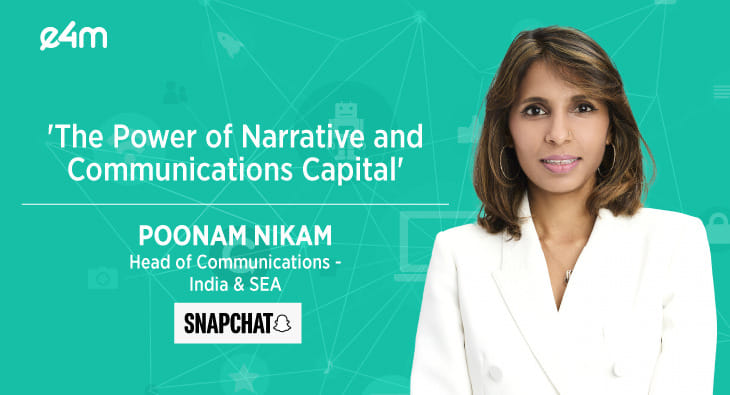

- Communication has evolved to prioritize clarity and differentiation in narratives over sheer volume or reach, with a focus on building trust through authentic storytelling.
- The post-pandemic consumer is highly media-literate, favoring genuine stories from peers over traditional sources like CEOs or media, as highlighted by Edelman's 2024 Trust Barometer.
- Generative AI has made content production easier but has increased the importance of meaningful, resonant communication, shifting metrics from reach to emotional impact.
- Effective storytelling remains rooted in classic principles, but the modern landscape requires adaptability to shorter, more personal, and visually-driven formats, emphasizing the importance of conveying meaningful messages.
Over the past few years, I have noticed a shift in how communication actually works. I think we would all agree that it is no more about getting the loudest headline or the widest reach. In today's works, content creation and consumption is constant, and attention is fragmented; what really cuts through is the clarity of the narrative, and more importantly, a differentiated one. The brand and leader that stay with you are not the ones you see the most, they are, in fact, the ones that stand for something distinct.
I have spent nearly two decades building communications strategies for digital businesses. And the single most important lesson I have carried through platform shifts, algorithm changes, and the dizzying rise of generative AI is this - narrative is not a campaign. It is the capital. It compounds over time. It earns trust. And when the market gets noisy, which it always does, it is the only currency that holds its value.
The New-Age Consumer
The post-pandemic consumer is perhaps the most media-literate audience in history. They have grown up watching branded content, they can identify a paid partnership in three seconds, and they are deeply allergic to anything that smells like spin.
Edelman's 2024 Trust Barometer placed peers and "people like me" as the most trusted source of information for consumers globally, ranking above CEOs, government officials, and media. Think about that for a moment. The most powerful voice for your brand is not your CMO's op-ed. It is an authentic story told by someone who genuinely believes in what you do.
At Snap Inc. we see this every day. The most meaningful communication reflects how people naturally connect and express themselves, with their real friends and family. Whether through a snap at the moment, a lens or through a forward. Especially Gen Zs, who only respond to communication that feels participative rather than performative. This is why the best communications professionals today think more like storytelling architects. They don't just manage messages. They create the conditions under which real stories can emerge, spread, and stick.
Storytelling in the Age of AI
Generative AI has done something paradoxical to communications: it has made content cheaper to produce and more expensive to make meaningful. When anyone can generate a press release or a blog post in seconds, the differentiator is no longer volume, it is voice, specificity, and emotional resonance.
I think of a conversation I had recently with a colleague who runs communications for a large D2C brand. She said something that stayed with me: "We stopped counting impressions. We started counting moments where someone actually felt something or something that stayed with them for a long time." That shift, from metrics of reach to metrics of resonance, is the quiet revolution happening inside the best comms teams right now.
Narrative capital is built through consistency. It is the founder who tells the same honest story about why they started, across a hundred different interviews. It is the company that responds to a crisis, not with legal boilerplate but with human acknowledgement. It is the brand that, over years, becomes synonymous with a specific set of values, not because it said so, but because it showed so, repeatedly.
At its heart, great storytelling follows the same rules it always has - a protagonist with stakes, a conflict that is real, and a resolution that earns its emotional payoff. What has changed is the canvas, shorter, noisier, more personal, more visual, more fragmented.
In the end, the question is not: How do we make more noise? The question is: What do we want to mean? In a world drowning in content, meaning is the only thing that floats.
Read more news about PR and Corporate Communication News, Internet Advertising, Marketing News, Digital Media News, People Movement News
For more updates, be socially connected with us onInstagram, LinkedIn, Twitter, Facebook YouTube & Google News