B'luru’s iconic KFC Signal makes way for Pizza Hut: The media value of brand landmarks
Netizens across social platforms have been flooding timelines with nostalgia, jokes, and stories of how deeply the KFC Signal was woven into their daily lives
 by
by
Published: Nov 18, 2025 9:41 AM | 9 min read
 Follow Us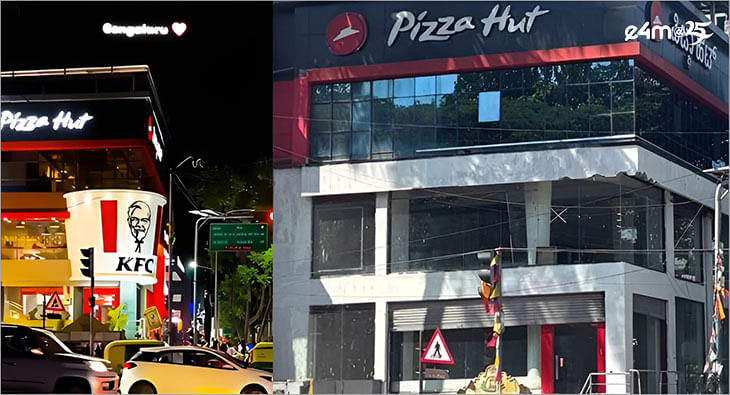

For many Bengalureans, the city has changed in a small but meaningful way over the last few days, as the familiar KFC Signal in Indiranagar is getting replaced. The towering red bucket that crowned the junction for decades wasn’t just a fast-food signboard, it was a wayfinder, a cultural cue, and part of the city’s collective memory. Now, it’s making way for Pizza Hut.
Netizens across social platforms have been flooding timelines with nostalgia, jokes, and stories of how deeply the KFC Signal was woven into their daily lives. On Reddit, people called it “the end of an era.” One user wrote, “Tragic — though I think it’ll still always be called KFC Signal.” Another confessed, “Damn, KFC was my way of remembering idhar turn lena hai metro ke liye.” Another user wrote, “Indiranagar itself doesn’t feel like Indiranagar anymore.” And of course, the humour surfaced too, “Imagine now saying Pizza Hut Signal.” A few also pointed out the deeper irony, that these unofficial landmarks live on mostly in nostalgia, which then ends up confusing newcomers who have no idea what “KFC Signal” even refers to.
But this isn’t just about a fast-food signboard coming down. In Bengaluru, brands have long spilled beyond storefronts to become wayfinders, cultural markers, and in many ways, unpaid out-of-home (OOH) assets. The city’s landscape is filled with such brand-led junctions, to name a few, Sony World Signal, Wipro Signal, Dalmia Circle, Shanti Sagar Signal, Hard Rock Signal to name a few, even hyper-local cues like “the Airtel office road.”
According to Thivyanathan A, Senior Vice President at Madison World, who has closely observed the city and its changing navigation habits, these brand-led references really took shape only in the last two decades, largely driven by the influx of migrants who relied on simple, memorable cues to find their way around an unfamiliar Bengaluru. “Some junctions organically turn into brand landmarks because commuters start using them for navigation. When people say ‘Take a left at the KFC signal,’ the brand quietly becomes part of the city’s mental map. These names stick because they simplify wayfinding, in a fast-growing city where thousands move in every year, familiar brand names often work better than official signal names,” he told e4m.
Over the years, these brand names have become far more memorable than the actual road names. What’s remarkable is that none of this was part of any brand playbook, yet these spots became some of Bengaluru’s strongest, longest-lasting recall triggers.
So, the disappearance of the KFC Signal is more than just a signboard being removed. It’s another reminder of how deeply brands get stitched into the city’s emotional and navigational fabric, and how Bengaluru’s identity subtly shifts every time one of these unofficial landmarks fades away. A case in point is Koramangala’s Sony World Junction. Even though the store moved to another lane, it still continues to be called “Sony World” without anyone thinking twice.
Experts say this kind of organic, hyper-local visibility is something brands can never fully replicate through paid advertising. Investor and entrepreneur Sandeep Kohli, who launched Yum! Brands (KFC and Pizza Hut) in India, agrees that the recall effect is substantial. “If you see it twice, on your way to work and then again on your way home — it nudges you to try the brand. Especially with QSRs like KFC, where the cost of trial is low, this repeated visibility really works.”
On losing such a landmark, he adds, “Iconic brands have a lot of resilience. One sign being removed will probably go unnoticed.”
Meanwhile, Aparna Bhawal, CMO, KFC India and Partner Countries, shared, "Every once in a while, a brand asset goes beyond marketing and becomes part of people's lives & culture. The Indiranagar ‘KFC Signal’ in Bangalore is one such landmark. We’re humbled & grateful for how the city embraced this restaurant and made it part of their lives — especially fitting since it is in the heart of the city where KFC began its India journey three decades ago. Indiranagar’s ‘KFC Signal’ reflects the deep love consumers have for the brand. And even as we move to a nearby location, it’s heartening to see the Internet agree that it will always be the ‘KFC Signal’."
Bengaluru’s Organic Brand Landmarks
Beyond nostalgia, the disappearance of signals like KFC also exposes a deeper truth about how Bengaluru internalises brands. Over the last 15–20 years, the city has transformed dramatically, and as Thivyanathan notes, “This landmark isn’t something that existed for 40–50 years; it became popular only in the last two decades as Bangalore expanded.”
Yet its cultural weight has far exceeded its age. These brand-led junctions have quietly become part of Bengaluru’s everyday vocabulary because of how commuters intuitively process space. Experts told e4m that these names stick because they make navigation simpler for a constantly growing city, where familiar brand names often serve as more practical reference points than official signal names.
Gaurav Arora, Co-Founder of Social Panga, “These spots show up in directions, in conversations, in memories. That’s the hidden media value. It’s not a billboard or establishment; it’s a part of the city that ends up saying the brand’s name for you.”
This is also where their “unpaid OOH power” becomes most visible. These intersections effectively behave like organic billboards — every time someone says “Take a left after KFC Signal,” “Cross Wipro Signal,” or “Stop near Sony Signal,” the brand receives daily verbal and visual reinforcement without spending a single rupee on media. As Sudhakar M.R., Co-Founder of Ad6 Advertising, Bengaluru’s specialised outdoor advertising firms, points out, Bengaluru’s busiest junctions can generate 1–5 lakh impressions a day, a scale that even many paid OOH campaigns struggle to achieve. Sudhakar describes such junctions as “unintentional media monuments.”
He explains that commuters instinctively rely on landmarks rather than road numbers, and this repeated exposure creates habit loops. Over time, the brand becomes embedded in people’s spatial memory, not through advertising, but through everyday navigation. According to him, when a landmark like KFC Signal disappears, the brand loses an entire layer of subconscious recall built over years of repetition.
Sudhakar shared, “The junctions deliver constant mental reinforcement, which is equivalent to always-on, zero-cost OOH.” Over years, this transforms junctions into the city’s linguistic markers — places called by brand names instead of their official titles, referenced in cab conversations, Google reviews, delivery instructions, and even memes.
And when a landmark like this fades, experts say the loss is quite straightforward as the brand instantly loses its invisible OOH presence. What the brand gives up is significant is daily verbal mentions, micro-market dominance, and a habitual recall point built subconsciously over thousands of commuter journeys.
Hidden Media Value & What Brands Actually Lose
For years, brands like KFC, Sony, and Wipro enjoyed free, perpetual, hyper-local visibility that no planned outdoor campaign could match — emotional association, navigational recall, and an offline presence reinforced purely through how people moved and spoke in the city. So what does a brand actually lose when such a landmark disappears?
Experts say three things vanish almost instantly: its organic top-of-mind recall, its hyper-local identity, and the massive “invisible reach” generated by the lakhs of impressions that came from the brand being uttered, referenced, and visualised every single day.
Brand strategists say losing this does create a small decline in spontaneous recall, fewer daily brand triggers, and reduced micro-market visibility. But they also point out that strong brands can absorb this change without business impact.
As per Arora, however, the brand won’t lose anything for at least a decade. “More importantly, the brand never intended for that landmark to become its identity, so there’s nothing actively at risk. These names stick. Even the Sony showroom that shut down years ago is still known as “Sony Signal” in Koramangala. So the “KFC Signal” isn’t going anywhere, even the vegetarians will keep calling it that for years to come.”
However, as Kohli points out, iconic brands tend to be far more resilient than we think, “One sign being removed will probably go unnoticed.” Experts also say consumers adapt incredibly fast. In a city where road names, buildings, and landmarks are always changing, this is just another shift. Bengaluru will move on, and the vocabulary will eventually align with whichever brand takes over that corner next.
Marketers believe the commercial impact is minimal and hyper-local. The only real loss is the long-running, free top-of-mind recall attached to that particular spot — not the brand’s actual value or business. “Customers who want KFC will still travel, even 10 kilometres,” added Thivya. And as new brands come in, the mnemonic simply changes hands. What was once KFC Signal could soon become Pizza Hut Signal or McDonald’s Signal without missing a beat.
Yet the larger cultural loss remains. As Sraman Majumdar, Executive Creative Director, Brave New World, puts it, “There’s a cultural currency that a brand gains from being part of the city’s wayfinding lexicon.” But he argues that the emotional loss lies more with Bengaluru than with the brand. “People will miss KFC Signal the way they missed Sony Signal, stubbornly sticking to the name, and eventually moving on. I’d argue that the city has lost more than KFC has, and yes, that does count as the end of an era.”
Because at the end of the day, these brand-led signals aren’t just navigation points, they are pieces of shared memory in a city that is changing faster than its residents can map it.
Brand consultant Fabian Trewor echoes this sentiment, noting that people form place-based memories through repetition, familiarity and shared rituals. “When the fabric of a location changes, these feelings wane because we have a strong visual connection with places.” But he also emphasises that the junction itself will retain significance, only the brand associated with it will evolve. Cities adapt; people recalibrate.
Ultimately, the disappearance of signals like KFC is a reminder of how Bengaluru’s identity is constantly remapped, not just by urban planners, but by the brands, memories, and everyday journeys that anchor its people.
Read more news about Out of Home, Internet Advertising, Marketing, Digital Media, TV Media
For more updates, be socially connected with us onInstagram, LinkedIn, Twitter, Facebook, YouTube & Google News