A newsroom without a redressal system is failing its women
Bansuri Swaraj was speaking at the inaugural edition of ‘e4m Women in Media, Digital and Creative Economy’
 by
by
Published: Mar 17, 2025 6:44 PM | 4 min read
 Follow Us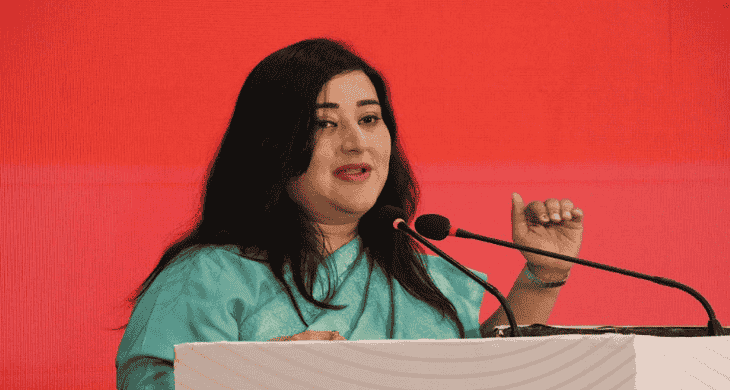

Bansuri Swaraj, Senior Advocate at the Supreme Court of India and Member of Parliament (Lok Sabha), spoke on “Gender, Law & Newsrooms: Building an Inclusive Media Landscape at the inaugural edition of ‘e4m Women in Media, Digital and Creative Economy’.
She spoke about gender bias in journalism and the legal frameworks necessary to protect and empower women in media and beyond.
Opening her speech with characteristic wit, Swaraj compared herself to an "opening batsman," setting the pitch for a larger conversation on gender representation in media, unconscious bias in law, and the structural challenges that still plague workplaces across industries.
Breaking Gender Barriers in Newsrooms
Swaraj highlighted the stark underrepresentation of women in journalism, noting that globally, women make up less than 20% of newsroom positions. Despite advancements, investigative journalism and political reporting remain overwhelmingly male-dominated, with women often assigned “softer” beats like lifestyle and human-interest stories.
She illustrated this bias with a compelling anecdote about how women journalists are often given different career trajectories than their male counterparts. A male journalist might be assigned a hard-hitting political exposé, while a female journalist is often steered towards feature writing or entertainment coverage.
However, she celebrated women journalists who have defied norms and taken on leadership roles, mentioning pioneers such as Ghazala Amin of Doordarshan, Usha Rai and Shobhana Bhartia. These women, she argued, have proven that women can lead from the front and redefine newsroom culture.
Unconscious Bias and the Burden of Proof on Women
Drawing from her own experience as a lawyer, Swaraj shared a revealing moment from her early career in courtrooms. She recalled an incident where, after successfully arguing a case, a court officer—who had earlier addressed her as "Madam"—suddenly referred to her as "Sir", as if her competence had transcended her gender.
“This unconscious bias is not just in law—it is in newsrooms, in politics, in every profession,” she asserted. “Women are often expected to work twice as hard to be taken seriously.”
Swaraj argued that gender bias isn’t just overt discrimination; it’s woven into language, expectations, and the fundamental way institutions operate. She stressed the need for systemic change in media hiring, retention, and leadership pipelines to ensure that more women rise to decision-making positions.
Strengthening Legal Safeguards for Women in Media
Swaraj’s address also touched on the legal protections available to women in the workplace. She revisited the Vishakha guidelines and the POSH Act of 2013, emphasizing the role of the Supreme Court in bridging legislative gaps to protect women from workplace harassment.
However, she pointed out that many media organizations still lack robust internal complaint committees, making it difficult for women to report harassment. “A newsroom that does not have a clear redressal mechanism is failing its women employees,” she said, calling for stricter enforcement of anti-harassment laws.
Political Representation and the Role of Women in Policy Making
Swaraj also underscored the importance of women’s political participation in shaping policies that impact them. She hailed the passage of the Nari Shakti Vandan Adhiniyam (Women’s Reservation Bill), which will mandate 33% representation of women in Parliament and State Assemblies by 2029.
“With more women in leadership roles, media narratives will change, and so will policies that shape our everyday realities,” she asserted.
Swaraj called on women in journalism, law and politics to break the culture of silence. “Your silence does not protect you. It only gives another opportunity for someone else to be victimized.”
She stressed that gender equality is no longer just about empowerment—it’s about leadership. “The future is female, and the future is now,” she declared, urging both men and women to actively dismantle biases and create a more inclusive media landscape.
Read more news about Television Media, Digital Media, Advertising India, Marketing News, PR and Corporate Communication News
For more updates, be socially connected with us onInstagram, LinkedIn, Twitter, Facebook YouTube & Google News