Journalism is becoming increasingly personality-centric: Prof. K.G. Suresh
He was speaking at an event organized by the Department of Journalism and Mass Communication at Banaras Hindu University
 by
by
Published: Jan 17, 2026 10:22 PM | 5 min read
 Follow Us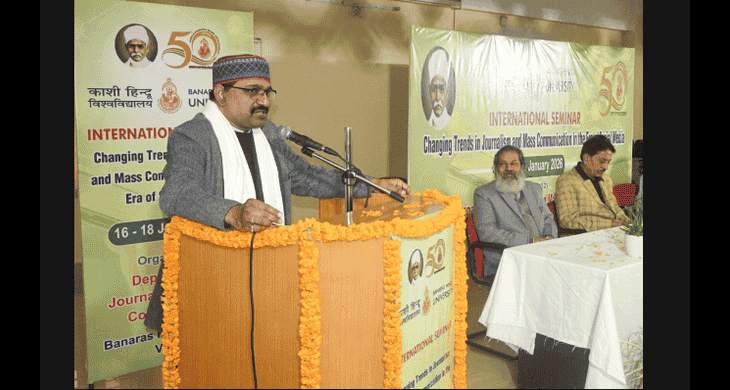

On the second day of the three-day international seminar titled “Changing Trends in Journalism and Mass Communication in the Era of Social Media”, organized by the Department of Journalism and Mass Communication at Banaras Hindu University, a thought-provoking panel discussion was held on the topic “Mass Communication vs. Social Media”.
The Keynote speaker of the session, Prof. K.G. Suresh, Director of India Habitat Centre, ex DG, IIMC & former Vice Chancellor, MCU described himself as a supporter of social media, stating that it has given a new direction to mass communication and played a significant role in the democratization of media. He noted that social media has brought to the fore many issues that were previously overlooked by mainstream media, thereby establishing new dimensions in journalism.
However, Prof. Suresh also drew attention to the challenges associated with social media. He said that the reels culture has increased superficiality in content. The desire to consume everything in one minute has led to compromises in quality. Today, the purpose of content creation has become merely to hold the user's attention on the screen for a few seconds. He expressed concern that today's youth have become disconnected from serious newspapers and entangled in reels culture, leading to increasing trivialization.He stated that on podcasts and digital platforms today, more emphasis is placed on views and monetization than on content quality, causing journalism to become increasingly personality-centric such as Podcasters & You Tubers. Prioritizing individuals over issues is a dangerous signal for democracy. To save journalism, it is essential to move away from a personality-driven approach and re-establish issue-centric journalism.
Prof. Suresh also mentioned that excellent research-based writing continues in regional languages today, but the number of readers is declining. Investigative journalism, which has been the foundational pillar of journalism, appears to be weakening today. There was an expectation that digital media would become the voice of marginalized people, but due to TRP and views-based trends, many important issues are being left behind. Emphasizing the need for serious discourse on the negative aspects of social media, he said that when connecting journalism with social media, special emphasis must be placed on impartiality and the principles of Five Ws and One H.
The distinguished speaker of the session, renowned media educationist and former Vice-Chancellor Prof. K.V. Nagraj, stated in his address that social media is increasingly taking the form of mobocracy today. He said that large business houses and corporate entities are controlling media through advertisements. Commenting on YouTube journalism, he noted the lack of responsibility and accountability in it.Prof. Nagraj said that society is being redefined in the name of development. Technology is increasingly becoming a monster, and instead of controlling it, we are allowing it to rule over us. Quoting Mahatma Gandhi, he said: “Extract what is best from society; ideology is extremely essential.” According to him, communication without ideology holds no meaning.He also stated that social media is enclosing us in a kind of cocoon, where active social intervention is declining. Commenting on the relationship between power and inequality, he said that where there is power, equality cannot exist. He acknowledged that both positive and negative aspects exist in media, but without social responsibility and accountability, journalism deviates from its purpose.
During the panel discussion, the speakers agreed that print media remains an extremely powerful medium today and its role in guiding society continues to be paramount. Expressing hope for meaningful conclusions from the seminar, the speakers emphasized the restoration of journalism's core values.
During the three-day international seminar, subject experts from various countries shared their views. A total of 180 research papers were presented in different sessions of the seminar, featuring serious discussions on diverse aspects related to digital media, social media, and contemporary journalism.
Dr. Irina Babik from Boise University, USA, said that digital media has made communication more participatory and rapid, but maintaining credibility and factuality has become the biggest challenge today. She described media literacy as an essential need of the time.
Dr. Anna Gladkova from Lomonosov Moscow State University, Russia, said that social media has given new momentum to global dialogue, but algorithm-based content is also increasing polarization in society. She emphasized the need for balanced and responsible journalism.
Dr. Kundan Aryal from Tribhuvan University, Kathmandu (Nepal), said that in developing countries, social media has promoted public participation, but in the absence of ethical journalism and social responsibility, this medium can also become a source of misleading information.
Dr. Jude William Genilo, Pro-Vice Chancellor of University of Liberal Arts, Bangladesh, said that the purpose of communication is not only to provide information but also to develop sensitivity and inclusivity in society. He stressed the need to build a strong bridge between academic research and media practices.
Dr. Sharon Wilson from Malaysian University said that the form of journalism is changing rapidly in the digital age. She highlighted the need to prioritize human values and integrity while keeping pace with technology.
The ideas presented in these sessions of the international seminar have provided new direction to meaningful thinking about the future of journalism and mass communication.In the panel discussion, Department Head Dr. Gyan Prakash Mishra welcomed and honored the speakers and guests by presenting angavastram, bouquets, and mementos. The session was chaired by Sanjeev Bhanawat, Editor of Communication Today. The proceedings were conducted by seminar organizing secretary Dr. Bala Lakendra.Among those prominently present were Prof. O.P. Singh, Prof. Prof. Anil Upadhyay, Dr. Raumashankar Pandey, Dr. Shobhana Nerlikar, Dr. Neha Pandey, Dr. Dhirendra Rai, Dr. Santosh Shah, Dr. Smiti Padhi, and all other participants.
Read more news about Print Media, TV Media, Advertising India, Digital Media, Marketing
For more updates, be socially connected with us onInstagram, LinkedIn, Twitter, Facebook, YouTube & Google News
