ABC: Regional print enters transition phase as Tier-2 & 3 markets reshape reading habits
The ABC report for Jan–June 2025 highlights market realignment driven by changing lifestyles, rising digital engagement & publisher innovation aimed at deepening local connect
 by
by
Published: Oct 31, 2025 8:52 AM | 11 min read
 Follow Us

After two years of post-pandemic stability, India’s Tier-2 and Tier-3 print markets are showing early signs of recalibration rather than decline.The latest Audit Bureau of Circulations (ABC) report for January–June 2025 indicates mild-to-moderate corrections across Hindi and southern-language editions, a shift industry executives say reflects changing consumption patterns and portfolio realignment, not weakening reader confidence.
Circulation dips across core regional markets
ABC data for the first half of 2025 shows a widespread decline across multiple regional editions, confirming that even traditional print strongholds in Tier 2 and 3 towns are not immune to changing reader habits.
Read e4m Deep Dive on ABC numbers
In Hindi markets, Amar Ujala Kanpur fell 12.1 per cent to 166,819 copies, while Lucknow dropped 9 per cent to 162,134. Amar Ujala Nainital slipped 5.8 per cent to 50,306, and Dainik Jagran Haldwani declined 12.5 per cent to 31,122. The Tribune editions in Bathinda, Jalandhar, and Gurugram recorded the steepest fall of 18.3 per cent to 147,424 copies.
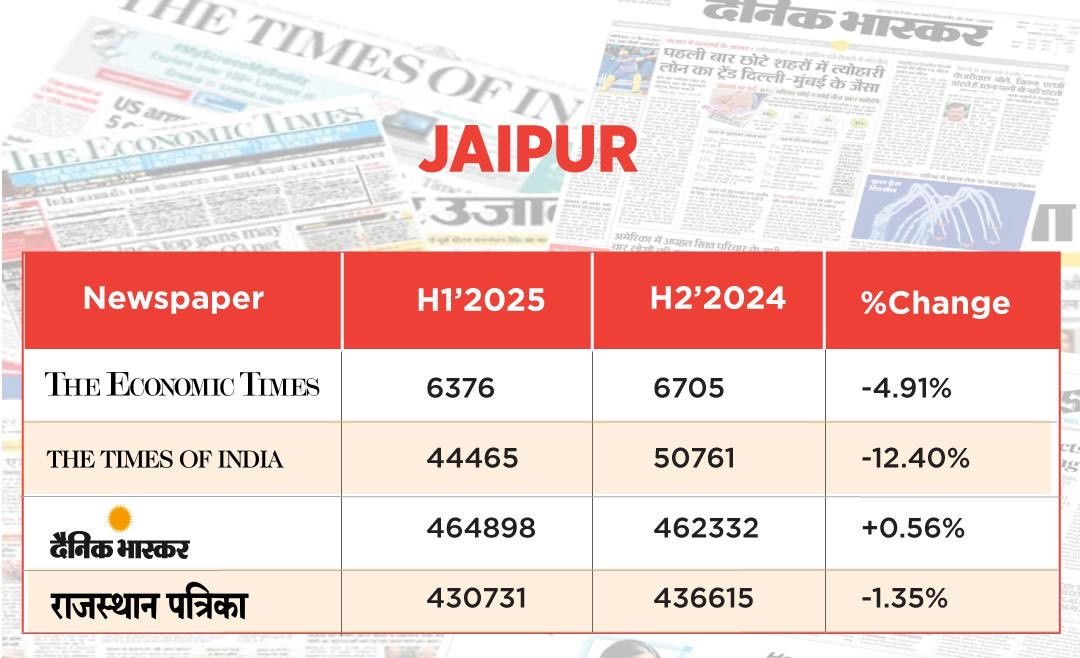
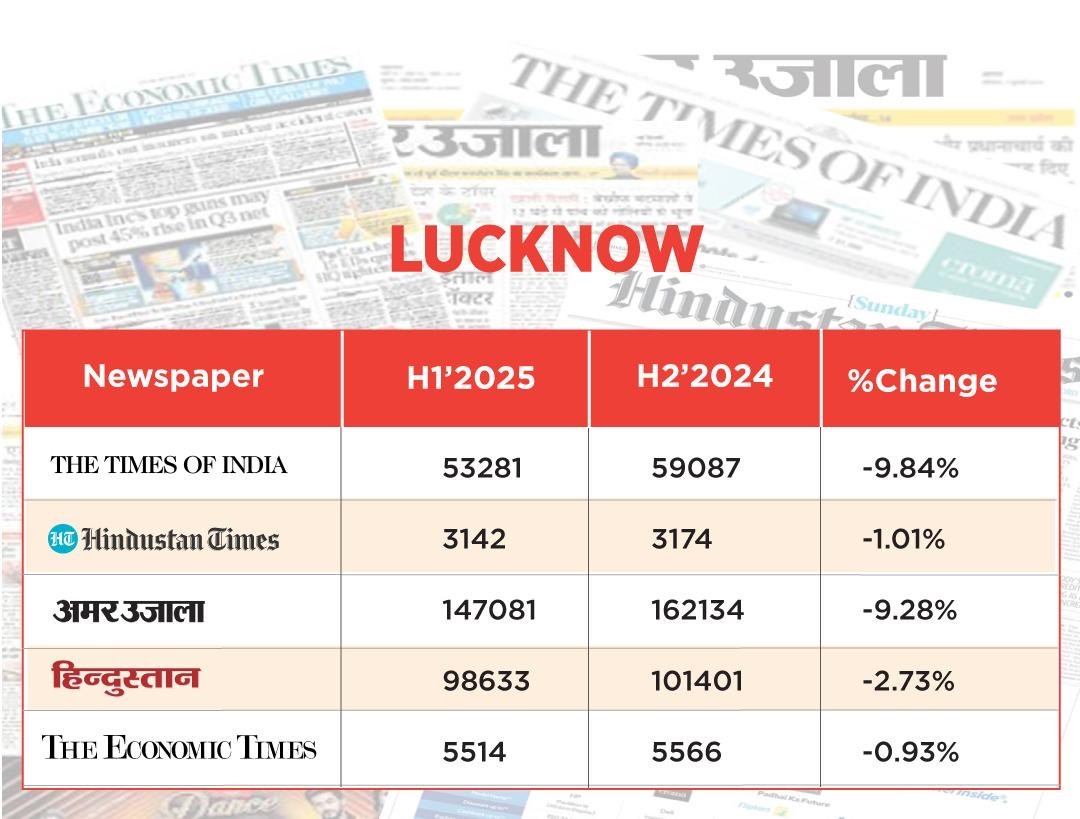
(Above tables are based on data from select cities)
In English business newspapers, ET Bhubaneswar declined 2.2 per cent to 24,816 from 25,381, while ET Nagpur fell 1.2 per cent to 5,733.
In western India, Lokmat Nagpur slipped 2.5 per cent to 202,677 copies, southern markets saw a similar softening. Malayala Manorama’s Kannur edition fell 6.2 per cent to 87,781, Kottayam declined 3.9 per cent to 232,090, and Malappuram dropped 4.8 per cent to 68,620. Mathrubhumi in Alappuzha fell 4 per cent to 57,721, while in Kannur it saw a decrease of 2.5 per cent to 133,882. Sakshi’s Guntur edition declined 4.5 per cent to 72,595 and Tirupati fell 6.9 per cent to 46,789.
Read e4m report on ABC's daily circulation numbers
All in all, the numbers point to a period of adjustment as publishers and readers recalibrate their relationship with print in smaller markets.
Pockets of resilience emerge
Despite all the slides, a few markets have bucked the trend.
For instance, Amar Ujala Karnal grew 6.5 per cent to 47,644 copies, while Dainik Bhaskar editions posted modest gains Jodhpur up 1.2 per cent to 84,301, Bhopal up 1.3 per cent to 189,095, Bilaspur up 0.6 per cent to 60,199, and Jaipur up 0.6 per cent to 464,898. Hindustan also reported strong performance in select markets, with Kanpur rising 6.3 per cent to 123,550 and Patna increasing 5.4 per cent to 305,984. In the South, Daily Thanthi Madurai rose 1.5 per cent to 103,615 and its Puducherry edition was up 1.1 per cent to 22,796. Dinamalar Puducherry jumped 7 per cent to 49,925, while its Coimbatore edition climbed 4.8 per cent to 129,781.
While industry observers say part of the ABC growth in certain markets can be attributed to new edition launches or pricing interventions, outliers like Dainik Bhaskar who have managed to post gains said they did so purely on the strength of reader demand and brand trust.
Sumit Modi, Chief Operating Officer, Madhya Pradesh, Rajasthan and Chhattisgarh, Dainik Bhaskar Group, said the paper’s performance in these markets was entirely demand-led rather than driven by new launches.
“In the case of Dainik Bhaskar, this growth is purely demand-led, as we’ve had hardly any new additions to our list of editions,” Modi said. “Over the years, our fearless and incisive reporting has added immense value to readers’ lives. Alongside, our high-quality and innovative advertising continues to deliver better response and healthy ROI to advertisers. Both factors have strengthened trust and built a mutually beneficial relationship with readers and advertisers and that’s what the numbers reflect.”
To sustain momentum, Dainik Bhaskar rolled out a mix of high-engagement reader and trade initiatives. A summer campaign which invited readers to hunt for answers hidden across pages that ended up drawing an average of 1.5 lakh daily participants and over 9.7 lakh unique readers to date. On the circulation front, the group combined on-ground outreach by 1,000+ teams, digital and performance campaigns, and CRM-led retention tools to reach new and lapsed readers. It also strengthened its distribution ecosystem through programs designed to reward and emotionally engage channel partners while using automation-driven field visits to drive efficiency.
Where print loyalty weakens, digital habits take hold
Yet beyond publisher-led innovation, the real story may lie in how smaller-town readers themselves are evolving and how that’s reshaping the print ecosystem.
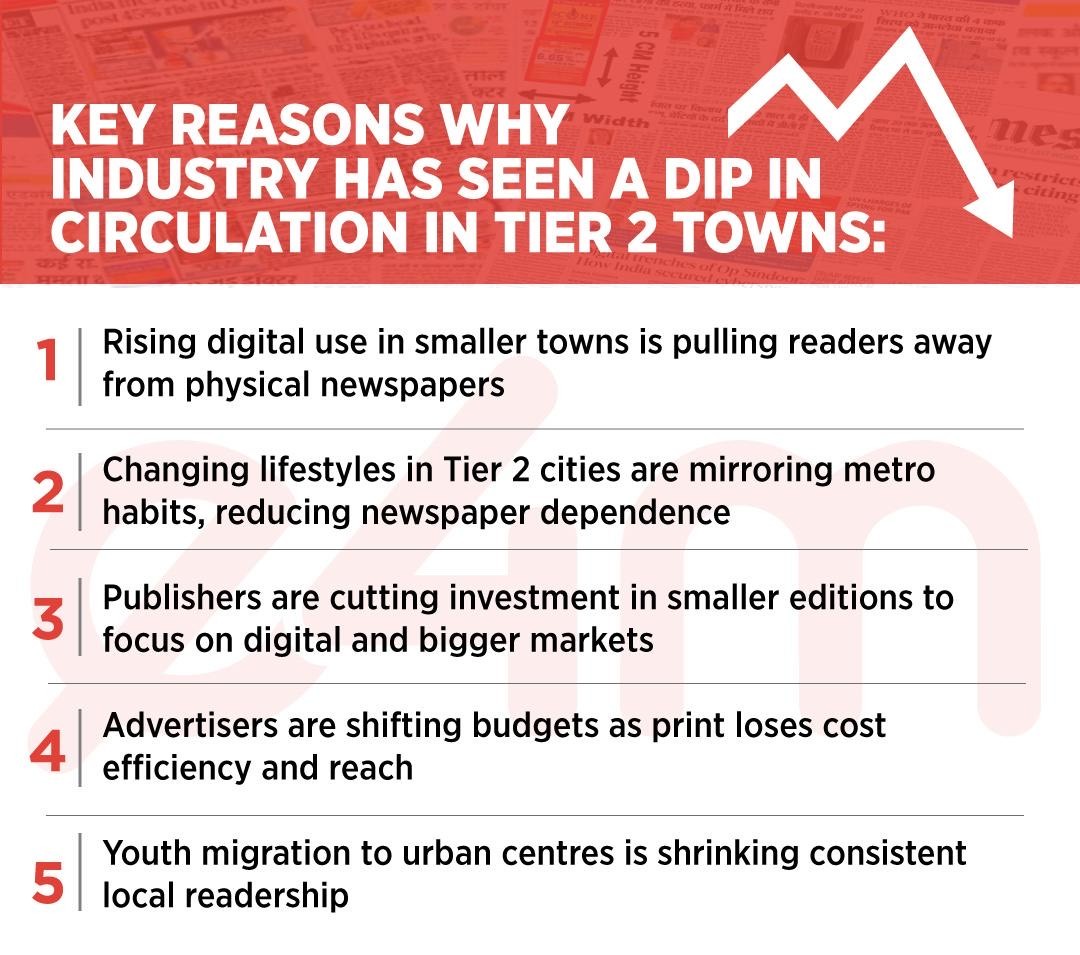
Mohan Singh, former Vice President at Madison Media and now a print media consultant, said the cultural and behavioural shifts in smaller towns are beginning to resemble those in metros. “Indore and Jaipur are gradually following metro culture. That could be one of the reasons for losing circulation. It directly correlates with higher digital adoption and a shift in daily lifestyle,” he explained.
He pointed out that the decline is not uniform across markets. Some cities are losing copies because of publisher strategy rather than demand. “A drop in circulation in Bareilly might not be solely due to falling reader demand,” Singh said. “It is also a direct result of strategic decisions by major publishers like Dainik Jagran and Amar Ujala to invest less in these editions. When resources are redirected toward digital or larger markets, smaller editions naturally take a hit.”
This dual influence of growing digital engagement and publisher realignment is reshaping how regional print evolves.
As reading patterns evolve, advertisers too are recalibrating where and how they spend.
Adding to this, Mayank Shah, Vice president, Parle products, mentioned that print as a medium still retains a certain level of importance, especially when we talk about specific categories and types of communication.
“For instance, in categories like automobiles or in cases where brands are targeting hyperlocal markets, both local and national players may still choose to use print. This is particularly true when the creative execution or messaging is such that print adds value. In these cases, print can still make a significant impact and continues to be relevant.
However, he elaborated, looking at regular communication that is more frequency-driven, where the objective is to optimize costs while maximizing reach, print starts to lose its edge. In Tier 2 and Tier 3 towns especially, print circulation has been on the decline. This reduction in reach, coupled with the issue of duplicity, makes print a less attractive medium from a cost-efficiency perspective.
Today, advertisers have access to a range of other platforms, as per Shah, such as digital and audio-visual mediums, which offer more precise targeting, better measurement, and often a higher return on investment. These platforms provide brands with the flexibility to adapt messages in real time and to reach consumers more effectively and efficiently, especially when it comes to day-to-day, tactical communication.
Regional realities behind the numbers
In southern and western India, publishers are seeing distinct trends that go beyond circulation numbers. According to Shreyams Kumar, Managing Director, Mathrubhumi Group and President, Indian Newspaper Society, regional and vernacular newspapers such as those in Malayalam and Kannada saw an average decline of around 3 per cent between January and June 2025, compared to the second half of 2024. English dailies, by contrast, saw a sharper drop of over 10 per cent during the same period.
“The pattern is largely uniform across cities and smaller towns,” Kumar said. “For English-language papers, the decline in smaller towns is slightly higher than in metros, partly due to increasing internet penetration.” Out of India’s 969 million internet subscribers, over 407 million are from rural regions, and that number continues to rise rapidly. “The figures suggest that the internet is becoming embedded in rural life from education to e-commerce to entertainment. This shift has inevitably affected news consumption as well.”
However, Kumar noted that digital expansion has not completely eroded print’s influence. “Increasing digital fatigue and excessive screen time among young children are now leading state governments to include newspaper reading in school curricula,” he said. “The proliferation of unverified content has caused a trust deficit in non-curated digital spaces, and that creates a real opportunity for legitimate news publishers offering verified and curated information.”
This renewed focus on credibility, Kumar added, gives print a vital edge. “Credibility and trust are the two major factors shaping reader sentiment, and these cannot be captured merely through circulation audits,” he said.
In Maharashtra, local migration patterns and changing reader behaviour are also playing a role in shaping circulation dynamics. According to Uday Jadhav, CEO of Sakal Media Group, education has reached even the remotest corners of the state, creating a skilled and aspirational youth population. “However, due to limited local opportunities, much of this talent is moving toward cities like Pune, Chhatrapati Sambhajinagar, Kolhapur, Nashik, and Nagpur,” he said.
Read e4m interview with Uday Jadhav on building a connection with print readers
As these young professionals and families move into urban centres, their exposure to multiple media formats widens but their need for credible, local, and community-focused news remains. Jadhav said Sakal’s circulation teams have been proactive in reaching out to these new readers through strong community networks. “We’ve built relationships through platforms such as YIN and Tanishka, along with local events and engagement initiatives,” he said. “This approach helps us not just acquire new readers but convert them into long-term, loyal subscribers.”
In the Marathi daily segment, Daily Sakal’s Jalgaon edition recorded 22,929 copies for H1 2025. Kolhapur remained the strongest performers with a circulation of 197,423 copies.
The Mumbai edition reported 11,554. In Nagpur, circulation stood at 65,523 copies.
Jadhav’s experience reflects what many regional publishers are observing, that print's relevance in smaller markets lies in its ability to build community trust and offer localized, people-first narratives that digital news often overlooks.
Temporary setbacks and structural challenges
Industry observers caution that not all circulation declines are structural. Some are seasonal or operational in nature. Continuous red and orange rain alerts during the first half of 2025 disrupted delivery and collections in several districts, impacting distribution in states like Kerala, Maharashtra, and Uttar Pradesh.
Kumar also pointed out that the ABC’s audit methodology contributed to short-term fluctuations. The bureau had initially mandated 100 per cent subscription payments through banking channels for the January–June 2025 audit period but later relaxed it to 60 per cent. “Many subscribers, especially in smaller towns, prefer paying in cash. Insisting only on digital transactions in markets that aren’t fully digitalised doesn’t serve any purpose,” he said. “As a result, several copies that were sold and circulated didn’t qualify for audit under these guidelines.”
Publishers focus on hyperlocal innovation
Even as circulation declines test the resilience of regional print, publishers are responding with innovation. Deepak Hiremath, Chairman and Managing Director of Vermmillion Communication, said the way forward lies in strengthening hyperlocal, youth-relevant content. “Affordable subscription bundling and community engagement drives like school and college contests can bring print closer to younger audiences,” he said.
He added that integrating print and digital touchpoints could boost engagement. “It’s time to blend the two mediums. A simple example is using QR codes in newspapers that lead readers online to continue the story. This builds habit and convenience,” Hiremath explained.
Kumar echoed that this is where print’s next phase lies. “Newspaper organisations must focus more on local and hyperlocal content, which digital media cannot cater to,” he said. “That’s where our strength truly lies.”
A market in transition, not decline
Industry watchers believe the current phase marks a recalibration, not a crisis. Many publishers are rethinking their strategies, introducing language-focused content, hybrid subscription models, and local loyalty programmes. Long-term subscription offers, bundled digital access, and visually engaging redesigns are being tested in cities like Nagpur, Patna, and Coimbatore.
Experts agree that the real competition today is not between newspapers but for attention spans. With smartphones dominating morning routines even in smaller towns, print must compete with instant news alerts and social media feeds. Yet, trust remains its strongest currency.
“While print is not entirely irrelevant and still plays a role in specific scenarios, its role has become much more limited. It is no longer the default or most cost-effective choice for reaching mass audiences, particularly in the smaller towns where its circulation is not as strong as it once was," Shah mentioned.
Festive advertising and regional supplements are expected to lift both volumes and readership in the coming quarters. As Hiremath summed up, “Print is not dying in smaller towns. It is evolving. The key is to make it locally relevant, easily accessible, and habit-forming. If we get that right, print will continue to hold its space in India’s changing media landscape.”
Read more news about Print Media, TV Media, Advertising India, Digital Media, Marketing
For more updates, be socially connected with us onInstagram, LinkedIn, Twitter, Facebook, YouTube & Google News