When a flight cancellation becomes a brand breakpoint
Guest Column: Shailesh Grover, Chief Growth Officer at Sensori.AI, recounts his frustrating experience while rescheduling a British Airways flight—and how it tarnished the airline’s brand image
 by
by
Published: May 19, 2025 9:33 AM | 5 min read
 Follow Us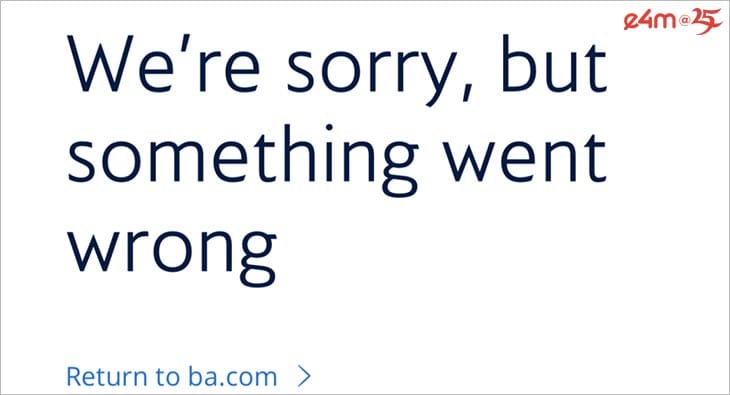

There’s something about travel that makes us feel vulnerable. We put our lives, plans, and expectations in the hands of systems we don’t control. So when something goes wrong, and it often does, the only thing that keeps us calm is the quiet confidence that the airline will make it right.
I wish I could say that was my experience with British Airways last week.
A routine booking, until It wasn’t
I had a flight booked from Delhi to London via Helsinki on May 16, operated by Finnair but booked through British Airways, as both are members of the oneworld alliance. Pretty standard stuff. Except… not.
A few days before the flight, I got a message that many travellers dread: “We’re sorry. Your flight to Helsinki is cancelled.”
There was some relief though as BA had already rebooked me on an alternative route: Delhi to London via BA256. The email politely requested that I “log in to manage my booking and accept the changes.”
Sounds simple enough - that’s where things fell apart.
The UX avalanche: One error at a time
I opened the BA app expecting a smooth acknowledgment flow. Instead, I was met with (BA web site and app are usually always broken):
- No trace of the new flight
- My original (cancelled) flight still showing as “confirmed”
- Zero actionable prompts
- And worst of all, no way to accept or even interact with the rebooking
I switched to the BA website. Same problem. The booking reference showed up, but the rebooking process led to broken screens and errors that looped me back to the start. The experience felt like a digital black hole.
BA’s email had provided a support number, a UK landline, not exactly helpful when you’re in India trying to fly back to London.
Data, data everywhere… Yet no intelligence in sight
Here’s what baffled me:
- BA knew my location, flight history, and that I was traveling soon.
- They knew my flight was cancelled, and they themselves had rebooked me.
- Their email clearly stated I needed to accept the change.
And yet, their app, site, and systems failed to reflect any of this in real-time. The burden was entirely on me to stitch it together and to navigate the chaos, decipher the intent behind the broken interfaces, and try to fix it myself.
This isn’t just a tech problem. It’s a trust problem.
Human to the rescue, but It shouldn’t have come to that
Eventually, I turned to BA’s online chat and connected with an agent named Gautam. To his credit, he was professional, empathetic, and helpful. He confirmed the issue, asked for my booking reference, verified my identity, and manually processed the rebooking.
It took a bit of back and forth, but he got it done. A new ticket was issued. The app finally updated. The flight was saved.
But here’s the thing: Why did I have to go through all that?
Why did it take 40+ minutes, multiple touchpoints, and a human intervention to do what a digital system should’ve been designed to handle seamlessly?
This isn’t about one booking, it’s about the brand
British Airways has long stood as a symbol of British prestige - a carrier with legacy, class, and loyalty baked into its DNA. But experiences like this don’t just frustrate. They erode desire.
Desire to fly with them again. Desire to trust that they’ll show up when it matters. Desire to associate the brand with ease, elegance, and efficiency.
Today’s traveler's are not just price-sensitive, they’re experience-sensitive. When a system collapses at a moment of need, it breaks trust. And trust, once broken, is incredibly hard to rebuild especially when competitors are just a swipe away.
The Loyalty Loop is Fragile
We talk a lot about customer acquisition, but what about retention through moments of friction?
Here’s what BA could have done better:
- Used real-time itinerary sync across app and web
- Geo-routed support numbers based on booking origin
- Triggered an in-app alert with one-click confirmation for rebooking
- Anticipated the emotional weight of cancellations and designed for reassurance, not confusion
Instead, the system fell back on legacy workflows and siloed experiences. And the emotional cost - A customer who no longer feels confident flying with them.
Every brand needs to ask: Are we creating confidence or confusion?
In a world of hyper-personalization, AI, and real-time decisioning, it’s unacceptable for a premium airline to deliver a disjointed, error-prone, multi-channel mess especially in a moment of disruption.
The flight was cancelled. That’s understandable. But the experience that followed. That’s a choice.
As brands, we need to remember: Desire doesn’t begin with product features or loyalty points. It begins with how you make people feel when things go wrong.
And in my case, British Airways missed a moment to create confidence and left me wondering whether I should give that desire to someone else.
Read more news about Marketing News, Advertising News, PR and Corporate Communication News, Digital News, People Movement News
For more updates, be socially connected with us onInstagram, LinkedIn, Twitter, Facebook, YouTube & Google News