The Marketing Triad: How brands are connecting content, commerce & the consumer journey
As consumer paths fracture across screens, platforms, and moments, India's marketers are ditching the channel playbook for optimising the entire system and not just individual channels
 by
by
Published: Jun 19, 2026 8:50 AM | 8 min read
 Follow Us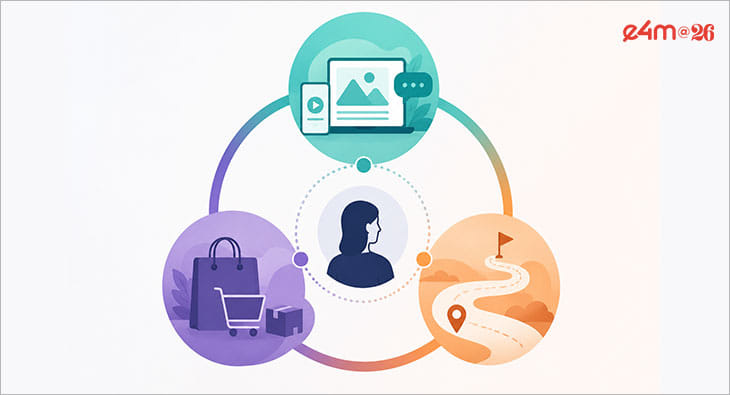

- The traditional linear model of advertising is being replaced by a journey-centric approach, where consumers interact with multiple touchpoints across various platforms before making a purchase, necessitating a cohesive brand experience.
- India's retail media advertising market is projected to grow significantly, with Connected TV and quick commerce advertising expected to see substantial increases by 2026, highlighting the need for brands to adapt their marketing strategies.
- Marketers are shifting from channel-specific planning to integrated strategies that map the entire consumer journey, focusing on continuity and contextual relevance to enhance customer engagement and conversion rates.
- The rise of AI and first-party data is enabling brands to better understand consumer intent and personalize experiences, emphasizing the importance of connecting awareness and purchase moments for effective marketing outcomes.
There was a time when advertising assumed consumers moved in a straight line. A brand reached them on television, built recall, and eventually drove a purchase. That model no longer reflects reality. Today, a consumer might discover a food brand on Instagram, watch a recipe on Connected TV, check reviews on YouTube, search for nutritional information, and place an order on a quick commerce platform, all within a single day.
No single channel owns that conversion. The purchase happens because multiple touchpoints work together to create a coherent experience. If a brand becomes irrelevant, repetitive or absent at any stage, the journey can break. This shift is forcing marketers to move beyond channel-centric planning toward journey-centric strategies that map, measure and optimise the entire consumer path rather than isolated media platforms.
When the Funnel Became a Web
The numbers tell the story. India's retail media advertising market is projected to reach Rs 30,360 crore by 2026, accounting for 15% of total ad revenue, while Connected TV advertising is expected to grow 22% in 2026 and approach the USD 1 billion mark, according to WPP Media's TYNY report. Quick commerce has emerged just as rapidly, with ad spends surging from Rs 1,325 crore to Rs 4,000 crore in 2025 and forecast to touch Rs 6,000 crore by 2026.
Read more: From who you reach to what is being consumed
These are not incremental gains within existing media channels. They are entirely new attention surfaces, each defined by a distinct consumer mindset, context and proximity to purchase. Consumers move seamlessly across these environments, often within the same day. Yet many brands continue to plan, measure and optimise in silos, creating gaps between where consumer attention exists and where marketing investment follows.
Richa Khandelwal, Founder and Managing Director of Leads Brand Connect, has been watching this shift play out in the FMCG food category, where she says the pressure to evolve is acute. "The focus today is not on optimising individual channels but on creating a connected consumer journey," she says. "We are mapping the entire path, from awareness to consideration to purchase, and trying to identify the role of each touchpoint in influencing purchase behaviour. We try to create continuity in messaging, creative storytelling, and brand experience irrespective of which channel the consumer engages on."
The flaw in the old channel-first model was not the channels themselves. Television built iconic brands, search powered digital growth, and social media accelerated awareness. The problem was treating each as a separate universe with disconnected briefs, creative and measurement, even as consumer journeys became increasingly fluid. This makes fragmentation costly, with brands that deliver strong omnichannel engagement retaining 89% of customers, compared to just 33% for those with weak cross-channel strategies.
The answer lies in continuity, not just consistency. Consumers expect each interaction to connect logically, emotionally and contextually to the next, making the brand feel like a single, coherent presence across multiple touchpoints.
From Communication to Demand Conversion
The implications for marketing are significant. For decades, the function was organised around communication, driving reach, awareness and recall. Budgets were allocated by channel, and success was measured through GRPs, impressions and brand metrics, while the actual purchase journey remained largely the responsibility of sales teams and retail networks.
That divide is becoming harder to sustain. WPP's TYNY report estimates digital will account for nearly 68% of India's USD 22.5 billion advertising market in 2026.
Ashish Khandelwal, Managing Director of BL Agro, articulates how fast growing, commerce-focused formats are directly linked with advertising investments to measurable sales outcomes. He mentions this is changing the internal conversation at a brand level. "Today, we no longer evaluate our marketing only on the awareness criteria. Now we check its ability to help the business across the complete consumer lifecycle," he says.
"A few years ago, our media spends were largely made to maximise reach and frequency. Today, we discuss more about creating the ease of purchase." He describes the shift in direct terms: "Connected consumer journeys are helping us understand where consumers are losing interest, what information they seek before making a purchase, and which touchpoints are most important for conversion. This has shifted marketing from a communication function to a demand-generation and demand-conversion function."
This refers to the practical consequences, that marketing, sales, and distribution can no longer be planned as separate functions with separate calendars and separate KPIs. It means media planning must account for not just reach but friction, where in the journey does the consumer's interest go unmet, where does the brand go missing, where does the path toward purchase break down?
Bajrang Saharan, Founder and CEO of Pressmate.in, describes this operationally within his own organisation, where journey-centric planning means aligning communication, technology, and service delivery as a single system. "Success is measured not only by reach or engagement," he says, "but by customer satisfaction, retention, and lifetime value." The channels that matter most in this view, he adds, are those that "build trust and drive action" at critical decision-making moments and not necessarily those with the highest aggregate reach.
AI, Data, and the Architecture of Contextual Relevance
What makes journey-centric planning possible at scale is not just strategic intent, but technological capability. The convergence of AI, first-party data and real-time signals has created the infrastructure to track and respond to consumer intent across touchpoints. The shift is from defining audiences by demographics to understanding what a consumer is doing in the moment and what they need from the brand in that specific context.
Princey Roy, Co-Founder and CEO of Huella Services, frames this evolution precisely. "AI and data can play a much stronger role," she says. "For the longest time, data has been used mainly to define audiences and improve targeting. But the next phase is about using data to shape the experience itself. AI can help brands understand intent signals, personalise narratives, optimise creative variations, and make communication more contextual across touchpoints. The real opportunity is not just precision targeting, but precision storytelling."
“Precision storytelling” captures what data alone cannot. Contextual relevance is not just about reaching the right person, but matching their mindset in a specific moment and environment. Today’s platforms use data fusion, real-time decisioning and AI to uncover journey insights, predict friction and recommend next-best actions. Yet creative remains critical. Even perfect targeting falls short if the message feels out of place for the platform, audience mindset or stage of the journey.
Roy puts, "A consumer watching premium content on CTV is in a very different mindset from someone scrolling social media or browsing a marketplace. The same message cannot simply be resized and pushed across every platform. The role of media is to understand the context, and the role of creativity is to respond to that context meaningfully."
The question of where consumer intelligence originates is becoming equally important as how it is applied. Marketplace and retailer data offer strong signals on category movement and purchase timing, but they carry an inherent limitation: they tell brands what sold, rarely why. Poulomi Roy, Chief Marketing Officer at Joy Personal Care, RSH Global, argues that building a first-party layer on top of commerce data is where the real competitive edge is being forged. "Marketplace and retailer data gives you strong signals on what is moving and when, that is valuable. But layering that with your own first-party understanding of the consumer adds the 'why', why they chose you, what keeps them loyal, and what she's looking for next," she says. "The moment of purchase and the moment of awareness are increasingly two sides of the same coin. What martech now enables is the ability to connect those two moments seamlessly. So awareness investments become traceable to commerce outcomes, and purchase signals feed back into more personalised, relevant brand communication. That is the real evolution of martech within FMCG organisations, from a campaign execution function to a strategic consumer intelligence capability that directly shapes business decisions."
The DPDPA is accelerating the shift toward first-party data, consent-led marketing and privacy-safe measurement, prompting brands to invest in stronger data foundations, clean rooms and predictive models. Khandelwal of BL Agro identifies this as a competitive frontier: "Brands that can build direct consumer understanding will have a significant competitive advantage in the years ahead." The era of rented audience data is giving way to one where owned consumer relationships become a strategic asset.
Rise of the Connected Consumer Journey
Jessica Furtado, Head of Marketing for APAC, India and CIS at Infobip, argues that fragmentation is now the defining reality of the digital ecosystem, forcing brands to think beyond individual platforms and focus on delivering consistent, contextual experiences across the entire consumer journey.
To address this, companies are increasingly investing in AI-powered orchestration layers that unify signals across channels and adapt engagement in real time. As Furtado puts it, "Precision marketing in the years ahead will not be measured by how well you perform within a single channel. It will be measured by how well your intelligence layer understands and serves the consumer as they move across their entire journey."
The brands best positioned to win are not necessarily those with the largest budgets, but those that treat media as a connected consumer experience rather than a collection of channels. As Khandelwal puts it: "The future of media planning lies in connected consumer journeys. Brands that successfully integrate data, creativity, media, and commerce will be best positioned to drive marketing efficiency and sustainable growth. We see this as the next major evolution of marketing effectiveness, moving from channel excellence to journey excellence."
That may be the most concise definition yet of what the industry is building toward. Not a smarter channel strategy. Not a better attribution model. A fundamentally different idea of what advertising is for, and who, at the centre of it all, it is ultimately serving.
Read more news about Marketing News, Advertising News, PR and Corporate Communication News, Digital News, People Movement News
For more updates, be socially connected with us onInstagram, LinkedIn, Twitter, Facebook, YouTube & Google News