Physical to Digital. FMCG’s Biggest Shift.
Raghavendra Katte, AVP Media, Jyothy Labs, speaks with Shripad Kulkarni on the 80/20 digital-physical paradox — and why 40% digital sales in premium metro FMCG signals a key transition
 by
by
Published: May 16, 2026 9:34 AM | 7 min read
 Follow Us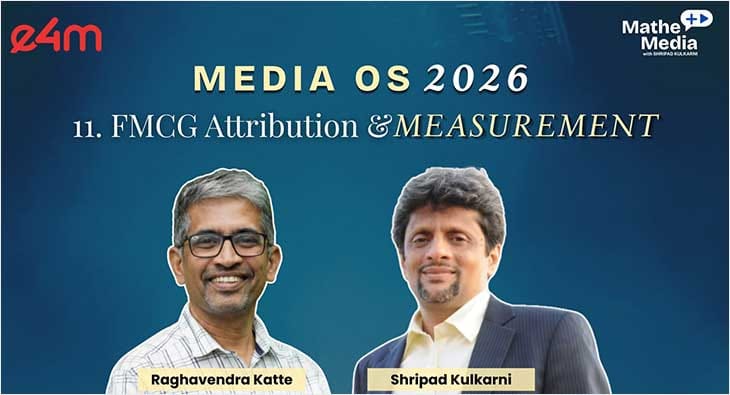

- The Indian FMCG sector is experiencing a significant shift towards digital commerce, with 80% of consumers engaging online, while 85% of sales still occur through traditional retail, indicating a narrowing gap in sales channels.
- Digital sales in premium categories, particularly in metropolitan areas, are growing rapidly, accounting for up to 40% of total sales, highlighting the ongoing transition to digital platforms.
- The industry's measurement and tracking capabilities are improving, with about 30% of FMCG sales now digitally trackable, but challenges remain in accurately attributing sales to specific media inputs.
- Raghavendra Katte emphasizes the need for marketers to adopt four key strategies: implement attribution modeling, prioritize actions with purpose, start simply, and maintain a culture of continuous learning and experimentation.
Indian FMCG is in the middle of its most consequential shift in a generation. The audience has moved to digital. The sales — for now — are still predominantly physical. But the gap is narrowing. And in certain categories, in certain markets, it has already crossed a threshold that makes the old playbook obsolete.
Raghavendra Katte, AVP Media at Jyothy Labs, does not deal in frameworks or forecasts. He deals in quarterly numbers, distribution reach, and data that is getting better — and is soon catching up up with the speed of the transition. His view from the inside is precise, unsentimental, and more optimistic than the headline numbers suggest.
The Paradox at the Centre
Start with the numbers that frame everything.
“85% of FMCG sales still come from non-digital where trackability is an issue. But audience has moved 80% into digital. So, it is like people are digital, still buying traditional. But the transition to Digital Commerce is growing exponentially”
— RAGHAVENDRA KATTE
Eight in ten consumers living digitally. Nearly nine in ten sales still happening in the physical world. That gap is real. But here is what the headline number does not capture: digital sales are growing rapidly. In premium categories in metros — personal care, health, nutrition, Premium Segment, Beauty categories — digital sales can already account for as much as 40% of total sales. The transition is not coming. It is already underway.
Tracking and Measurement: Two Different Problems
This is where Raghavendra makes a distinction that most industry conversations conflate — and getting it wrong leads to the wrong solutions.
Measurement — the ability to attribute a sale to a specific media input, to draw a clean line from a rupee spent to a unit sold — is broken. That is a genuine, unsolved problem.
Tracking and monitoring is different. And it is improving every day.
Today, FMCG sales can be tracked digitally from warehouse to distributor to stockist to retailer. Kirana stores are digitising. Retailers are digitising. The supply chain is becoming visible in ways it never was before. About 30% of FMCG sales can now be tracked and monitored digitally through this chain — and that number is growing. Fast, as all last mile in distribution is rapidly getting digitised.
“Everything has to be seen from a digital lens, as simple as that. Even my primary sales, secondary sales which happens, there is a digital version trigger at our end. So there is nothing called only physical. Today my inputs are also digitally tracked. Even if I make a television ad, if I were to do a radio jingle, BTL, a poster, even a simple trade scheme — everything is digitally tracked.”
The input side is digitally linked. The output side is becoming more visible. The measurement gap — connecting the two — is where the hard work remains.
The Moat Is Gone
For decades, FMCG companies built their competitive advantage on two pillars: distribution reach and budget dominance. The logic was simple. If you could reach every kirana in every pin code, and outspend every challenger on media, no new entrant could touch you.
Quick commerce erased both.
“FMCG had this so-called concept called barrier. We used to spend a lot of money so that no other player can enter. That got trashed. Another was distribution — few can have infrastructure to reach. These two got impacted by quick commerce. Very badly. There is a classic trap of those who are in traditional wanting to go e-commerce, and those in e-commerce wanting to come to traditional.”
The established player now has to compete on a surface where a new entrant with no distribution infrastructure can appear at the moment of purchase and offer a price benefit. The quick commerce platform has become the level playing field that distribution depth was specifically designed to prevent.
I Survived MTGT
Raghavendra’s read on where this is headed is characteristically pragmatic. Markets correct. The cost of last-mile delivery cannot be subsidised indefinitely. But in the meantime, the traditional player cannot take their hands off either world. He gives the example of Modern Trade, General Trade (MTGT)
“As a marketer I should be aware — I survived MTGT, so let me survive e-commerce and quick commerce. But the learnings of MTGT are still relevant for me, same issues. We then had a question: who will sell vegetables in an AC room? Today nobody is asking that question.”
Modern Trade versus General Trade was the last great disruption to FMCG distribution. The industry survived it, adapted, and found that the learnings were transferable. Raghavendra is betting the same will be true this time. Every unanswerable question eventually gets answered. The transition is the work.
The Measurement Has Failed
Even as tracking improves, the deeper measurement problem remains unsolved. And Raghavendra does not soften it.
“Today the biggest failure of measurement science has happened. All of us are in that zone today. We do not get TV data that replicates what is happening in the market. We do not get digital data which is replicating. So as a marketer we are left to fend for ourselves.”
TV data that does not replicate reality. Digital data that does not replicate reality. Both measurement pillars compromised simultaneously. The problem is not the absence of data. It is the absence of data quality, data integration, and the organisational willingness to pay for what good attribution actually requires.
“Rich people having poor data is the reason we are struggling with the attribution model. We do not remunerate our agency partner in a creative way. We still hold back with the focus on spending.”
India Cannot Copy the West
Attribution frameworks built for Western markets — where digital commerce dominates, where data infrastructure is mature, where consumer behaviour is more linear — do not transplant cleanly to India. Raghavendra is direct about this.
“As a marketer we cannot necessarily take most things from abroad. We need to learn and unlearn in the India market only. We need to learn our markets. That is the biggest challenge of attribution.”
Eight kilometres of paddy field to the nearest retail shop. A digital buyer placing an order at the end of it. That is the India attribution problem. The solution will have to be built here — from the ground up, market by market.
The Artist, Not the Scientist
Given all of this — the measurement gap, the broken moat, the India-specific complexity — what does Raghavendra believe will actually move the needle? His answer is not a technology platform or a new data source. It is a disposition.
“Modelling is not just about numerical values — it is about understanding what went in that made the difference. And that requires an artist, not a scientist. You cannot press a couple of buttons in a scientific lab and expect it to work. The trigger is always the story.”
The model is only as good as the creative intuition that feeds it. The numbers can tell you what happened. They cannot tell you why it mattered. That is still a human job.
Four Mantras
When asked what every marketer should do — regardless of budget, category, or company size — Raghavendra does not reach for a complicated answer.
“Four mantras. First: everyone should do attribution modelling. Second: prioritise with purpose — know what you are going to do and why. Third: start as simple as possible, then keep expanding. Fourth — and most importantly — never stop learning and experimenting.”
Do it. Prioritise and focus. Start simple. Keep learning. Four mantras that do not require a technology budget, a data science team, or a Western playbook. They require only a decision to begin — and the discipline to continue.
From a Marcom Investment Expert who has watched distribution moats crumble, measurement science fail, and imported models collapse against Indian market realities — this is not resignation. It is the hard-won confidence of someone who has been here before, survived it, and knows the way out.
4 Simple and Clear Mantras., which ALL brands can follow.
Raghavendra Katte is a contributor to the Media OS 2026 Report, examining how Indian advertising is being rebuilt from the ground up. This piece has been curated by Shripad Kulkarni based on the conversation for the MatheMedia Podcast Season
Read more news about Marketing News, Advertising News, PR and Corporate Communication News, Digital News, People Movement News
For more updates, be socially connected with us onInstagram, LinkedIn, Twitter, Facebook, YouTube & Google News
