Omnichannel integration, AI adoption & more: Hyundai's Virat Khullar shares key insights
At the e4m Automotive Marketing Summit 2.0, Virat Khullar, Head of Marketing, Hyundai Motor India, unpacks SUV dominance, AI at scale, digital attribution and more
 by
by
Published: Mar 2, 2026 6:40 PM | 4 min read
 Follow Us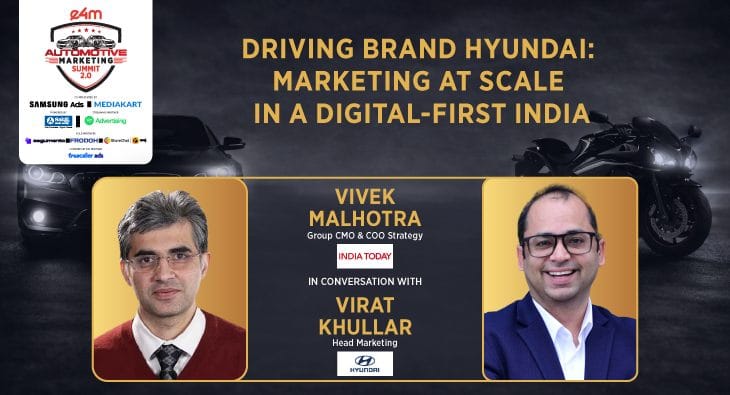

At the E4M Automotive Marketing Summit 2.0, Virat Khullar, Head of Marketing, Hyundai Motor India, laid out a sharp and data-backed blueprint for building an auto brand at scale in a rapidly digitising market. In a fireside chat titled 'Driving Brand Hyundai: Marketing at Scale in a Digital-First India', with Vivek Malhotra, Group CMO & COO Strategy, India Today, Khullar touched on SUV growth, omnichannel integration, AI adoption, premiumization, and the evolving Indian consumer.
On the SUV boom, Khullar was clear that Hyundai’s leadership was no coincidence. “Nothing happens by chance in the automobile industry. You have to plan much in advance and understand the consumer much, much earlier,” he said. While SUVs now account for 50-60% of the Indian market, Hyundai’s portfolio is even more skewed, with nearly 70% of its sales coming from the segment.
He credited early product foresight, pointing to models like the Tucson and Terracan, launched when India was still largely a hatchback and sedan market. The turning point, however, was the Creta. “Ten years of its existence, every year the Hyundai Creta has been the market leader in its segment,” he said, adding that the brand has crossed 1.2 million cumulative Creta sales, with over 200,000 units sold last year alone.
But for Khullar, product success must be amplified through community building. “It’s not just about parking the car in the garage and travelling from A to B. We create explorer communities where SUV owners live in the world of SUVs.” From Guinness World Record drives with the IONIQ 5 to influencer-led cross-country campaigns for the Creta Electric, Hyundai has focused on making SUVs aspirational and experiential.
The buying journey, however, has transformed dramatically. “Ten years back, 90% of the funnel used to happen at the dealership. Today, 90% of discovery and consideration happens online,” Khullar noted. Crucially, much of that discovery occurs outside Hyundai’s owned platforms.
Calling this shift marketing’s “biggest friction point,” he explained Hyundai’s push toward a seamless Customer 360 (C360) ecosystem. “When you walk into the showroom and put in your mobile number, we know what you want. We don’t start from point A; we start from point B and take you to Z.” Nearly one-third of Hyundai’s sales last year were directly attributed to digital sources. “If that line has been drawn, that means digital is delivering real volumes,” he said.
On AI, Khullar described both opportunity and caution. “There is definitely power in artificial intelligence in all parts of business, and very strongly in marketing.” Hyundai is using AI for dynamic creative optimization, contextual advertising on CTV and YouTube, and real-time campaign responses during live events like cricket matches. “You know there will be an A outcome or a B outcome. At 11 p.m., you can shoot out that advertising immediately,” he explained.
At the same time, he stressed guardrails. “In a business like ours, the maker-checker mechanism has to be very, very strong. You can’t have cars getting hallucinated or showing the wrong features.”
While performance marketing and attribution dominate modern conversations, Khullar repeatedly returned to brand equity. Hyundai’s long-standing association with Shah Rukh Khan and its ICC partnership are, he said, about long-term brand strength. “Brand equity or brand strength is the engine of the car. Conversion will be the wheels that take the product to places.”
On premiumization, Khullar broadened the definition beyond pricing. “Trust is a premium,” he said, citing transparent billing, workshop support, and clear information during research as critical levers. Hyundai’s average selling price has nearly doubled over five years, reflecting higher variant uptake and feature-led demand.
He also challenged conventional assumptions around age and segments. “The youngest customer in my portfolio is buying the sedan,” he revealed, underscoring the importance of first- and second-party data over instinct. “Today, you have a plethora of data. Read it, rethink what you thought, and then communicate.”
As car buying shifts from frugality to functionality, Khullar believes features like ADAS, connectivity, and safety now drive decisions. And with households becoming more “secular” in decision-making, Gen Z plays a growing role. “The 50-year-old may be paying, but the 15-year-old could be deciding,” he said.
Summing up the marketer’s mandate, Khullar offered a simple framework: “Understand your consumer very, very well. And understand the technology by which you reach the consumer. These fundamentals were true 10 years back, and they will remain true 10 years from now.”
Read more news about Marketing News, Advertising News, PR and Corporate Communication News, Digital News, People Movement News
For more updates, be socially connected with us onInstagram, LinkedIn, Twitter, Facebook, YouTube & Google News
